What makes a law "just"? Is a law valid simply because a government passed it, or must it adhere to a higher standard of morality to be considered legitimate? This question lies at the heart of Natural Law Theory. Unlike legal positivism, which argues that law is merely a social construct created by human authorities, Natural Law Theory posits that justice is rooted in objective moral principles that exist independently of human legislation. These principles serve as a universal yardstick, constraining the power of governments and ensuring that human-made laws align with fundamental rights.
The Core Premise: Morality Over Mandate
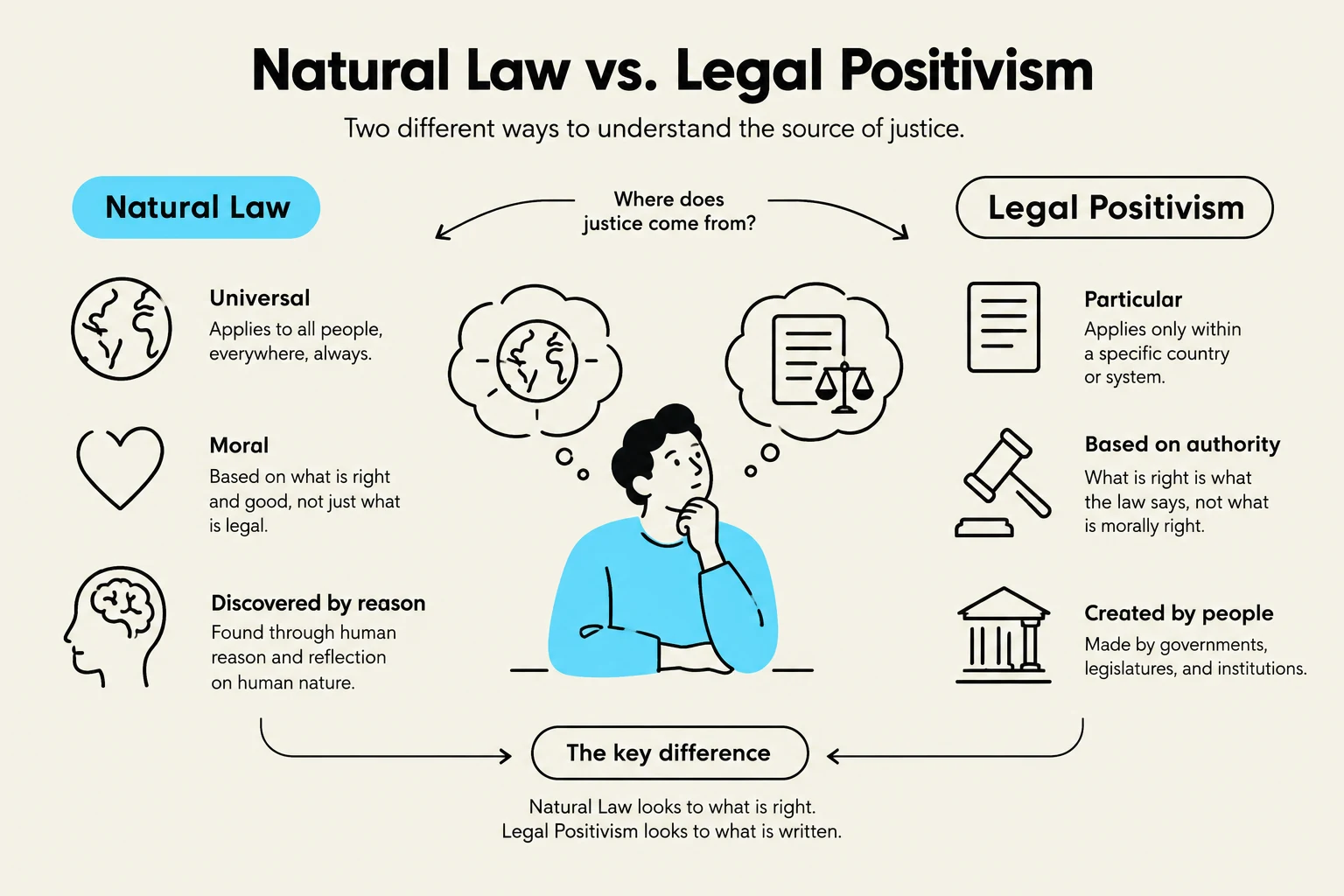
At its essence, Natural Law Theory suggests that there is a distinction between "law as it is" (positive law) and "law as it ought to be" (natural law). According to this perspective, justice is not a subjective preference or a tool of the state; rather, it is an inherent feature of the universe or human nature that can be discovered through reason.
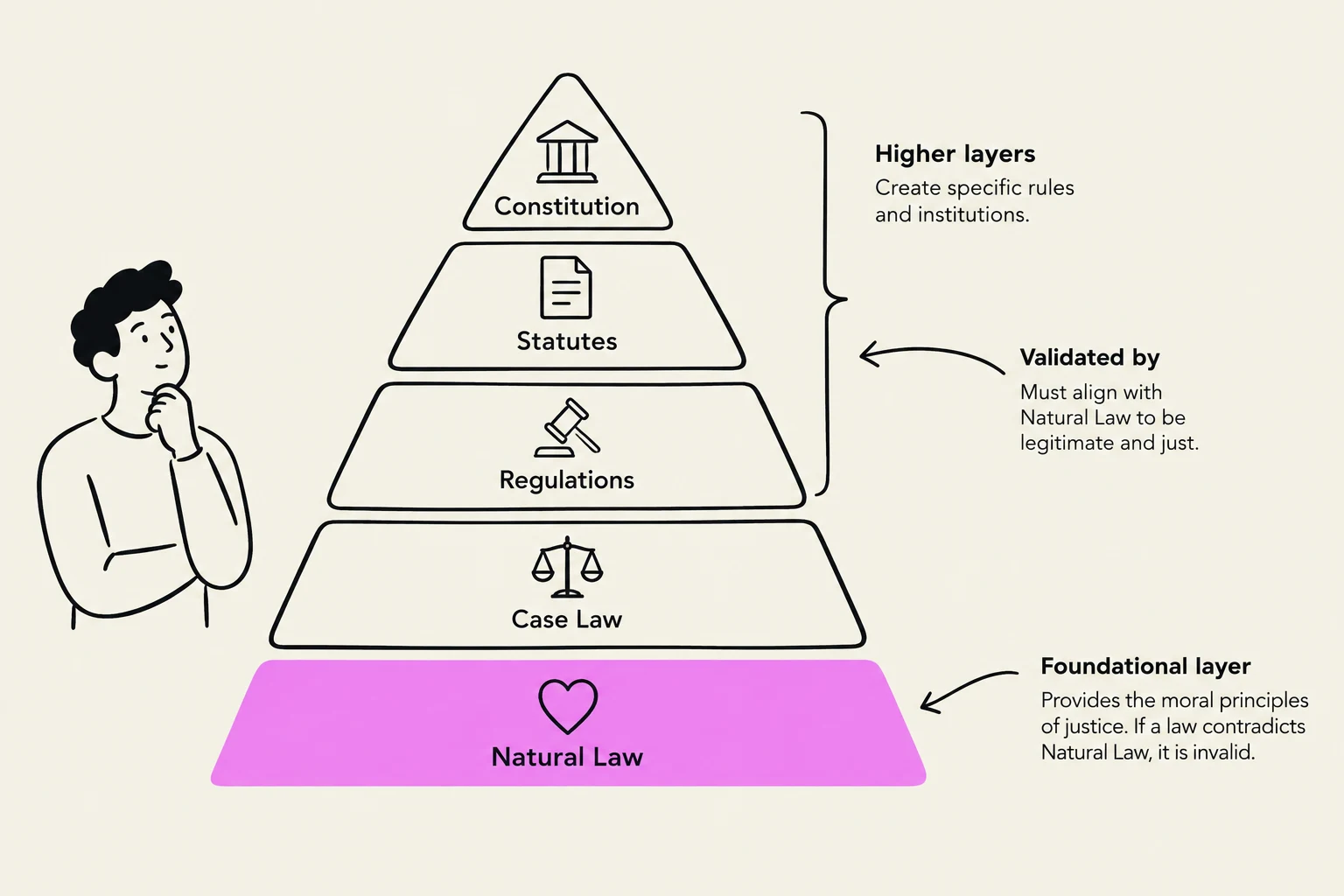
The central argument is that for a human law to be truly binding in a moral sense, it must be consistent with these natural moral truths. If a government enacts a statute that violates fundamental human dignity—such as a law permitting slavery or arbitrary execution—Natural Law theorists argue that such a statute is not a true law, but rather a perversion of law.
Exam Tip: When comparing Natural Law to Legal Positivism, remember the "Separation Thesis." Positivists argue that the legality of a rule is separate from its morality. Natural Law theorists reject this, arguing that morality is an essential component of legal validity.
A pyramid diagram illustrates the hierarchy of law, with Natural Law at the foundation, followed by Case Law, Regulations, Statutes, and the Constitution at the apex. Explanations describe the roles of higher layers and the validation provided by Natural Law.
Constraining Government Power
One of the most significant political implications of Natural Law Theory is its role as a check on state authority. If rights are "natural," they are not granted by the state; they are inherent to the individual. Consequently, the state does not have the authority to take them away arbitrarily.
This concept shifts the relationship between the citizen and the sovereign. In a system governed by Natural Law, the government's legitimacy is conditional. The state's power is constrained by a "higher law" that protects individual rights. This provides a philosophical basis for:
Human Rights: The idea that every person possesses certain unalienable rights by virtue of being human.
Civil Disobedience: The justification for citizens to peacefully resist unjust laws that violate natural justice.
Constitutionalism: The use of written frameworks to limit the scope of government action.
This flowchart illustrates the concept of natural law, where human laws are assessed for legitimacy based on their alignment with universal moral principles.
Natural Rights vs. Legal Rights
To understand how this theory functions in practice, it is helpful to distinguish between natural rights and legal rights.
Natural Rights: These are rights that exist prior to any government. They are universal, inalienable, and discovered through reason (e.g., the right to life or liberty).
Legal Rights: These are rights granted to citizens by a specific legal system (e.g., the right to vote in a specific election or the right to a minimum wage).
While legal rights are essential for the functioning of a modern society, Natural Law Theory argues that they must be built upon a foundation of natural rights to be truly just. For example, a state might grant a legal right to property, but if it simultaneously passes a law to seize that property without cause, it is violating the natural right to security and fairness.
Worked Example: The Nuremberg Trials
A classic historical application of Natural Law Theory can be seen in the aftermath of World War II during the Nuremberg Trials. Many of the defendants argued that they were simply following the "positive laws" of the Nazi regime. They claimed that since their actions were legal under German law at the time, they could not be held criminally liable.
The prosecutors and judges, however, relied on principles akin to Natural Law. They argued that certain actions—such as genocide and crimes against humanity—are so fundamentally contrary to the moral order that no human law can ever make them legal. The tribunal asserted that there is a higher standard of justice that transcends national statutes, effectively holding that "following orders" is not a valid defense against violations of fundamental moral law.
This illustration compares Natural Law and Legal Positivism, explaining their core principles and differences in understanding the source of justice.
Summary of Key Concepts
Feature
Natural Law Theory
Source of Justice
Objective moral principles/Human nature
Role of Reason
Used to discover universal moral truths
View on Unjust Laws
They are invalid or "perversions" of law
Government Power
Constrained by inherent human rights
By anchoring justice in something more permanent than the whims of legislators, Natural Law Theory provides a robust framework for protecting human dignity and holding power to account. It reminds us that the legitimacy of a legal system is measured not by its ability to enforce order, but by its commitment to justice.
Keep reading for free.
Create an account to finish this reading and make it part of your study routine.