Learn the systematic methods for naming and writing chemical formulas for binary molecular and ionic compounds, including the use of prefixes and charge balance.
In the study of chemistry, a single substance can be described in two ways: by its name and by its chemical formula. However, you cannot use the same rules for every substance. The method you use to name a compound or write its formula depends primarily on the type of chemical bond present within the substance. Generally, we categorize these into two main groups: binary molecular compounds and binary ionic compounds.
Binary Molecular Compounds
Binary molecular compounds are formed when two nonmetals react with one another. Because nonmetals have similar electronegativities, they tend to share electrons to achieve stability rather than transferring them completely.
Naming Molecular Compounds
To name these compounds, we follow a systematic three-step approach:
The first word is the name of the first element in the formula.
The second word is the name of the second element, modified by changing its ending to -ide.
Greek prefixes are used to indicate the exact number of atoms of each element present in the molecule.
Important Rule: The prefix mono- (meaning one) is never used for the first element in a name.
Prefixes for Atom Numbers
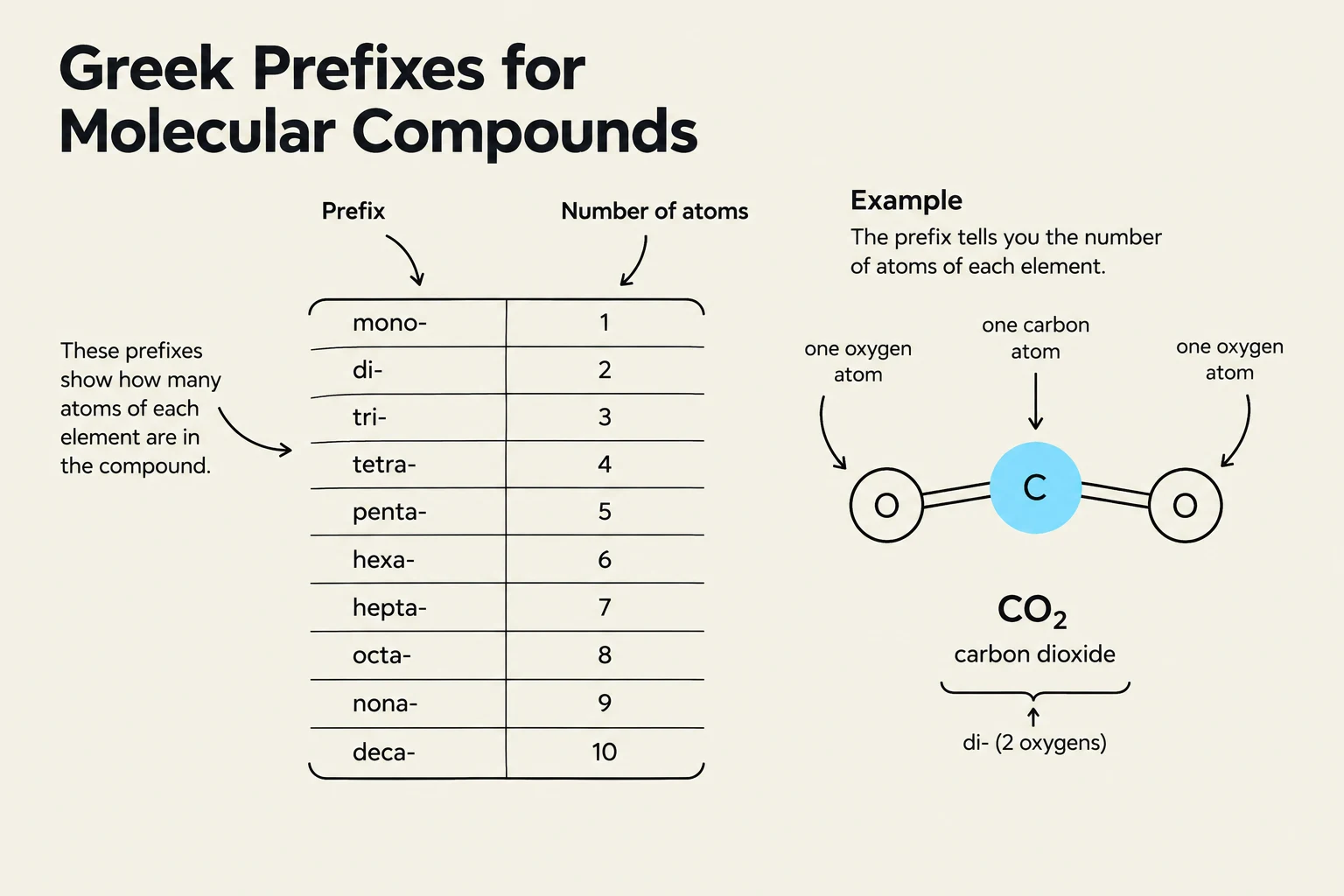
Since molecular compounds can consist of different ratios of the same two elements, prefixes are essential to distinguish them. Common prefixes include:
mono-: one atom
di-: two atoms
tri-: three atoms
tetra-: four atoms
penta-: five atoms
To prevent awkward vowel combinations—such as the "a" in tetra- meeting the "o" in oxide—the final vowel of certain prefixes like tetra- or penta- may be dropped (e.g., tetroxide instead of tetraoxide).
This diagram illustrates Greek prefixes used in naming molecular compounds, showing the relationship between prefixes and the number of atoms in a molecule, with an example of carbon dioxide (CO2).
Writing Molecular Formulas
When writing a formula from a name, you must translate the prefixes back into subscripts. For example, "dinitrogen tetroxide" tells you there are two nitrogens and four oxygens, resulting in the formula N2O4. Conversely, when writing a name from a formula, identify the number of atoms for each element and apply the appropriate prefixes.
Binary Ionic Compounds
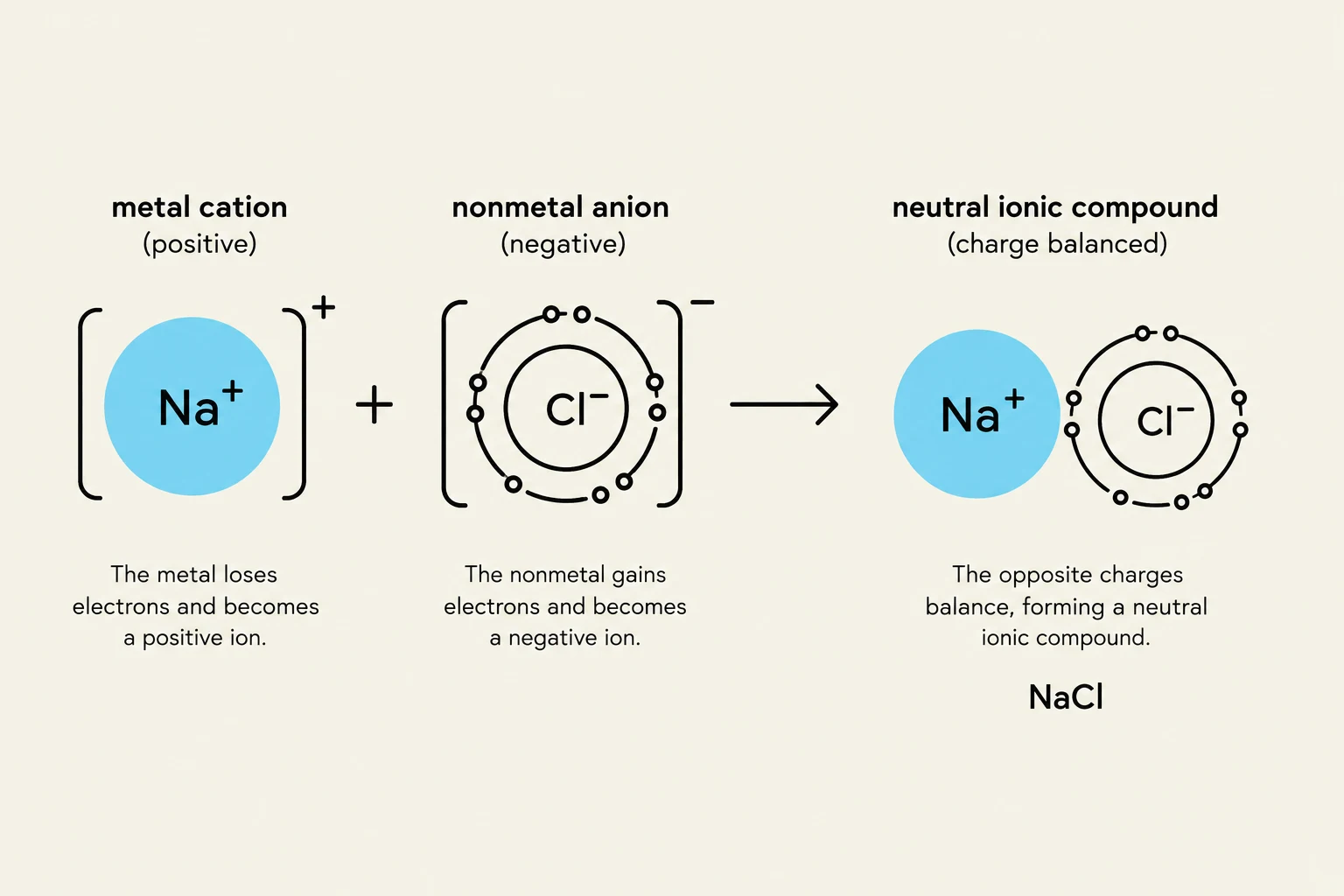
Binary ionic compounds typically consist of a metal and a nonmetal. Unlike molecular compounds, these are held together by the electrostatic attraction between a cation (a positively charged ion) and an anion (a negatively charged ion).
Cation and Anion Naming
For main group elements, the naming process is straightforward and consists of two words:
The first word is the name of the cation (the parent metal element).
The second word is the name of the anion (the parent nonmetal element with an -ide ending).
For example, NaCl is named sodium chloride.
Writing Ionic Formulas: The Charge Balance
The most critical rule when writing formulas for ionic compounds is that the charges must be in balance. The overall compound must be electrically neutral, meaning the sum of the positive and negative charges must equal zero.
Diagram illustrating the formation of a neutral ionic compound, NaCl, from a metal cation (Na+) and a nonmetal anion (Cl-).
Example: Iron(III) Oxide
If you are asked to write the formula for iron(III) oxide:
Identify the ions: Fe3+ and O2−.
Balance the charges: To reach a sum of zero, you need two Fe3+ ions (total +6) and three O2− ions (total −6).
The resulting formula is Fe2O3.
Note on Transition Metals: Transition metals can form multiple different cations. To avoid ambiguity, we use Roman numerals to indicate the charge of the cation (e.g., Cu(I) oxide vs. Cu(II) oxide).
Empirical and Molecular Formulas
Not all formulas represent the actual number of atoms in a single molecule. We distinguish between two types:
Empirical Formula: Represents the smallest whole-number ratio of elements within a compound.
Molecular Formula: Represents the actual number of atoms of each element in a single molecule.
The molecular formula is always a whole-number multiple of the empirical formula.
Calculating the Molecular Formula
If you are given the percent composition and the molecular mass, you can derive the molecular formula using the following relationship:
Molecular Formula=n×(Empirical Formula)
To find the multiplier n, divide the given molecular mass by the mass of the empirical formula unit:
n=Empirical Formula MassMolecular Mass
This diagram illustrates the process of converting percent composition to a molecular formula, a fundamental concept in chemistry. It breaks down the steps, including converting percentages to moles, finding the simplest ratio, determining the empirical formula, and finally calculating the molecular formula using molar mass.
For instance, if a compound has an empirical formula of CH2 and a molecular mass of 56 u, you would calculate the empirical mass (≈14 u), find n=56/14=4, and determine the molecular formula is C4H8.
Keep reading for free.
Create an account to finish this reading and make it part of your study routine.