Explore the various types of mutagens that can damage DNA, including physical and chemical agents, and understand the critical cellular mechanisms that repair this damage to maintain genetic integrity.
DNA is the fundamental blueprint for all living organisms, but it is not an immutable structure. While mutations can occur spontaneously at random, various external factors can significantly increase the frequency of these genetic changes. These external factors are known as mutagens. Understanding how mutagens damage DNA and how our cells work to repair that damage is critical to understanding genetics, cancer development, and toxicology.
Classes of Mutagens
A mutagen is any physical or chemical agent that raises the frequency of mutations above the natural spontaneous rate. These agents are generally categorized into three major classes: physical, chemical, and biological.
Physical Mutagens
Physical mutagens involve energy forms that can directly disrupt the structure of the DNA molecule.
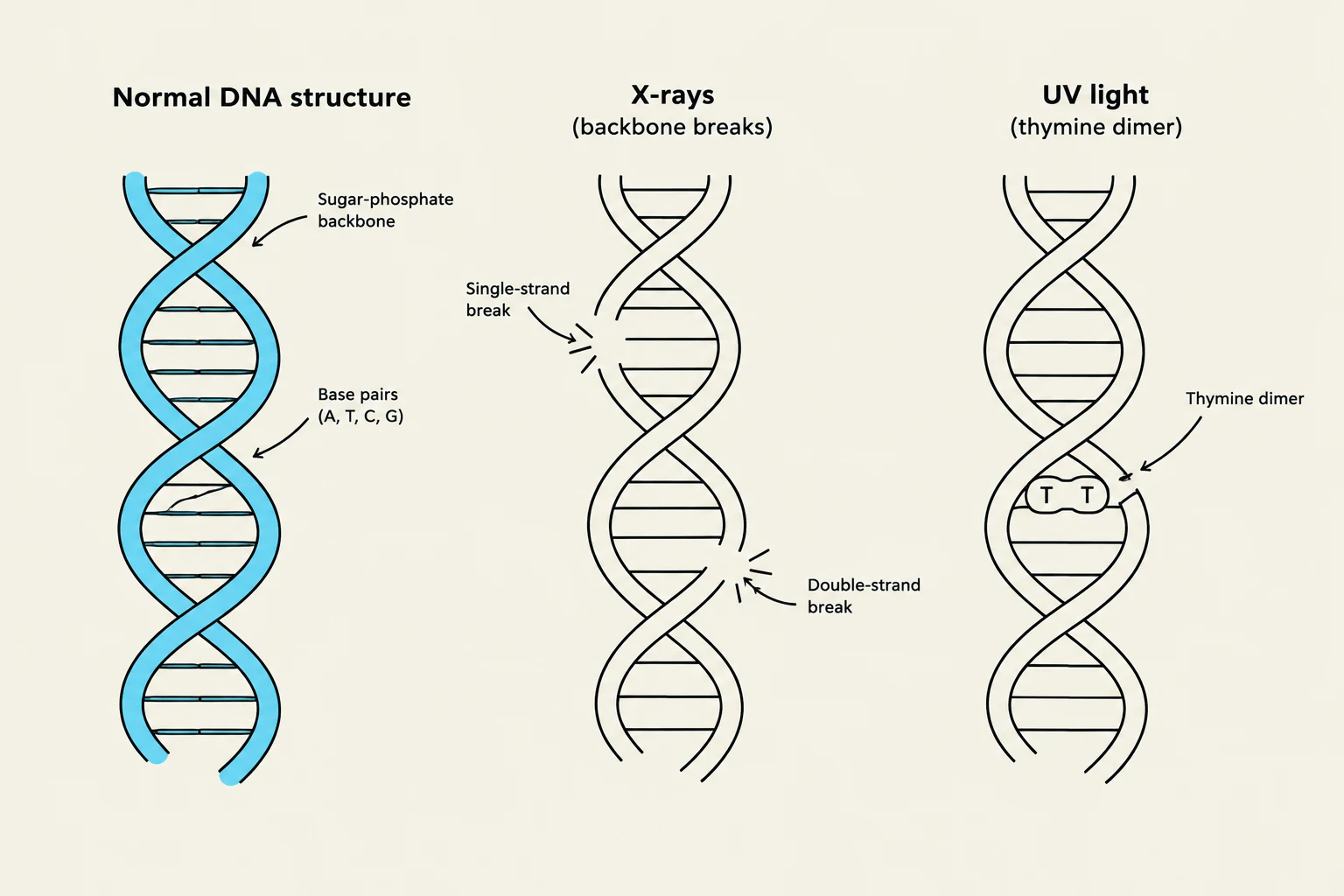
X-rays: These high-energy waves are powerful enough to break the DNA backbone, leading to severe structural damage.
UV-light: Ultraviolet radiation causes a specific type of lesion known as thymine dimers, where adjacent thymine bases on a DNA strand become covalently bonded to one another, distorting the double helix.
This illustration shows the normal DNA structure and how it can be damaged by X-rays (causing backbone breaks) and UV light (causing thymine dimers).
Chemical Mutagens
Chemical mutagens alter the DNA through various biochemical reactions that change the identity or structure of the bases. Common mechanisms include:
Base Replacement (Base Analogs): These are chemicals that "mimic" the structure of normal nitrogenous bases, causing the cell to mistakenly incorporate them into the DNA during replication.
Deamination: The removal of an amino group from a base, which changes its chemical identity.
Hydroxylation: The addition of a hydroxyl group (-OH) to a base.
Alkylation: The addition of an alkyl group to a base.
These chemical changes can lead to two primary types of mutations: point mutations (changes in a single base pair) or frameshift mutations (insertions or deletions that shift the reading frame of the genetic code).
Assessing Mutagenicity: The Ames Test
How do scientists determine if a new chemical is a mutagen? One of the most famous methods is the Ames Test, developed by Bruce Ames in the 1970s. This test was famously used to investigate whether the flame-retardant chemical "Tris" used in children's pajamas was mutagenic.
The Ames Test is a biological assay that uses a "reverse mutation" approach. It utilizes specific strains of bacteria, specifically Salmonella typhimurium and Escherichia coli.
To understand this, we must distinguish between two types of bacteria:
Prototrophs: Wild-type bacteria that can grow on minimal media because they can synthesize all necessary nutrients.
Auxotrophs: Mutant bacteria that have lost the ability to complete a specific biosynthesis pathway and therefore cannot grow on minimal media without a supplement.
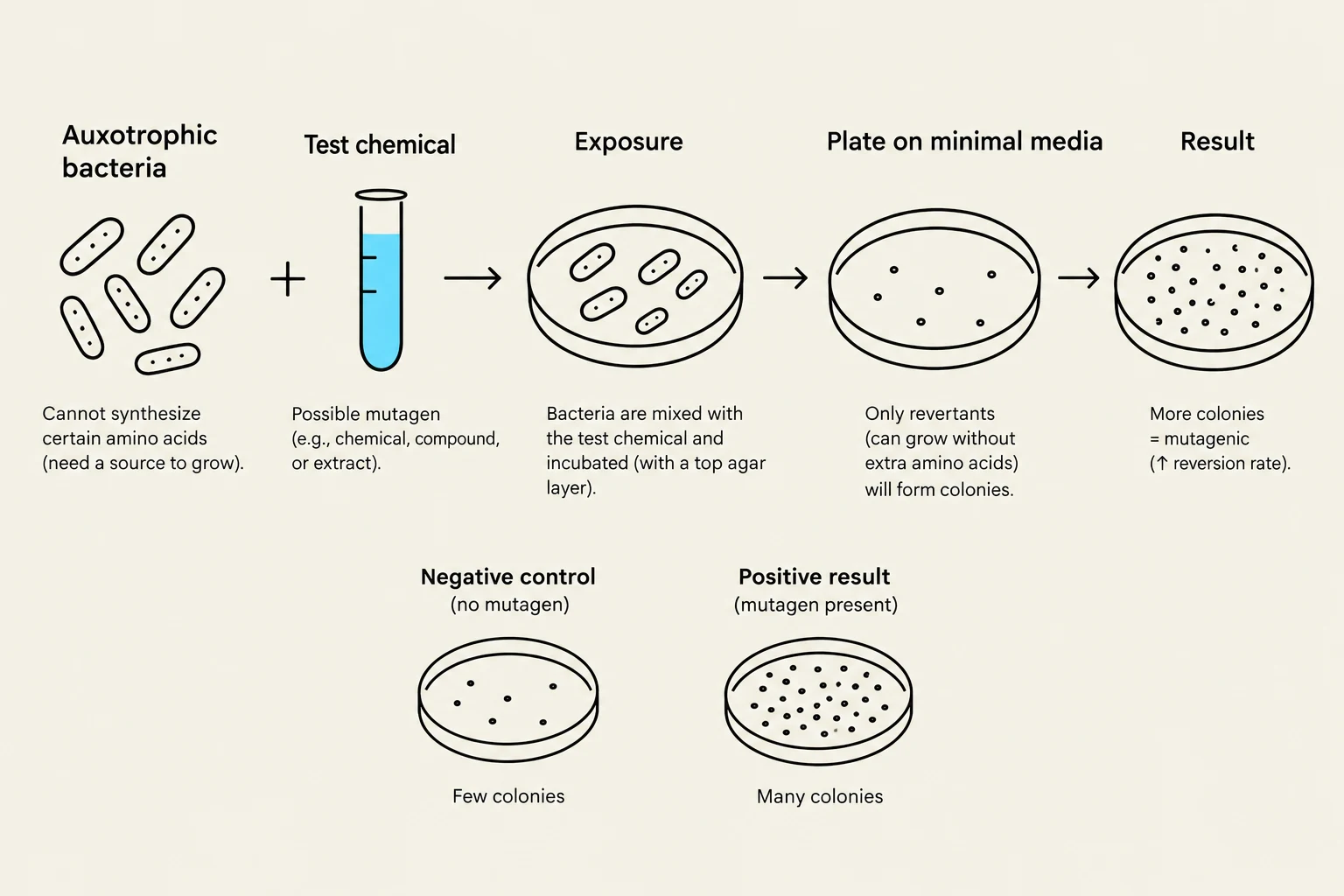
In the Ames Test, scientists use auxotrophic bacteria that cannot grow without a specific nutrient. If a chemical is a mutagen, it will induce mutations that "fix" the defect, turning the auxotroph back into a prototroph. If the bacteria begin to grow on minimal media, the chemical is identified as a mutagen.
This diagram illustrates the Ames test, a method used to assess the mutagenic potential of chemical compounds. It involves exposing auxotrophic bacteria to a test chemical and then plating them on minimal media. The growth of colonies indicates reversion to prototrophy, suggesting the chemical is mutagenic.
DNA Repair Mechanisms
Because DNA is constantly under attack, cells have evolved highly efficient repair mechanisms to prevent mutations from becoming permanent. These mechanisms can be categorized by the type of damage they address.
Single-Strand and Lesion Repair
Base Excision Repair (BER): This mechanism targets damaged bases. An enzyme cleaves the altered nitrogenous base, another enzyme nicks the DNA strand, exonucleases remove the surrounding nucleotides, and DNA polymerase and ligase fill and seal the gap.
Nucleotide Excision Repair (NER): This system detects larger distortions in the double helix, such as those caused by thymine dimers. A protein complex nicks the damaged strand on both sides of the lesion, and the gap is filled by DNA polymerase and sealed by ligase.
Mismatch Repair (MMR): This mechanism corrects errors made during replication, such as mismatched nucleotides or small insertions/deletions. A protein complex nicks the DNA near the mismatch, exonucleases remove the incorrect segment, and DNA polymerase and ligase restore the correct sequence.
Double-Strand Break (DSB) Repair
When both strands of the DNA backbone are broken, the consequences are severe. If unrepaired, these can lead to chromosome rearrangements. Cells use two main strategies:
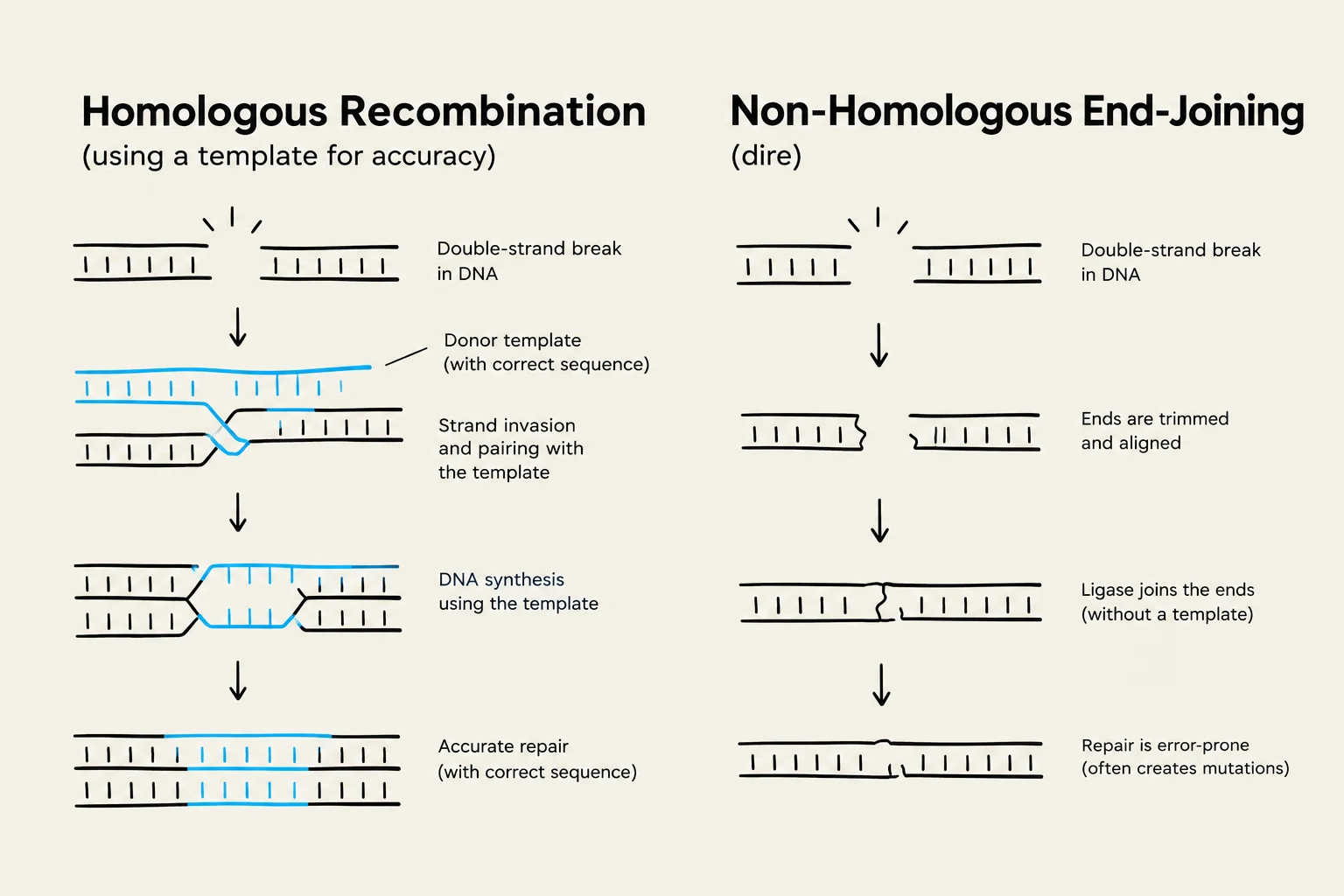
Homologous Recombination: This uses a sister chromatid as a template to accurately repair the break; it occurs during the S and G2 phases of the cell cycle.
Non-Homologous End-Joining (NHEJ): This is a faster but more error-prone method that simply "stitches" the broken ends together, sometimes adding or deleting a few base pairs in the process.
This diagram illustrates two DNA repair mechanisms: Homologous Recombination, which uses a template for accurate repair, and Non-Homologous End-Joining, which is error-prone and can lead to mutations.
Exam Tip: Remember that NER is specifically associated with bulky lesions like thymine dimers, whereas BER is for single damaged bases. If a question asks about "distortions to the double helix," think Nucleotide Excision Repair!
When Repair Fails: Genetic Consequences
If these repair mechanisms fail due to inherited mutations in the repair genes themselves, the results can be catastrophic for human health:
Xeroderma pigmentosum: Caused by mutations in genes involved in Nucleotide Excision Repair (NER). Patients are extremely sensitive to sunlight and are at a very high risk for skin cancer.
Hereditary Colon Cancer: Often linked to mutations in Mismatch Repair (MMR) genes.
Hereditary Breast Cancer: Linked to mutations in BRCA1 and BRCA2, which are essential for Double-Strand Break repair via homologous recombination.
Keep reading for free.
Create an account to finish this reading and make it part of your study routine.