Muscle Coordination and Synergies: Understanding Neuromuscular Control
Explore the fundamental roles of agonists, antagonists, and synergists in human movement. Learn how the nervous system utilizes muscle synergies to coordinate complex actions efficiently, ensuring smooth and purposeful motion.
When you reach for a cup of coffee or sprint across a field, your brain isn't just sending a single "go" signal to one muscle. Instead, it is managing a complex, high-speed orchestra of electrical impulses that coordinate dozens of muscles simultaneously. This ability to organize muscle activity to produce smooth, efficient, and purposeful movement is known as neuromuscular control.
The relationship between agonist, antagonist, and synergist muscles during elbow flexion.
To understand how we move without stumbling or shaking, we must look beyond individual muscles and examine the functional relationships between them. This article explores the roles of agonists, antagonists, and synergists, and how the nervous system uses these relationships to create "muscle synergies."
The Functional Roles of Muscles
In any given movement, muscles do not act in isolation. They are categorized based on their role in producing a specific motion. Understanding these roles is essential for grasping how the nervous system manages stability and movement.
1. The Agonist (Prime Mover)
The agonist is the muscle primarily responsible for producing a specific movement. When you perform a bicep curl, the biceps brachii acts as the agonist because its contraction is the main driver of elbow flexion.
2. The Antagonist
The antagonist is the muscle that opposes the action of the agonist. For a movement to be smooth, the antagonist must relax or lengthen in a controlled manner as the agonist contracts. In the bicep curl example, the triceps brachii is the antagonist. If the triceps were to contract forcefully at the same time as the biceps, the arm would lock up, and movement would be impossible.
3. The Synergist
Synergists are "helper" muscles. They assist the agonist in performing the movement or help stabilize the joint to ensure the agonist can work more efficiently. They may add extra force to the movement or act as stabilizers to prevent unwanted motion in adjacent joints.
Exam Tip: When analyzing a movement, always identify the direction of the intended motion first. The muscle that shortens to create that direction is your agonist, while the muscle that would perform the exact opposite motion is your antagonist.
Muscle Synergies: The Nervous System's Secret Weapon
This illustration contrasts complex input, where individual muscle fibers are activated independently, with muscle synergy, where a single brain command activates a functional group of muscles for coordinated action.
If the brain had to calculate the exact tension required for every single muscle fiber during a complex task like walking, the computational load would be overwhelming. To solve this, the nervous system utilizes muscle synergies.
A muscle synergy is a functional grouping of muscles that are activated together as a single unit to achieve a specific goal. Instead of controlling muscles individually, the motor cortex can send a single command that triggers a pre-programmed pattern of activation across a group of muscles.
Why Synergies Matter
Efficiency: They reduce the complexity of motor control by simplifying the number of independent variables the brain must manage.
Adaptability: Synergies allow us to adapt to changing environments. If you trip while walking, your nervous system doesn't recalculate every muscle; it triggers a "recovery synergy" to stabilize your limbs and upright your torso.
Smoothness: By coordinating the timing of agonists and antagonists, synergies prevent jerky, "staccato" movements, ensuring fluid transitions between different phases of motion.
Worked Example: The Squat
To see these concepts in action, let's analyze a standard bilateral squat.
Muscle Role
Muscle Group
Action in the Squat
Agonist
Quadriceps
Extends the knee to push the body upward.
Agonist
Gluteus Maximus
Extends the hip to return to a standing position.
Antagonist
Hamstrings
Must control the descent and relax during the ascent to allow knee extension.
Synergist
Erector Spinae
Stabilizes the spine to maintain an upright posture.
Synergist
Adductor Magnus
Assists in hip extension during the upward phase.
In this movement, the nervous system coordinates the quadriceps and glutes (agonists) while ensuring the hamstrings (antagonist) provide enough tension to stabilize the knee without resisting the upward drive.
Clinical Significance: When Coordination Fails
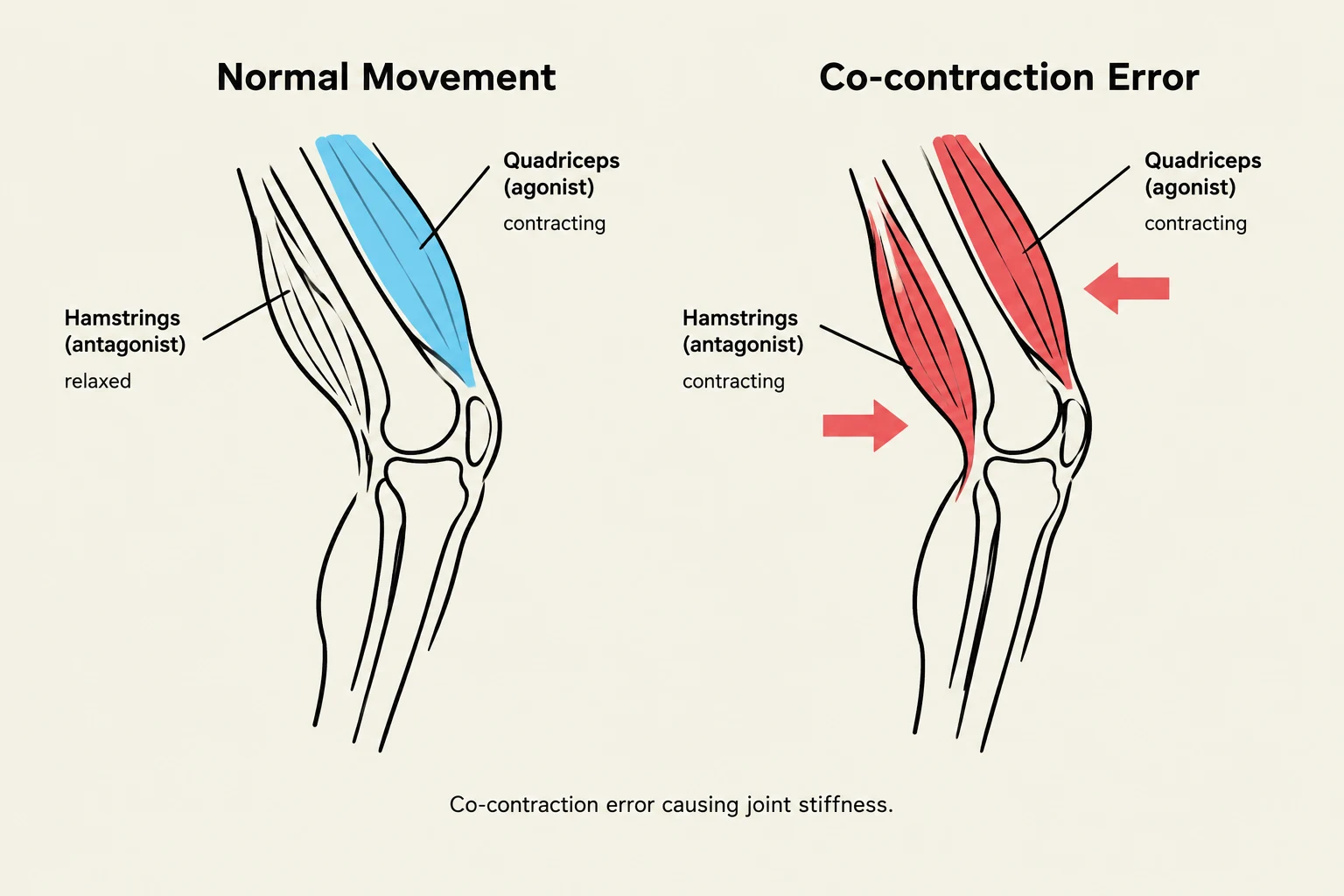
Diagram illustrating normal knee movement versus a co-contraction error where both agonist and antagonist muscles contract, leading to joint stiffness.
When the relationship between these muscle groups is disrupted, movement becomes inefficient or even pathological. This can occur due to several factors:
Co-contraction Errors: If the nervous system fails to inhibit the antagonist, both the agonist and antagonist contract simultaneously. This results in joint stiffness and high metabolic cost, as the muscles are essentially fighting each other.
Neurological Injury: Conditions such as stroke or Parkinson's disease can disrupt the ability to form or execute muscle synergies, leading to spasticity (excessive muscle tone) or tremors.
Muscle Imbalances: If a synergist is too weak, the agonist may overcompensate, leading to poor movement patterns and potential injury over time.
Summary
Effective movement is not just about strength; it is about the sophisticated coordination of muscle groups. By managing the interplay between agonists, antagonists, and synergists through muscle synergies, the nervous system transforms a chaotic collection of muscle contractions into the smooth, purposeful motions that define human life.
Keep reading for free.
Create an account to finish this reading and make it part of your study routine.