Muscle Contraction and Tension: Mechanisms and Types
Explores the fundamental principles of muscle contraction, including the length-tension relationship, muscle tone, and the processes of muscle twitches and myograms. It details strategies for increasing contraction strength through recruitment and frequency summation, and classifies contractions as isometric or isotoni
To understand how we move, lift, and even maintain posture, we must look beyond the simple idea of "muscle pulling." The strength of a muscle's pull—known as tension—is not a fixed value. Instead, it is a dynamic property that fluctuates based on the muscle's physical position, the intensity of the electrical signals it receives, and the speed at which those signals arrive. By studying the relationship between length, stimulus, and frequency, we can uncover the mechanical logic of the human body.
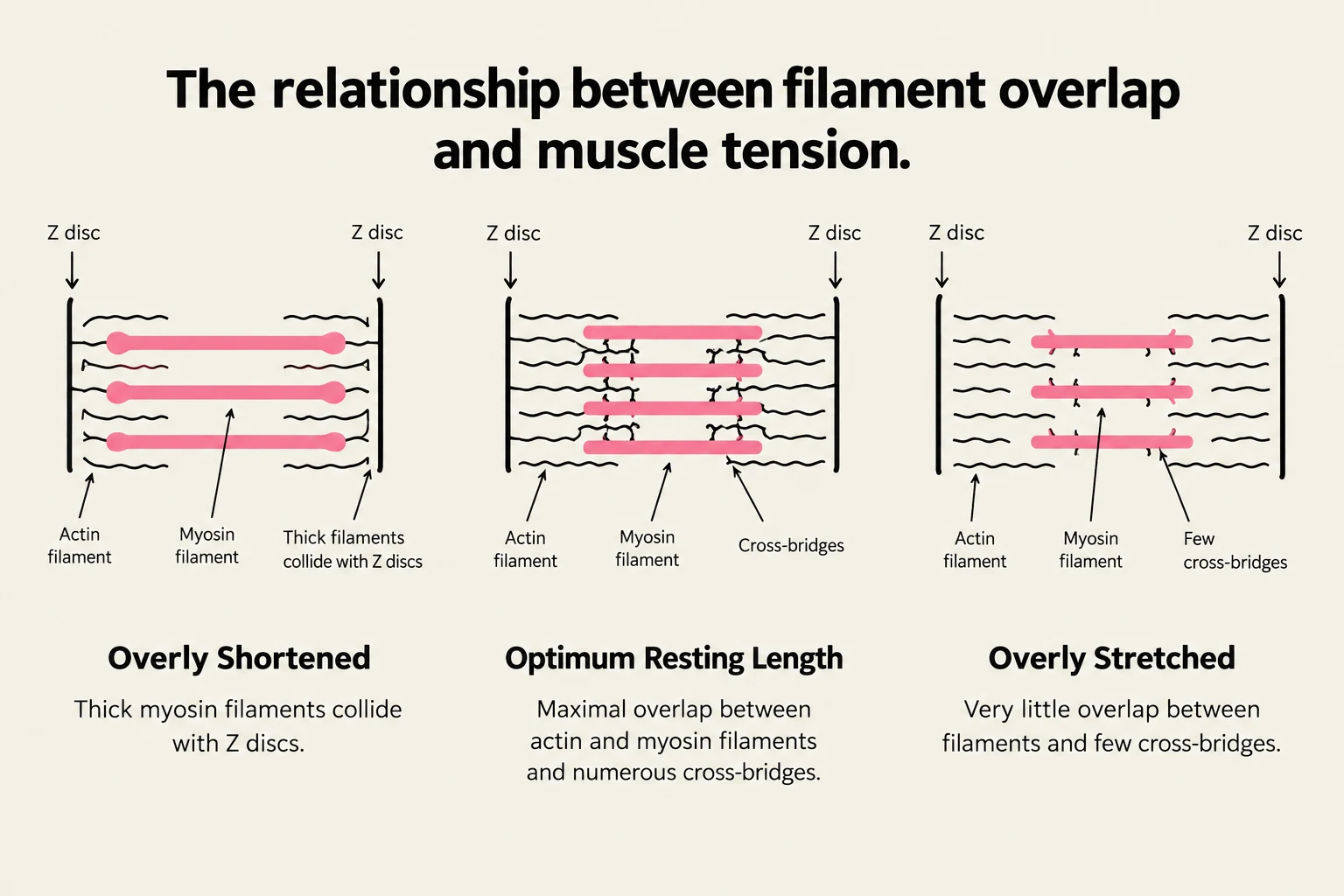
Diagram illustrating the relationship between filament overlap and muscle tension, showing three states: Overly Shortened, Optimum Resting Length, and Overly Stretched.
The Length–Tension Relationship
The amount of tension a muscle can generate is heavily dependent on its initial length before stimulation occurs. This is known as the length–tension relationship. At the molecular level, contraction is driven by the sliding of thick (myosin) and thin (actin) filaments past one another.
The efficiency of this process depends on the degree of overlap between these filaments:
Overly Shortened: If a muscle is too short, the thick filaments physically collide with the Z discs (the boundaries of the sarcomere), which interferes with the contraction process and reduces force.
Overly Stretched: If a muscle is stretched too far, there is minimal overlap between the thick and thin filaments. This limits the number of cross-bridges that can form, resulting in weak tension.
Optimum Resting Length: There is a "sweet spot" where the overlap is maximized, allowing for the greatest number of cross-bridges to form. This state produces the maximum possible force.
To ensure our muscles stay near this optimal length, the nervous system maintains a state of partial contraction known as muscle tone.
The Muscle Twitch and the Myogram
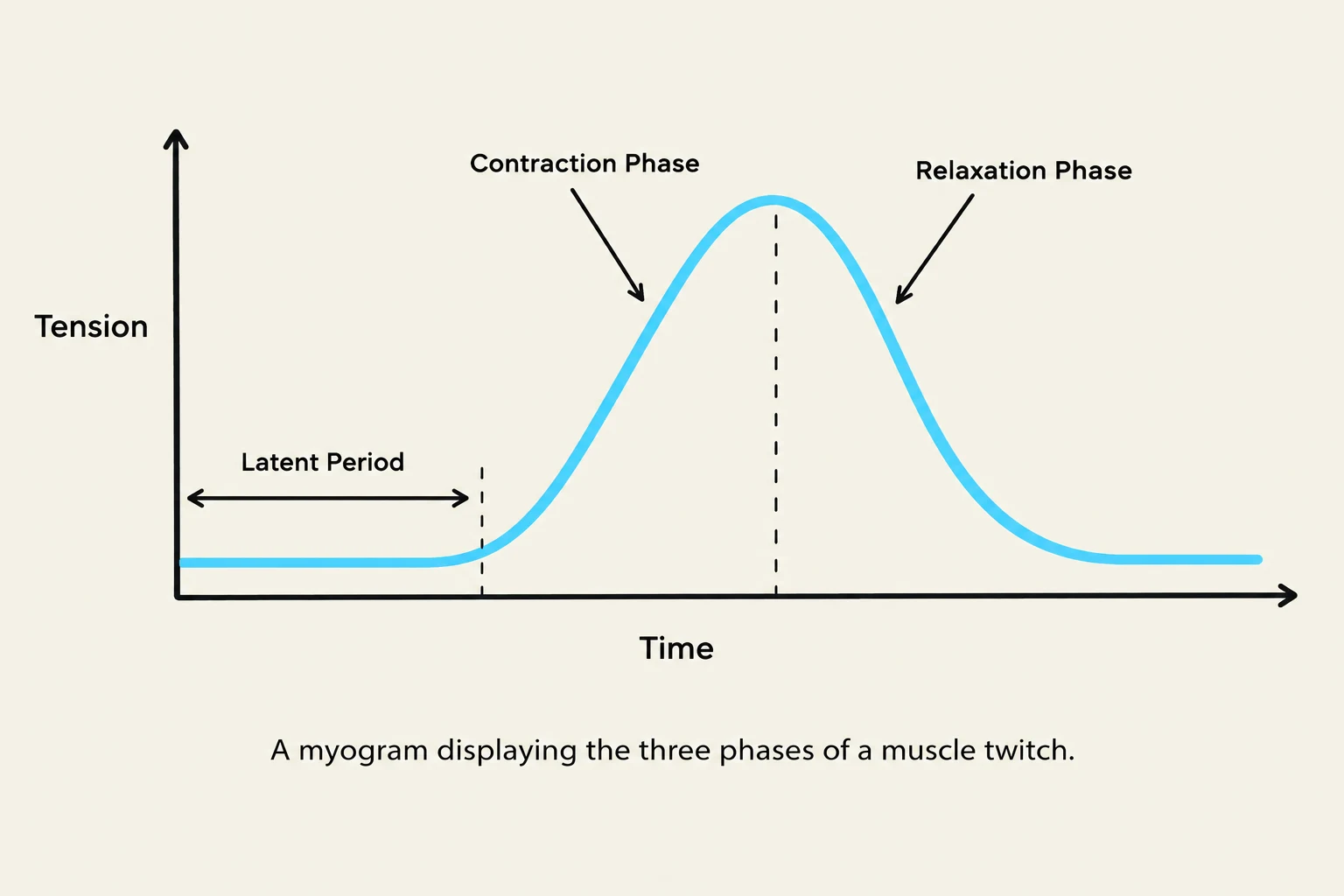
A myogram displaying the three phases of a muscle twitch.
When a single electrical stimulus is applied to a muscle, it undergoes a quick cycle of contraction and relaxation called a muscle twitch. Scientists track these events using a myogram, a graph that measures the tension produced over time.
A typical myogram displays three distinct phases:
Latent Period: This is the brief delay between the stimulus and the start of visible tension. During this time, excitation-contraction coupling is occurring—the electrical signal is traveling through the T-tubules and triggering the release of calcium from the sarcoplasmic reticulum. While internal tension is being generated, it is not yet visible on the myogram.
Contraction Phase: During this phase, external tension is generated as the muscle fibers shorten and move a load.
Relaxation Phase: Tension declines as calcium is reabsorbed back into the sarcoplasmic reticulum, causing the cross-bridges to detach.
Exam Tip: Remember that the latent period does not involve visible movement, but it is a critical period where the chemical "machinery" of contraction is being activated.
Increasing Contraction Strength
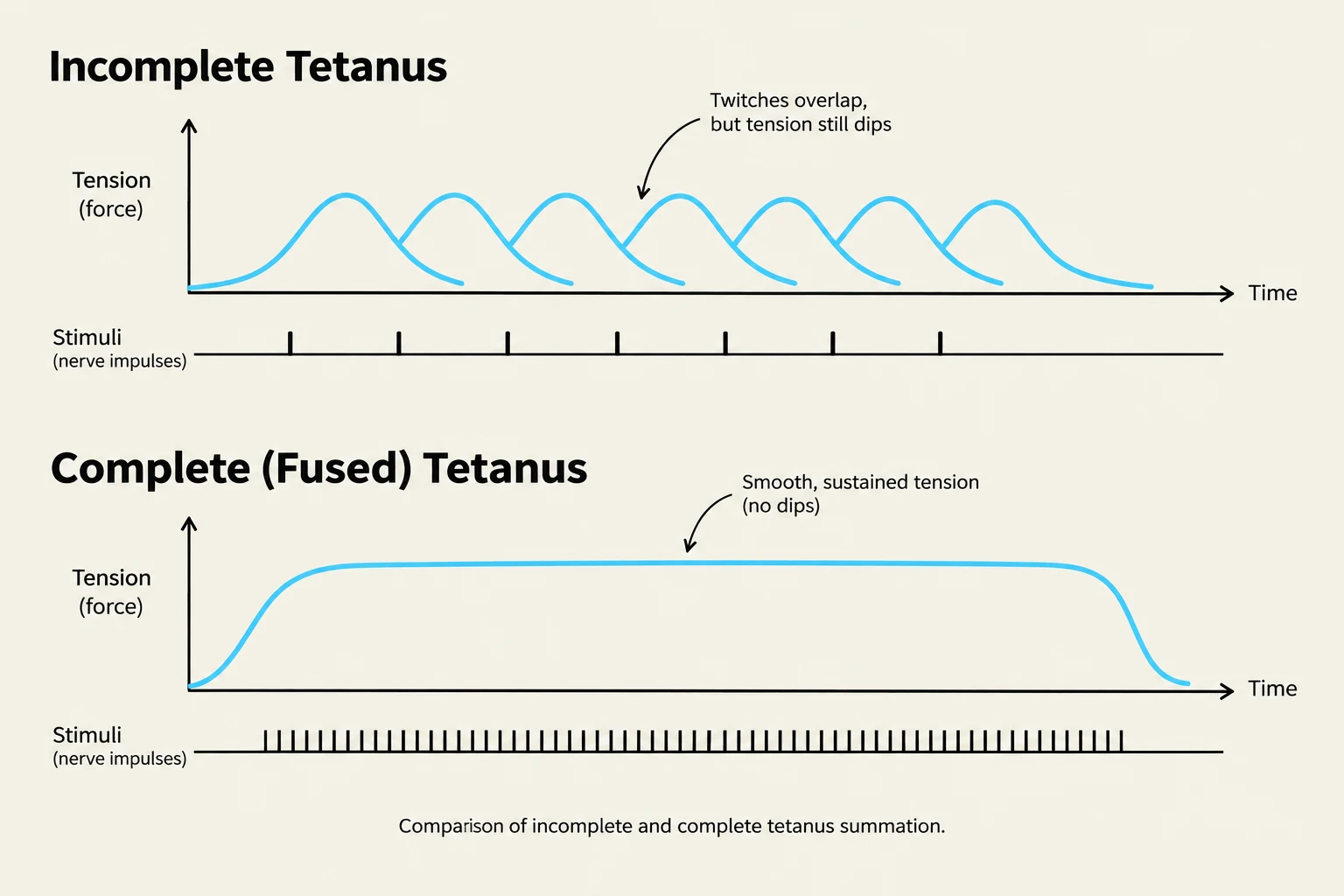
Comparison of incomplete and complete tetanus summation, illustrating the effect of nerve impulse frequency on muscle tension.
A single twitch is rarely enough to move a heavy object. To increase the strength of a contraction, the body uses two primary strategies: changing the number of motor units involved or changing the speed of stimulation.
Recruitment (Multiple Motor Unit Summation)
The nervous system can increase tension by increasing the stimulus voltage, a process called recruitment or multiple motor unit (MMU) summation. When the voltage increases, more motor neurons reach their threshold (the minimum voltage required to trigger a twitch), thereby activating more motor units.
This follows the size principle:
Low voltage recruits small motor units, which are used for fine, precise movements (like those in the eyes or hands).
High voltage recruits both small and large motor units, providing the powerful contractions needed for large muscles like the quadriceps.
Frequency Summation
Even if the number of motor units stays the same, increasing the frequency of the stimuli will increase tension. This is known as temporal (wave) summation.
Incomplete Tetanus: If stimuli are delivered rapidly, the muscle only partially relaxes between twitches. Each new twitch "rides piggyback" on the previous one, resulting in a fluttering, increased tension.
Complete (Fused) Tetanus: At unnaturally high frequencies, the muscle does not relax at all, resulting in a single, steady, maximal contraction.
Classifying Contractions: Isometric vs. Isotonic
We can also classify contractions based on whether the muscle changes its length during the process.
Isometric Contraction
In an isometric contraction, the muscle generates tension, but the external resistance is too great to allow the muscle to shorten. Therefore, the length of the muscle remains the same. These are vital for maintaining posture and stabilizing joints.
Isotonic Contraction
In an isotonic contraction, the muscle changes length while maintaining a constant tension. There are two types:
Concentric Contraction: The muscle shortens as it overcomes a load (e.g., lifting a dumbbell toward your shoulder).
Eccentric Contraction: The muscle lengthens while still maintaining tension (e.g., slowly lowering a weight back down in a controlled manner).
Post-Mortem Changes: Rigor Mortis
The necessity of energy for muscle function is most clearly seen when life ceases. Muscle relaxation is an active process that requires ATP to allow the myosin heads to detach from actin.
After death, the sarcoplasmic reticulum begins to deteriorate, leaking calcium into the cytosol. This calcium triggers the formation of new cross-bridges, but because the body can no longer produce ATP, the myosin heads cannot detach. This results in rigor mortis, the hardening and stiffening of the muscles. This state typically begins 3–4 hours after death, peaks at about 12 hours, and eventually diminishes as the muscle proteins themselves begin to decay.
Keep reading for free.
Create an account to finish this reading and make it part of your study routine.