Motor Skills: Anticipation, Information Processing, and Memory
Explore the cognitive processes behind elite athletic performance, including anticipation, the three stages of information processing (stimulus identification, response selection, response programming), and the role of memory systems in motor skill acquisition and execution.
In the high-stakes environment of competitive sports, the difference between a gold medal and a loss often comes down to milliseconds. Whether it is a goalkeeper diving for a penalty or a sprinter exploding from the blocks, performance is not just about physical strength; it is about how efficiently the brain processes information. To understand elite performance, we must look beneath the surface of the movement and explore the cognitive architecture of anticipation, the memory systems that store skills, and the sequential stages of information processing.
Anticipation: Predicting the Unpredictable
Anticipation is the ability to predict upcoming events to improve performance. Rather than simply reacting to a stimulus after it has occurred, an athlete uses environmental cues to prepare for what is coming next. This predictive capability is categorized into three distinct types:
Event anticipation: Predicting what will happen (e.g., recognizing that a striker is about to shoot).
Spatial anticipation: Predicting where an event will occur (e.g., determining the trajectory of a ball to find its landing spot).
Time anticipation: Predicting when an event will occur (e.g., timing the exact moment to swing a racket during a serve).
Experienced athletes excel at this because they utilize stimulus identification to read meaningful patterns in their environment. For instance, a goalkeeper might read a striker's hip angle or the specific plant of a foot to predict a shot's direction.
Successful anticipation offers significant benefits: it reduces reaction time, provides a competitive advantage, and can even reduce the risk of injury by allowing for preemptive movement. However, anticipation is a high-risk strategy. If an athlete anticipates incorrectly—diving the wrong way or misjudging timing—the "cost" is high, potentially resulting in missed targets or physical injury.
This diagram illustrates the concept of anticipation, breaking it down into predicting the event (what), spatial location (where), and temporal sequence (when), with examples related to sports.
The Three Stages of Information Processing
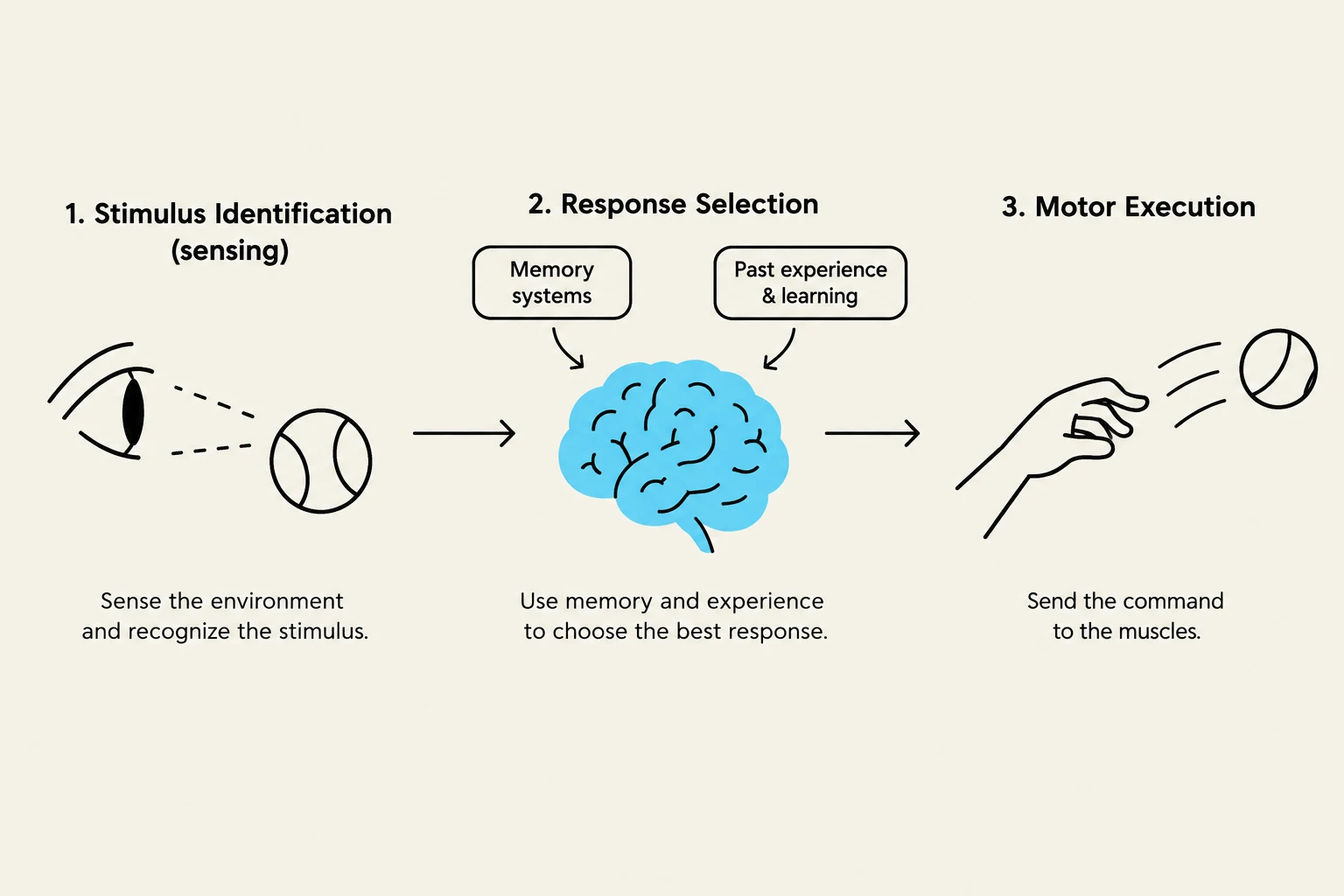
Every motor skill, from a simple reflex to a complex tennis serve, follows a sequential flow of information through the nervous system. This is often referred to as the information processing model, consisting of three critical stages:
Stimulus Identification: This is the detection and recognition of incoming sensory information. This can be visual (seeing a ball), auditory (hearing a whistle), tactile (feeling contact), or proprioceptive (knowing the position of your joints in space).
Response Selection: Once the stimulus is identified, the brain must decide on the appropriate action from a set of available options. For example, a basketball player must decide whether to pass, shoot, or dribble.
Response/Movement Programming: The final stage involves organizing the motor commands required to execute the chosen action. The brain must coordinate which muscles to flex, the range of motion, and the timing of the movement.
Exam Tip: When analyzing a skill, remember that complex movements take longer in the "Response Programming" stage because they involve more joints, more muscles, and more complex neurological coordination.
This diagram illustrates the three stages of a motor response: stimulus identification, response selection, and motor execution. It shows how sensory input is processed by the brain, considering memory and past experiences, to generate a motor command that is sent to the muscles.
Timing and Decision Making
A crucial distinction in motor learning is the difference between how long it takes to decide and how long it takes to move. We define these using the following relationship:
Response Time=Reaction Time+Movement Time
Reaction Time: The interval from the onset of the stimulus to the very beginning of the movement (the decision phase).
Movement Time: The interval from the beginning of the movement to its completion (the execution phase).
Understanding this distinction is vital for coaches. If an athlete is slow, a coach must determine if the issue is slow decision-making (reaction time) or poor physical execution (movement time).
Factors Affecting Decision Speed
Several factors can slow down the response selection stage:
Hick’s Law: This law states that as the number of choices increases, the time required to make a decision also increases. This relationship is logarithmic rather than linear, meaning that while more choices slow you down, the increase in time doesn't double exactly every time you double the options.
Stimulus-Response Compatibility: This refers to how "natural" a response feels in relation to a stimulus. If a stimulus and its required response are logically linked (e.g., a light on the left requires a left-hand movement), processing is fast. If they are incompatible (e.g., turning a steering wheel left to make a car go right), processing time increases significantly.
Memory Systems: Storing the Skill
For a motor skill to move from a conscious effort to an automatic habit, it must pass through different memory systems.
Memory System
Duration
Function
Sensory Memory Store
~1 second
A very brief holding cell for raw sensory input.
Short-Term Memory
~20 seconds
Holds information for a short period during active processing.
Long-Term Memory
Permanent
Permanent storage achieved through repetition and rehearsal.
Continuous motor skills, such as riding a bicycle, are typically stored in long-term memory. Once a skill is moved into long-term memory through repeated practice and by connecting new information to existing knowledge, it becomes much easier to retrieve, allowing the athlete to focus less on "how" to move and more on the "strategy" of the game.
Summary for Students: To optimize training, simplify the environment. Reduce the number of choices (Hick's Law) and ensure stimulus-response compatibility to help athletes move their skills from short-term processing into long-term, automatic memory.
Keep reading for free.
Create an account to finish this reading and make it part of your study routine.