Explores the fundamental concepts of motor control, distinguishing between performance and learning, and detailing the mechanics of reaction time, open-loop vs. closed-loop systems, and factors affecting decision-making in motor skills.
Understanding how humans acquire new movements and how quickly they can respond to environmental changes is a cornerstone of motor control theory. Whether you are a coach trying to improve a sprinter's start or a researcher studying human cognition, you must distinguish between what an individual does in a single moment and what they have actually learned over time.
Performance vs. Learning
In common language, we often use "performance" and "learning" interchangeably, but in motor control, they represent two very different concepts. Performance refers to the temporary execution of a skill during a specific trial or session. A student might perform a basketball free throw perfectly once due to luck or high motivation, but this does not mean they have mastered the skill.
Learning, conversely, is defined by a permanent change in capability. True learning is assessed through consistent, long-term improvements in skill execution across many trials. If the ability to perform the skill remains stable over time, we can conclude that learning has occurred.
The Three Components of Motor Skills
Every motor skill, from the simplest reach to the most complex athletic maneuver, is composed of three fundamental cognitive and physical stages:
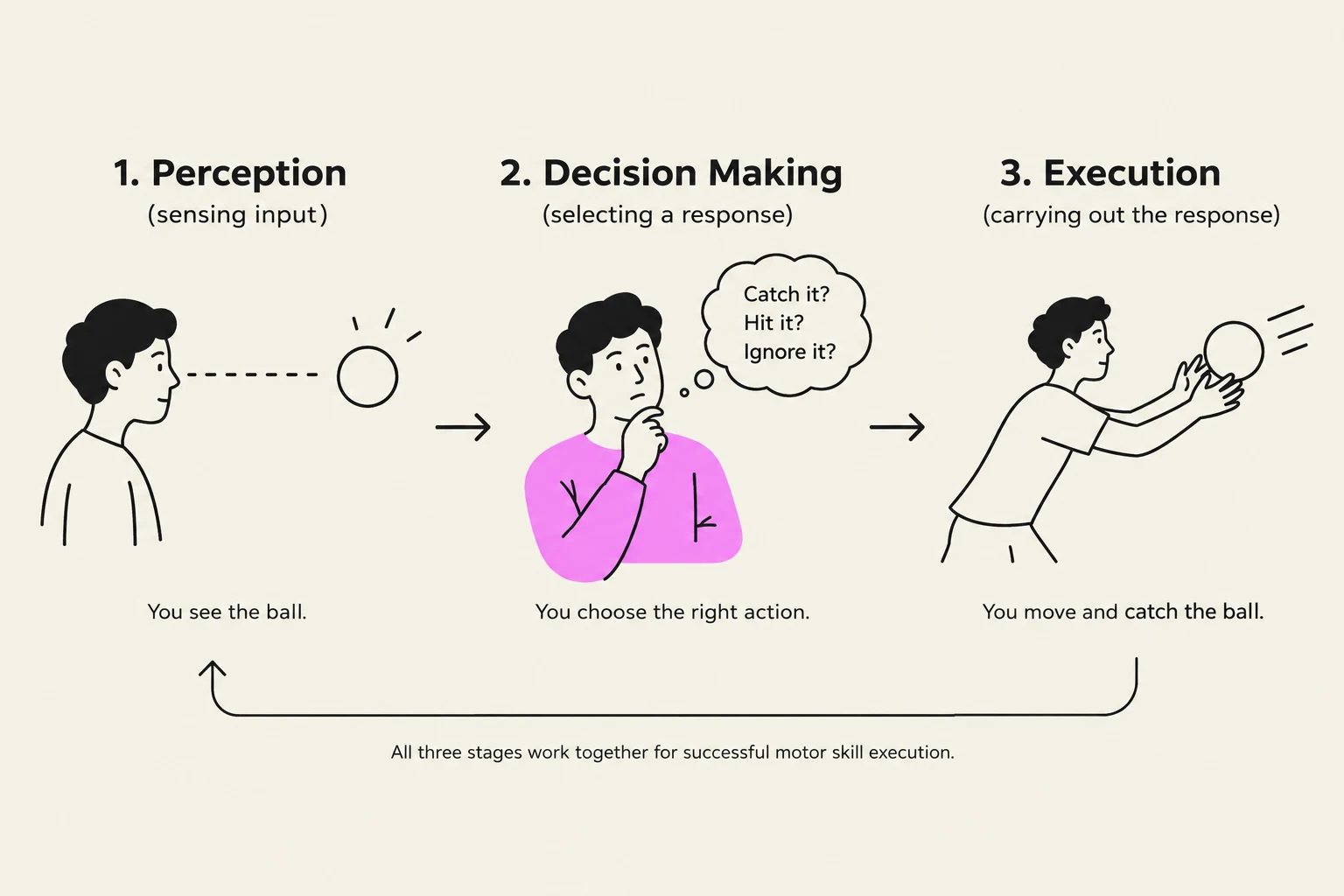
Perception: The process of sensing and interpreting environmental information (e.g., seeing a ball approach or hearing a starter's pistol).
Decision Making: The cognitive process of determining the appropriate response based on the perceived information (e.g., deciding whether to dive left or right).
Movement: The physical execution of the chosen action via the muscular system.
Skills are further classified by their environmental predictability. An open skill is characterized by high levels of unpredictability, such as a rugby player reading a changing defensive line. In these environments, the performer must constantly update their perception and decisions.
This diagram illustrates the three stages of motor skill execution: perception, decision making, and execution. It shows how sensory input is processed, a response is selected, and then carried out.
The Mechanics of Reaction Time
Reaction time is the interval between the onset of a stimulus and the initiation of a response. It is crucial to distinguish this from movement time (the time from the start of the movement to its completion). Together, they constitute the total response time:
Response Time=Reaction Time+Movement Time
While movement is visible, reaction time studies focus on the internal cognitive processes occurring in the mind.
Reaction Time Metrics and Anticipation
Reaction times vary based on experience and the complexity of the task.
General Population: Average reaction times typically fall between 200 and 250 milliseconds.
Elite Athletes: Through extensive practice, athletes often achieve faster times, generally ranging between 120 and 200 milliseconds.
Anticipation vs. Reaction: In competitive sprinting, a reaction time of less than 100 milliseconds is considered a false start. This threshold suggests the athlete reacted to anticipation (predicting the sound) rather than the actual stimulus, as a response faster than 100 ms is considered biologically impossible for a true reaction.
Exam Tip: If a question asks why a sprinter's reaction time was 80 ms, the answer is likely "anticipation" rather than "faster processing," because the human physiological limit for true reaction is higher.
Motor Control: Open-Loop vs. Closed-Loop
The brain organizes movements into "packages" known as motor programs, which are stored in long-term memory. These programs are retrieved during the movement programming stage before execution.
Control systems are generally categorized into two types based on their reliance on feedback:
Open-Loop Control
This system is used for rapid, ballistic movements where there is no opportunity for mid-movement sensory feedback to adjust the action. The entire movement is pre-structured before it begins and runs to completion.
Examples: A golf swing, tumbling in gymnastics, or the initial explosive drive in a sprint start.
Key Characteristic: Once launched, the program runs without modification; adjustments can only occur after the movement is finished.
Closed-Loop Control
This system is used for slower movements that allow for continuous sensory feedback and error correction during execution.
Examples: Balancing while walking or adjusting a reach to grab a moving object.
Key Characteristic: The performer can use proprioception and visual cues to "fine-tune" the movement while it is happening.
Diagram illustrating the difference between open-loop and closed-loop systems, showing the process of stimulus, sensory input, processing, and execution, with the addition of feedback in closed-loop systems.
Evidence for Motor Programs
Since we cannot directly observe the brain "packaging" a movement, scientists rely on indirect evidence to prove motor programs exist:
Reaction Time Complexity: Reaction time increases when a movement involves more elements, more limb coordination, or longer durations. This suggests the brain needs more time to organize the "package" before the movement can start.
Startle Response: Intense stimuli can dramatically shorten reaction times, suggesting a pre-packaged, automatic response is ready for immediate deployment.
Deafferentation Studies: Research shows that even when sensory feedback (afferent information) is removed, organisms can still perform well-coordinated, fast movements. This proves that while feedback is needed for adaptation, it is not what drives the initial coordinated movement.
Central Pattern Generators (CPGs): Networks of neurons in the brainstem and spinal cord can produce rhythmic, oscillating movements (like walking or breathing) with only a brief trigger from the brain.
Point of No Return: In fast movements, there is a threshold after which a motor program must run to completion and cannot be stopped or altered mid-stream.
Muscle Response Patterns: Electromyography (EMG) shows consistent patterns of agonist (prime mover) and antagonist (counteracting muscle) activity even when a movement is suddenly interrupted.
Factors Affecting Decision Making
When a task involves a choice, the decision-making stage is extended. Two critical concepts here are:
Hick's Law: As the number of choices increases, the reaction time increases roughly in proportion to the number of options. However, this relationship is logarithmic, not linear; doubling your options does not necessarily double your reaction time.
Stimulus-Response Compatibility: Decision-making is faster when the stimulus and the response are logically or spatially linked. For example, if a light flashes on the left, you will react faster using your left hand than if you were required to use your right hand.
Keep reading for free.
Create an account to finish this reading and make it part of your study routine.