Explore the fundamental principles of motor control and learning, covering how the nervous system organizes movement, the stages of skill acquisition, and the cognitive processes involved in performance.
Understanding how humans move is more than just observing physical action; it is about deciphering the complex relationship between the brain, the body, and the environment. The field of motor control and learning provides the scientific foundation for understanding how individuals master new skills, optimize their current performance, and ultimately prevent injuries. Whether you are a coach, a fitness professional, or a rehabilitation specialist, mastering this discipline allows you to train people as individuals rather than using a "one size fits all" approach.
Foundations of Motor Control and Learning
At its core, this discipline is divided into two interconnected areas: motor control and motor learning. Motor control focuses on the neural, physical, and behavioral aspects of movement—essentially, how the nervous system organizes muscles and limbs to produce a specific motion. Motor learning, on the other hand, focuses on the relatively permanent changes in the ability to perform a skill resulting from practice or experience.
To study these areas effectively, researchers use specific theoretical frameworks to explain how movement is organized and executed. Two of the most prominent are:
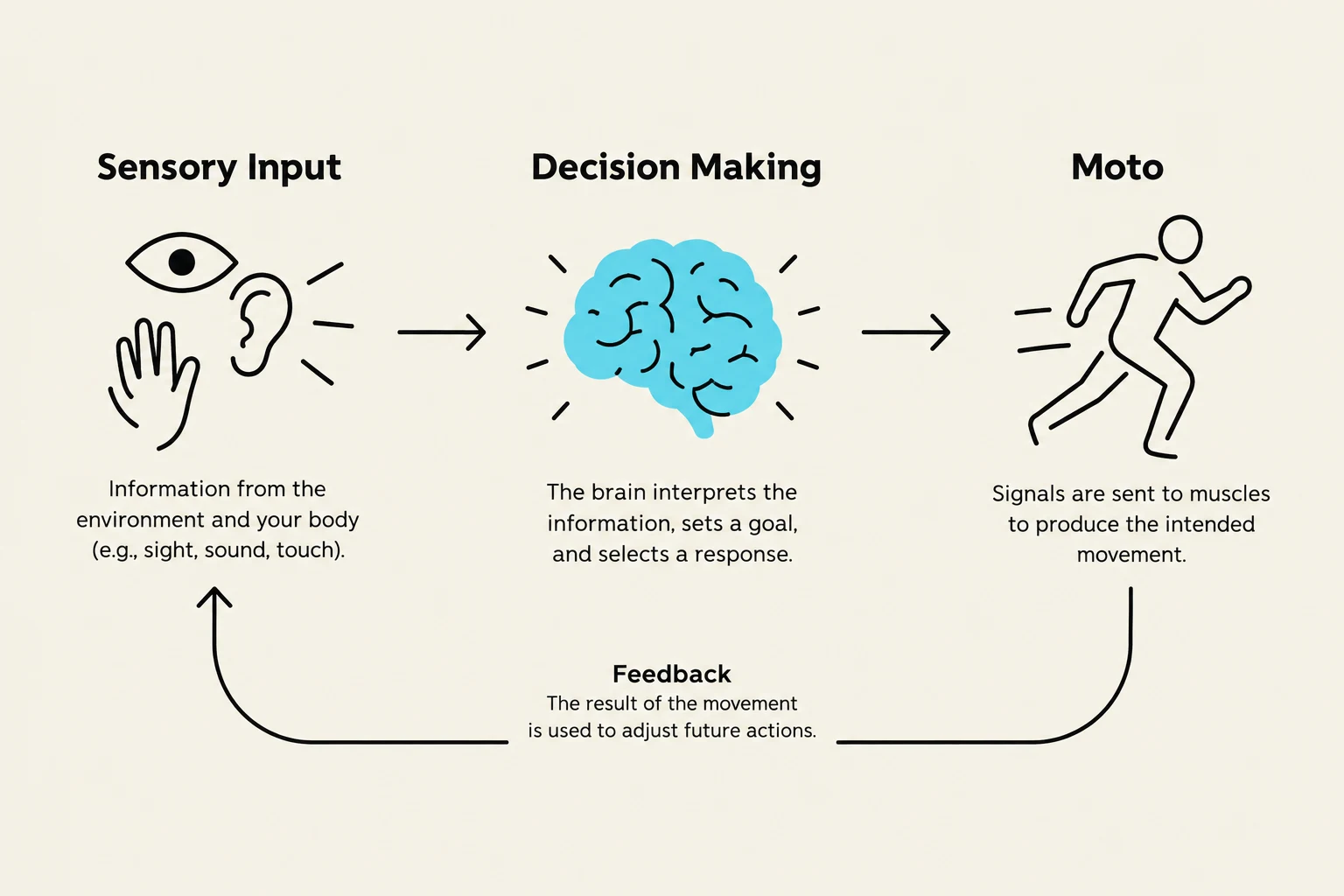
Information-Processing Theory: This views the human performer as a system that receives sensory input, processes that information, makes a decision, and then executes a motor response.
The Generalized Motor Program (GMP): This theory suggests that we do not store a separate "program" for every single movement we make. Instead, we store generalized patterns of movement that can be adapted (via parameters like speed or force) to suit different situations.
This diagram illustrates the process of sensory input, decision making, and motor output, including feedback.
The Role of the Central Nervous System
The Central Nervous System (CNS) is the command center for all movement. It is responsible for the complex task of motor skill acquisition, which is the process of turning a conscious, difficult movement into an automatic, fluid one.
The CNS manages several critical sub-processes that determine how well a skill is learned:
Feedback Processing: As we move, our nervous system constantly processes internal signals (proprioception) and external signals (visual or auditory) to correct errors in real-time.
Retention: This refers to the ability to perform a skill after a period of no practice. High retention indicates that the skill has been truly learned rather than just temporarily memorized.
Transfer of Motor Skills: This is the influence that prior learning has on new learning. For example, a tennis player may find it easier to learn squash because of the "transfer" of hand-eye coordination skills.
Exam Tip: When analyzing a case study, distinguish between performance (a temporary state of execution) and learning (a permanent change in capability). Retention and transfer are the primary ways we measure true learning.
Cognitive Processes: Attention and Memory
Movement is not purely mechanical; it is deeply cognitive. The quality of a motor skill is heavily influenced by cognitive processes, specifically attention and memory.
Attention refers to the allocation of mental resources to a task. In simple movements (like walking), attention requirements are low. However, in complex movements (like a gymnastics routine or a tactical play in soccer), the performer must manage high levels of attentional demand.
Memory is required to store the "motor programs" and the sequences of movements. If a performer cannot effectively move information from short-term working memory into long-term memory, they will struggle with the retention of the skill.
This diagram illustrates the relationship between cognitive load and movement complexity, showing that more complex movements demand greater attention and memory.
Analyzing Performance: Speed, Accuracy, and Coordination
To evaluate how well someone is performing, we look at specific analytical components. One of the most fundamental principles is the trade-off between speed and accuracy.
Fitt’s Law
In motor learning, Fitt’s Law describes the mathematical relationship between the speed of a movement and its accuracy. Generally, as the speed of a movement increases, the accuracy decreases. This is a critical consideration when designing practice environments or rehabilitative exercises; if a patient is required to move too quickly, their precision may fail, leading to poor motor patterns.
Motor Coordination
Beyond speed and accuracy, we must assess motor coordination. This involves the timing, sequencing, and pattern of muscle activations. High-quality coordination is what separates an expert performer from a novice; the expert can achieve the same goal with greater efficiency and less wasted energy.
Individual Differences in Skill and Ability
Finally, a key component of this field is recognizing that no two performers are identical. Even when practicing in the same environment with the same methods, individuals will show different results due to:
Ability: The underlying, relatively stable capacity to perform a task (e.g., reaction time or manual dexterity).
Skill: The specific proficiency developed through practice in a particular task.
By understanding these individual differences, practitioners can tailor practice methods—comparing varying conditions to find the "ideal" environment for a specific sport, fitness goal, or rehabilitative need.
Keep reading for free.
Create an account to finish this reading and make it part of your study routine.