Morphology and Life Cycles of Cestodes (Tapeworms)
An overview of cestode morphology, including the scolex and proglottids, and their complex life cycles involving intermediate and definitive hosts. Covers various families and orders such as Hymenolepidae, Dilepididae, and Proteocephalata, detailing larval stages like cysticercoids and plerocercoids.
Cestodes, commonly known as tapeworms, are highly specialized parasitic flatworms belonging to the class Cestoda. They are characterized by their lack of a digestive tract, instead absorbing nutrients directly through their tegument from the host's intestine. To survive, they have evolved complex morphological structures for attachment and intricate life cycles involving one or more intermediate hosts to reach their definitive hosts.
Fundamental Morphology: The Scolex and Body Plan
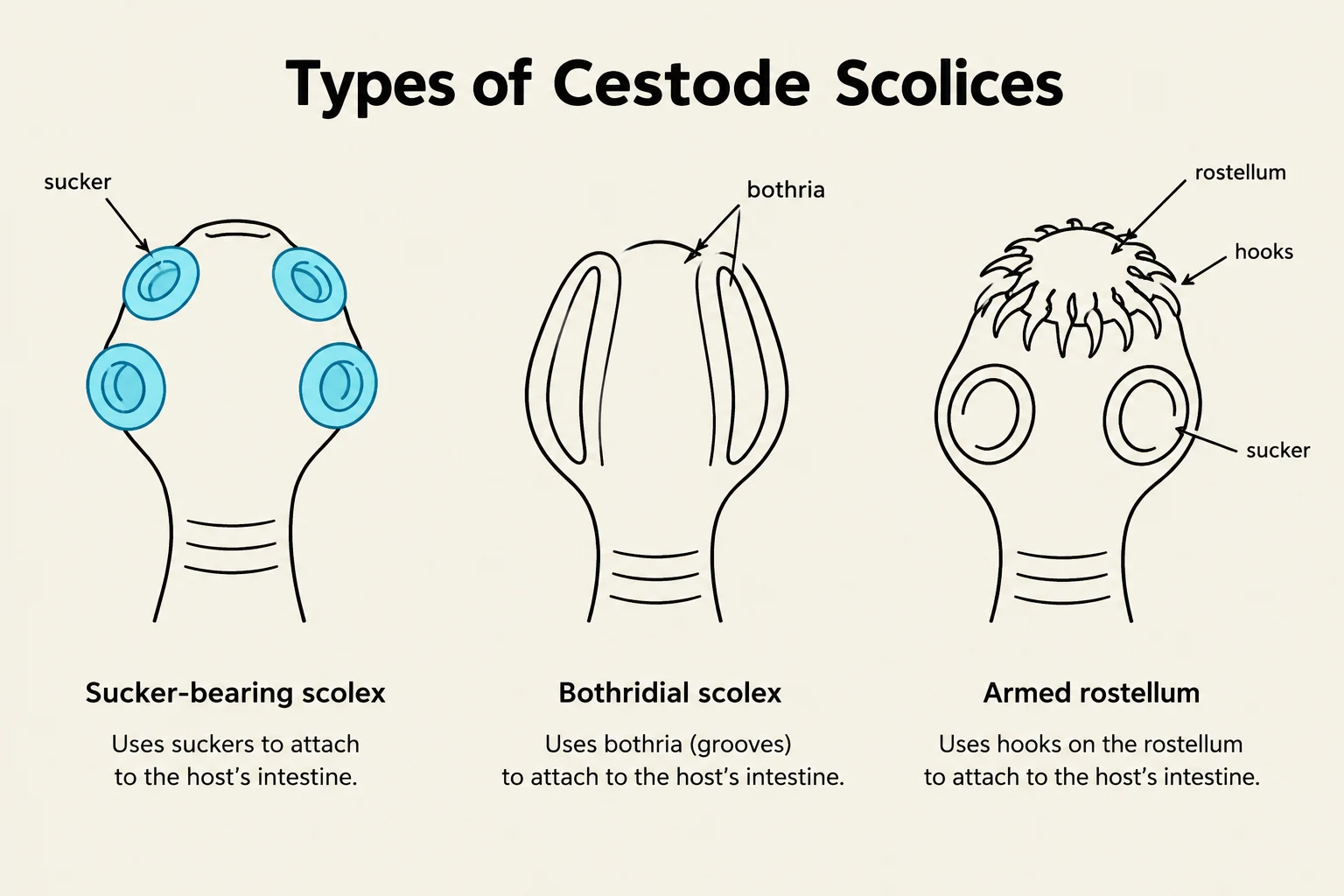
The primary anatomical feature of a cestode is the scolex, or head, which serves as the attachment organ to the host's intestinal wall. Depending on the order and species, the scolex may feature suckers, grooves (bothria), or a retractable, armed rostellum equipped with hooks.
Beyond the scolex, the body consists of a series of segments called proglottids. In some species, such as those in the family Dilepididae, the reproductive organs are arranged such that there are two sets of genitalia per proglottid, often with genital pores located on both sides.
Diagram illustrating three types of cestode scolices: sucker-bearing, bothridial, and armed rostellum, with descriptions of their attachment mechanisms.
Exam Tip: When identifying species, always look at the scolex. An "armed" rostellum contains hooks, whereas an "unarmed" rostellum does not.
The Hymenolepidae Family: Human and Rodent Pathogens
The family Hymenolepidae includes several species that infect birds and mammals, with two notable species affecting humans.
Hymenolepis nana (The Dwarf Tapeworm)
H. nana is a cosmopolitan parasite and one of the most common tapeworms in humans, particularly in children. It is morphologically distinct due to its small size (less than 40 mm), a retractable armed rostellum, four suckers, and a unilateral genital pore.
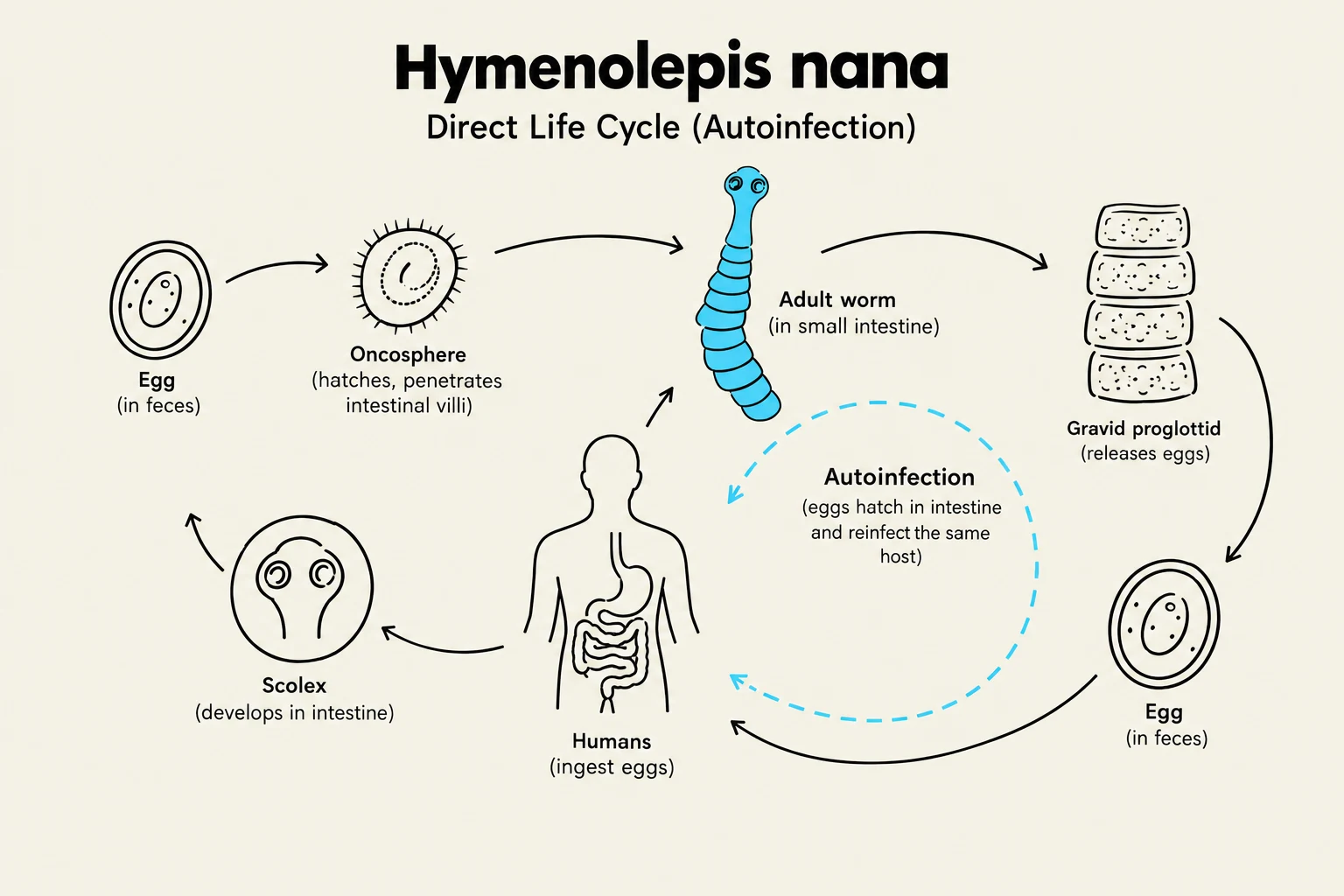
Its life cycle is unique because an intermediate host (IH) is technically optional. If a human or rodent ingests the eggs (containing the oncosphere), the parasite can penetrate the intestinal mucosa and develop directly into a cysticercoid within the intestinal wall. From there, it re-emerges into the lumen within 5–6 days to mature. However, the cycle can also involve arthropods like fleas or beetle larvae as intermediate hosts.
Hymenolepis diminuta
Unlike its smaller relative, H. diminuta can grow up to 90 cm. It features an unarmed rostellum and four suckers. This species requires an intermediate host—typically one of approximately 90 species of arthropods, such as grain beetles (Tribolium, Tenebrio).
Dilepididae and Anoplocephalidae: Diverse Hosts and Forms
Dipylidium caninum (The Double Pored Tapeworm)
Commonly found in dogs, cats, and children, D. caninum is characterized by having two sets of genitalia, with a genital pore on each side of the proglottid. Instead of a traditional uterus, the gravid proglottids contain egg capsules holding hundreds of eggs. When these proglottids detach, they may resemble "cucumber seeds". The intermediate host is typically a flea; once the flea is ingested by a definitive host (DH), the parasite matures.
Anoplocephalidae and Moniezia
The family Anoplocephalidae primarily infects hoofed animals. A prominent genus is Moniezia, such as M. expansa, which infects sheep. These worms can grow quite large, up to 6 meters, and utilize oribatid mites as their intermediate hosts.
Diagram illustrating the direct life cycle and autoinfection of Hymenolepis nana, a tapeworm.
Specialized Orders and Marine Parasites
Cestodes exhibit highly specialized life cycles depending on their environment, particularly in aquatic ecosystems.
Proteocephalata and Ophiotaenia
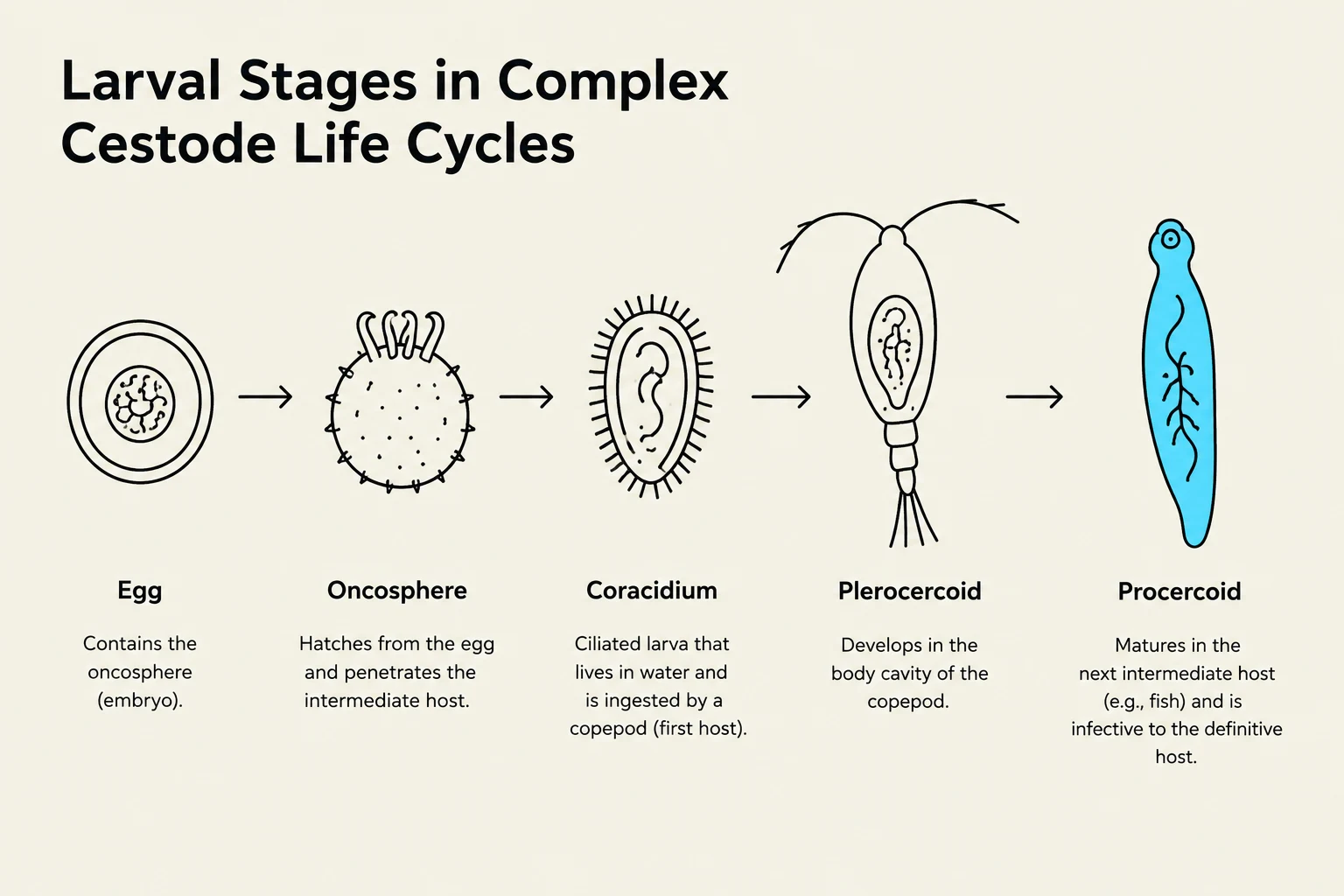
The order Proteocephalata includes species like Ophiotaenia koennbergii that infect freshwater fish, amphibians, and reptiles. Their life cycle involves a crustacean intermediate host where the parasite develops into a procercoid (the first larval stage). This is then eaten by a second intermediate host or paratenic host, where it develops into a plerocercoid (the second larval stage). In some fish, such as the largemouth bass, plerocercoids can migrate to the coelom or even the gonads, potentially causing parasitic castration.
Tetraphyllidea and Trypanorhyncha
These orders are primarily parasites of elasmobranchs (sharks and rays).
Tetraphyllidea: Characterized by four bothridia (specialized attachment organs) on the scolex, often with accessory suckers.
Trypanorhyncha: These possess an elongated scolex with four retractable tentacles armed with hooks. Their life cycles often involve marine molluscs, crustaceans, or fish as intermediate hosts.
Lecanicephalidea and Amphilinidea
Lecanicephalidea: These parasites of elasmobranchs have a scolex divided into anterior and posterior regions by a transverse groove, with the posterior region typically featuring four suckers and no hooks.
Amphilinidea: Represented by Amphilina foliacea, these are monozoic (single-segmented) worms that live in the body cavity of hosts like sturgeons. Their life cycle involves an amphipod as an intermediate host.
Summary of Larval Stages and Host Roles
Understanding cestode biology requires distinguishing between the various larval stages and the roles of the hosts involved.
Term
Definition
Definitive Host (DH)
The host in which the adult tapeworm resides and reproduces sexually.
Intermediate Host (IH)
The host in which larval stages develop.
Procercoid
The first larval stage, often developing in a crustacean.
Plerocercoid
The second larval stage, often infective to the definitive host.
Cysticercoid
A larval stage (seen in Hymenolepis) that develops within an arthropod or the intestinal wall.
Tetrathyridium
A specific metacestode stage found in the family Mesocestoididae.
Diagram illustrating the larval stages in the life cycles of cestodes, including egg, oncosphere, coracidium, plerocercoid, and procercoid.
Note on Mesocestoididae: For the family Mesocestoididae, the complete life cycle is not fully known, but it is believed that they utilize mites as the first intermediate host and can undergo asexual reproduction via fission.
Keep reading for free.
Create an account to finish this reading and make it part of your study routine.