Momentum and the Center-of-Mass of a System of Particles
This document explains the concepts of momentum, conservation of momentum, and the center of mass for systems of particles in classical mechanics. It covers definitions, laws, and applications in collisions and impulse.
In classical mechanics, we often transition from studying single objects to studying groups of objects. When we analyze a "system of particles," we shift our focus from individual interactions to the collective behavior of the group. By understanding how momentum is distributed and how the center of mass moves, we can predict the motion of complex systems—ranging from colliding billiard balls to exploding projectiles—without needing to track every single internal force.
Momentum of a Single Particle and a System
At its most fundamental level, momentum p is a vector quantity defined as the product of an object's mass m and its velocity v:
p=mv
When we move from a single particle to a system of particles, we are interested in the total momentum of that system. The total momentum ptotal is simply the vector sum of the momenta of all individual particles within the system:
ptotal=p1+p2+…
When analyzing these systems, it is crucial to distinguish between internal forces and net external forces. Internal forces are the interactions occurring between the particles within the system (such as two billiard balls hitting each other). External forces are those exerted on the system from the outside.
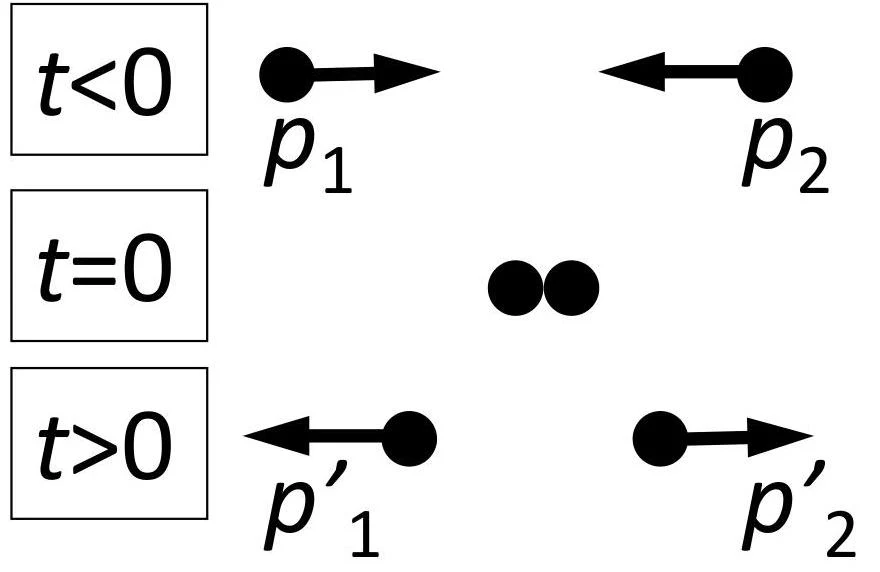
A diagram illustrating the concept of momentum conservation in a collision. Before the collision (t<0), two particles with momenta p1 and p2 are moving towards each other. At the moment of collision (t=0), they are in contact. After the collision (t>0), they move away with new momenta p'1 and p'2.
The Inertial System and Conservation of Momentum
A key concept in this study is the inertial system. We can define an inertial system as one where we can "draw a box" around the particles such that no net external force crosses the boundary of that box.
If the net external force Fext, net acting on a system is zero, the total momentum of the system remains constant over time. This is known as the Law of Conservation of Momentum:
If Fext, net=0, then ptotal=constant
This means that even if the particles inside the system collide, explode, or push against one another, the sum of their momenta will not change as long as no outside force interferes.
Exam Tip: To determine if momentum is conserved, always identify your system boundaries. If an external force (like friction or gravity acting on a single object) is present, the total momentum of that specific system will change.
Example: The Recoiling Cannon
Consider a 5,000 kg cannon that fires a 50 kg cannonball at 200 m/s. Since the cannon and ball start at rest, the initial momentum is zero. To conserve momentum, the final momentum must also be zero:
pi=0pf=Mvc+mbvb=0
Solving for the cannon's recoil velocity vc:
vc=−Mmbvbvc=−5,000 kg50 kg(200 m/s)=−2.0 m/s
The negative sign indicates the cannon moves in the opposite direction of the ball.
The Center of Mass (COM)
The center of mass is a unique point that represents the average position of the mass in a system. It allows us to treat a complex collection of particles as a single point mass for the purpose of studying external motion.
The position of the center of mass rcom is calculated as:
rcom=M1∑i=1Nmiri=m1+m2+…m1r1+m2r2+…
Where M is the total mass of the system.
Newton's Law for a System
While individual particles follow Fi=miai, the entire system follows a simplified version of Newton's Second Law. The net external force acting on a system is equal to the total mass of the system multiplied by the acceleration of its center of mass:
Fext=Macom
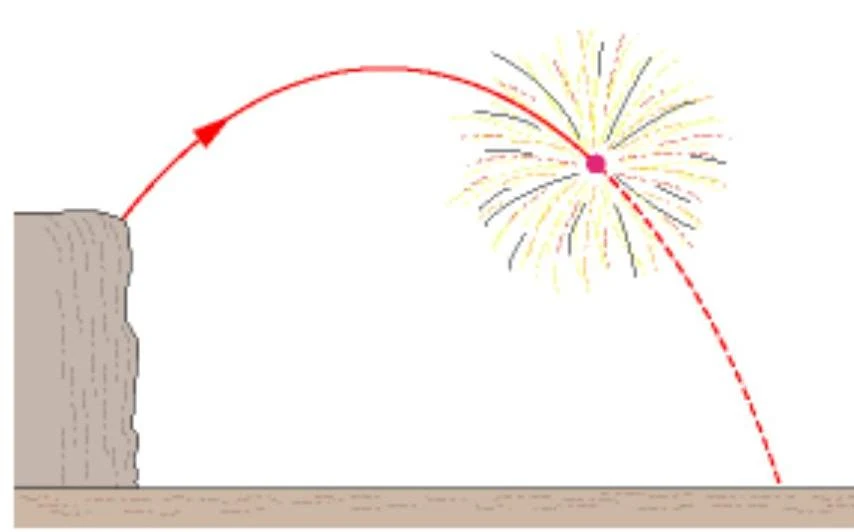
A diagram illustrating projectile motion, showing a curved trajectory from a cliff to an exploding firework.
This explains why an object exploding in mid-air still follows a parabolic trajectory; while the individual pieces fly in many directions, the center of mass of all those pieces continues to move as if it were a single projectile under the influence of gravity.
Collisions: Elastic vs. Inelastic
A collision is an isolated event where bodies exert strong forces on each other for a short duration. In all collisions within an inertial frame, total linear momentum is conserved. However, kinetic energy (K) may or may not be conserved.
1. Inelastic Collisions
In an inelastic collision, kinetic energy is not conserved; some energy is transformed into heat, sound, or internal deformation.
Completely Inelastic Collision: The objects stick together after impact and move with a single common velocity $v'$.
pi=pf⟹m1v1+m2v2=(m1+m2)v′
2. Elastic Collisions
In an elastic collision, both total momentum and total kinetic energy are conserved.
For a collision where a moving mass m1 hits a stationary target m2 (v2=0), the final velocities are:
v1′=(m1+m2m1−m2)v1v2′=(m1+m22m1)v1
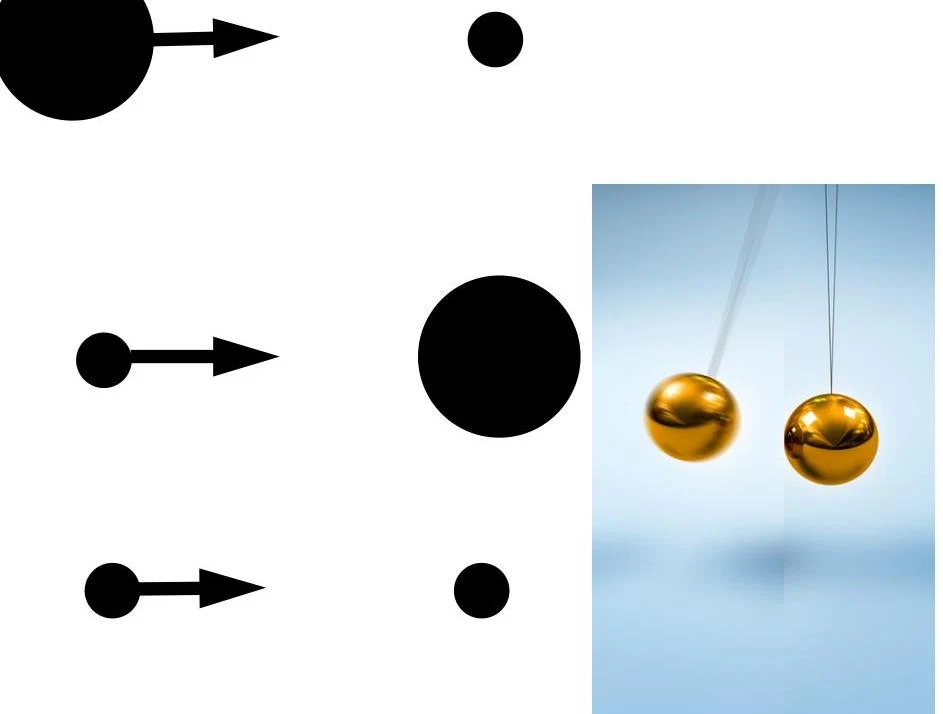
Diagrams illustrating the concept of momentum transfer, showing a larger circle moving towards a smaller circle and a pendulum-like device with golden spheres.
Limiting Cases for Elastic Collisions:
If m1≫m2: The heavy mass continues at v1, and the light mass shoots forward at 2v1.
If m1≪m2: The heavy mass remains stationary, and the light mass bounces back at −v1.
If m1=m2: The masses exchange velocities; m1 stops and m2 moves forward at v1.
Impulse and Change in Momentum
The concept of impulse relates the force applied to an object to its change in momentum. If a constant average force Favg is applied over a time interval Δt, the impulse is:
Δp=FavgΔt
This is vital in safety engineering. For example, when a car hits a barrier, the force experienced by the passengers depends on how quickly the momentum changes. A longer impact time Δt results in a smaller average force Favg.
Momentum in 2D and 3D
Momentum is a vector, meaning it must be conserved in every dimension independently. In a two-dimensional collision, you must solve for the x and y components separately:
∑pi,x=∑pf,x∑pi,y=∑pf,y
By decomposing the velocity vectors into cosθ and sinθ components, you can solve for unknown speeds and angles in complex off-center collisions.
Keep reading for free.
Create an account to finish this reading and make it part of your study routine.