Molecular, Complete Ionic, and Net Ionic Equations
Learn how to represent chemical reactions at different levels of detail, from the overall molecular equation to the particle-level complete ionic and net ionic equations. Understand spectator ions and how they are removed to reveal the actual chemical change.
When you observe a chemical reaction in a laboratory, you might see a clear liquid suddenly turn cloudy with a solid precipitate, or perhaps a gas bubbles out of a solution. While a standard chemical equation tells you which substances are reacting, it often hides the "real" action happening at the particle level. To truly understand which ions are interacting and which are simply "along for the ride," chemists use three different levels of representation: molecular, complete ionic, and net ionic equations.
The Molecular Equation: The Formula View
The starting point for any ionic reaction analysis is the molecular equation. This representation shows all reactants and products as complete chemical formulas. It is useful for seeing the overall stoichiometry of the reaction, but it can be misleading because it treats soluble compounds as single units rather than the collection of ions they actually are in solution.
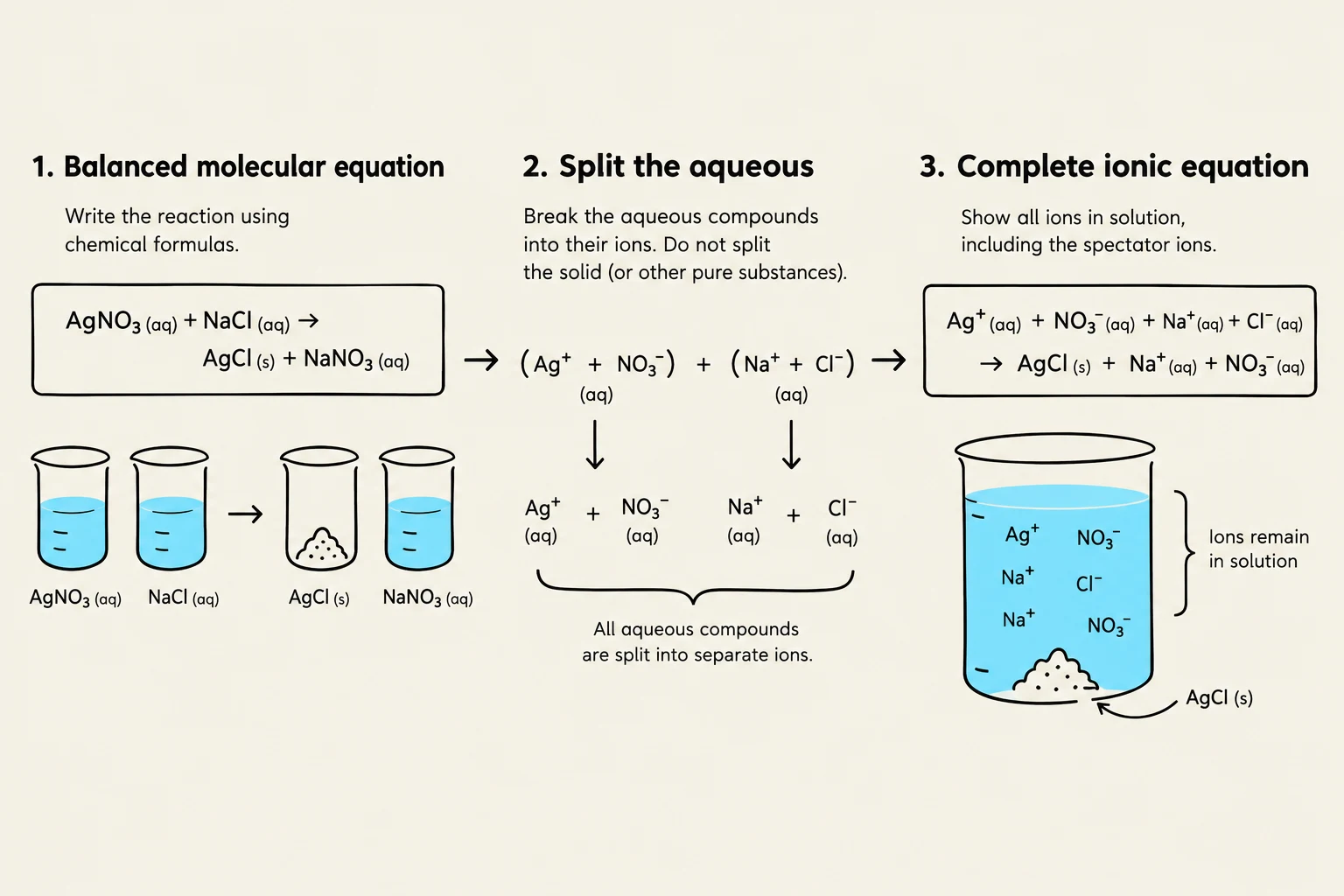
In a molecular equation, we use state symbols—such as $(s)$ for solid, $(l)$ for liquid, $(g)$ for gas, and $(aq)$ for aqueous—to indicate the physical state of each substance. For example, in a precipitation reaction, we might see:
AgNO3(aq)+NaCl(aq)→AgCl(s)+NaNO3(aq)
This equation tells us that silver nitrate and sodium chloride react to form solid silver chloride and aqueous sodium nitrate. However, it doesn't show us that the AgNO3 is actually dissociated into Ag+ and NO3− ions in the water.
This diagram illustrates the process of converting a balanced molecular equation into a complete ionic equation, showing the dissociation of aqueous compounds into ions and the formation of a precipitate.
The Complete Ionic Equation: Exposing the Ions
To move from the formula level to the particle level, we write the complete ionic equation. This version of the equation "exposes" the particles that are actually present in the solution.
The most critical rule in this step is deciding what to split. You should only split strong aqueous electrolytes. A strong aqueous electrolyte is a soluble compound labeled with the $(aq)$ state symbol. Because these substances are highly soluble, they exist in the water as separate, individual ions.
Conversely, you must keep the following species intact in their molecular formula form:
Solids (precipitates) labeled $(s)$
Liquids labeled $(l)$
Gases labeled $(g)$
Weak electrolytes (substances that do not dissociate completely)
For example, if we take our previous reaction and split the aqueous species, we get:
Notice that AgCl(s) remains as a single formula because it is an insoluble product (a precipitate), while the $(aq)$ species have been broken down into their constituent cations and anions.
This illustration contrasts the molecular formula of sodium chloride (NaCl) with its ionic form (Na+ and Cl-) when dissolved in water or melted, highlighting that the same compound can be represented differently.
Identifying Spectator Ions
Once you have written the complete ionic equation, you will notice that some ions appear exactly the same on both the reactant side and the product side. These are called spectator ions.
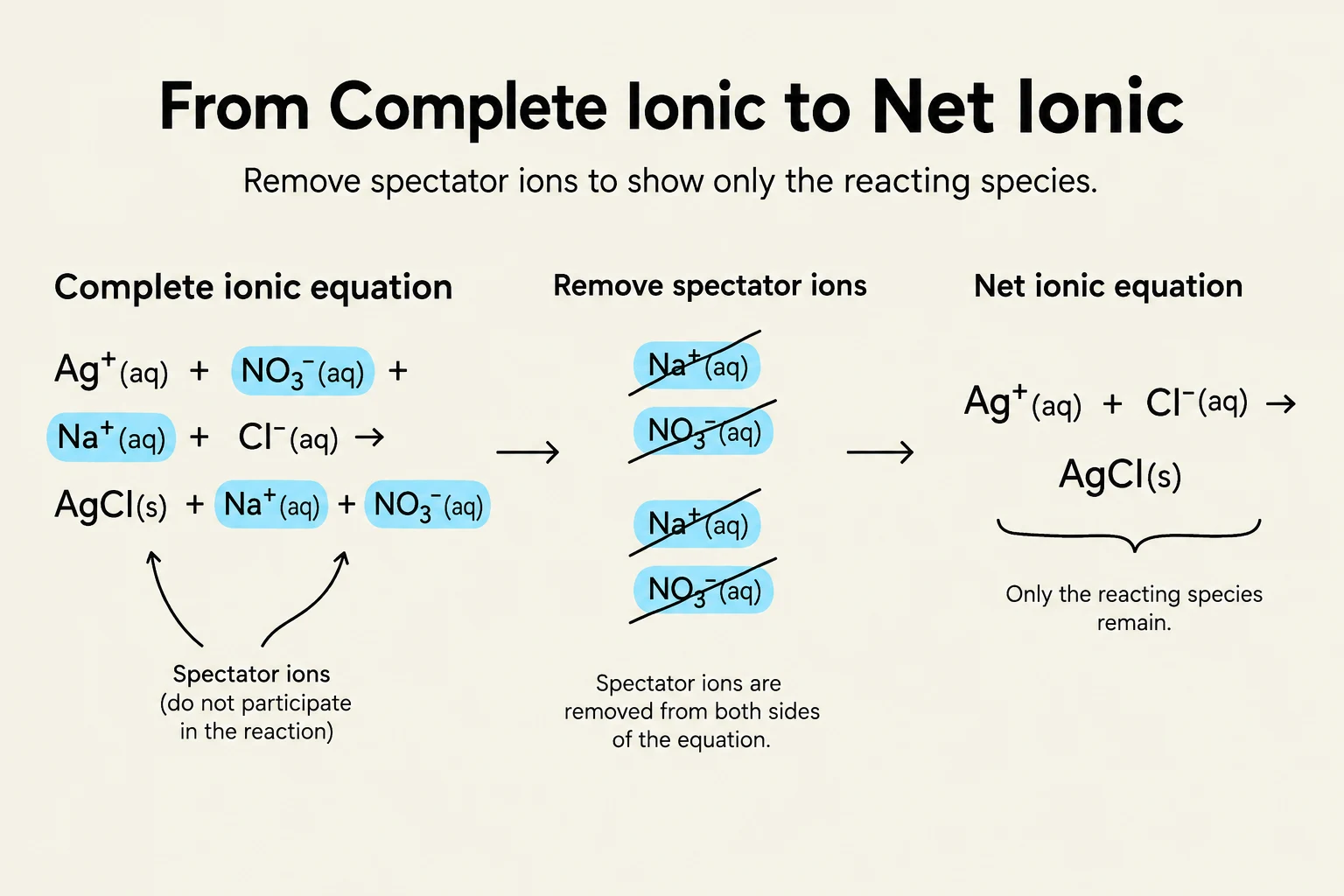
Spectator ions do not undergo any chemical change during the reaction; they are simply present in the solution throughout the process. In the example above, Na+(aq) and NO3−(aq) appear on both sides of the arrow. They are the spectators.
Exam Tip: Don't Guess!
Spectator ions are easiest to recognize by matching, not by guessing which ions look "unimportant". A true spectator must appear in exactly the same form (including charge and state) on both sides of the equation. You should never attempt to cancel a single ion against an insoluble compound (for example, you cannot cancel Ag+ against AgCl(s)).
The Net Ionic Equation: The Real Chemistry
The net ionic equation is the final, most "revealing" view of the reaction. It is derived by removing all spectator ions from the complete ionic equation. What remains is the actual chemical change that occurred.
In a precipitation reaction, the net ionic equation specifically shows the formation of the insoluble solid (the precipitate) from the aqueous ions that reacted to create it.
Remove Spectators: Cancel Na+ and NO3− from both sides.
Net Ionic:Ag+(aq)+Cl−(aq)→AgCl(s)
This final equation tells the true story: a silver ion and a chloride ion combined to form a solid precipitate.
This illustration demonstrates the process of converting a complete ionic equation to a net ionic equation by removing spectator ions, which do not participate in the reaction.
When No Reaction Occurs
It is important to note that not every combination of ions results in a reaction. If you follow the workflow and find that every single ion is a spectator ion—meaning all reactants and products remain soluble aqueous species—then, in terms of a precipitation reaction, no reaction has occurred.
Summary Checklist for Accuracy
To avoid common mistakes, follow this reliable sequence:
Balance the molecular equation first: You cannot split ions correctly if your coefficients are wrong.
Maintain coefficients when splitting: If you have 2KI(aq), it must become 2K+(aq)+2I−(aq) in the complete ionic equation.
Split only strong aqueous electrolytes: Use the $(aq)$ label as your guide.
Keep everything else intact: Do not split $(s)$, $(l)$, $(g)$, or weak electrolytes.
Cancel identical species: Only remove ions that are identical on both sides.
By following these steps, you move from a simple formula to a deep understanding of the microscopic interactions driving chemical change.
Keep reading for free.
Create an account to finish this reading and make it part of your study routine.