Explore the evolving landscape of funeral practices, from traditional burial and cremation to eco-friendly options, personalized ceremonies, and innovative remembrance rituals.
The way society handles death is undergoing a profound transformation. Historically, grieving families were often limited to two primary choices: how much to spend on a casket and where to bury their deceased loved one. However, modern funeral practices have expanded into a vast spectrum of options. Today, the industry is shifting from a rigid, institutional model toward one that emphasizes personalization, environmental sustainability, and diverse methods of body disposition.
Understanding Body Disposition
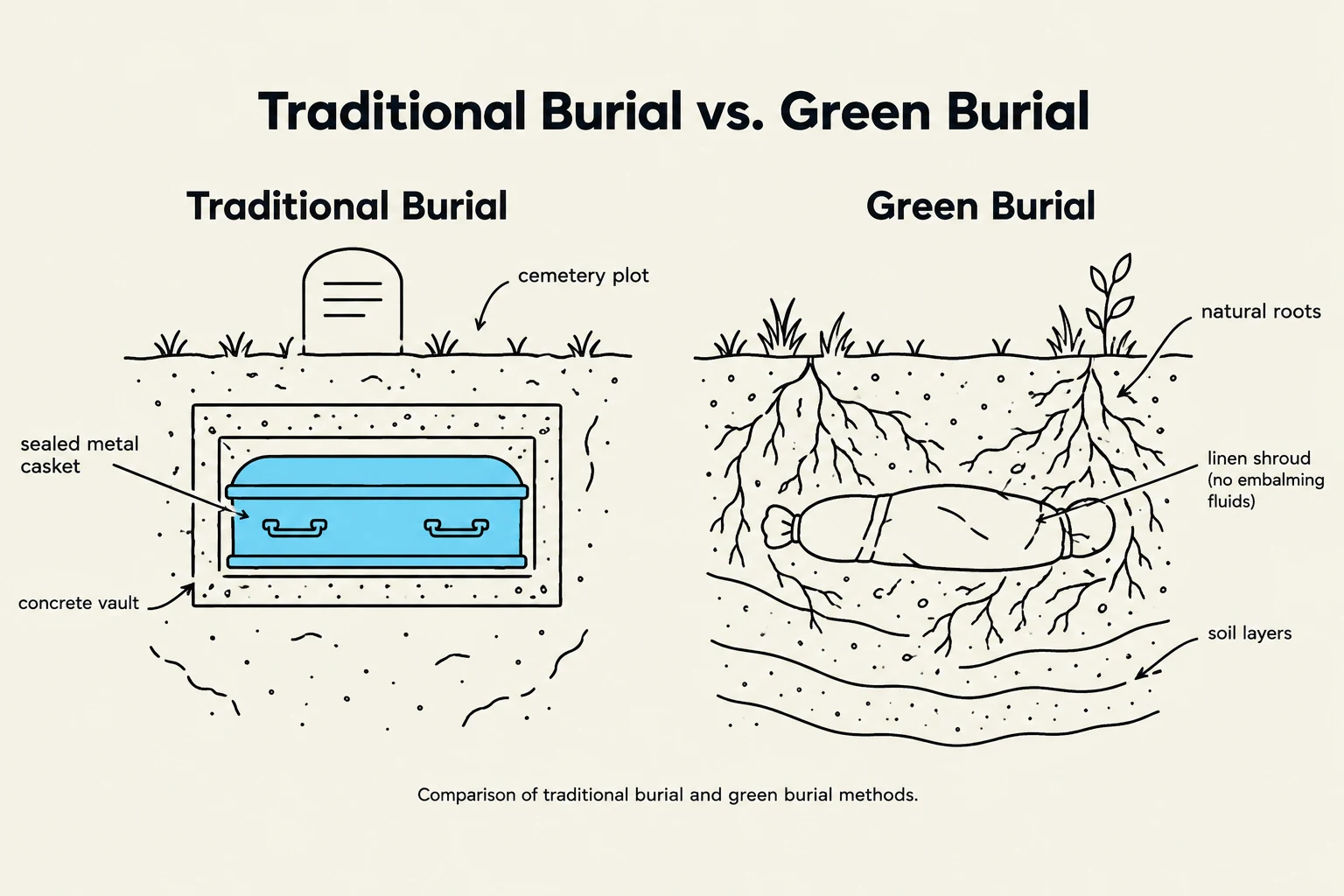
Comparison of traditional burial and green burial methods.
Body disposition refers to the methods used to handle and dispose of a corpse after death. While traditional methods remain common, new technologies and philosophical shifts have introduced a wide array of alternatives.
Traditional Methods: Burial and Cremation
The most conventional forms of disposition are burial and cremation.
Burial: This involves placing the deceased in a casket within a cemetery plot. The selection of a casket has traditionally been a centerpiece of the funeral industry, though modern mortuaries are increasingly using touchscreen technology and software to allow families to design their own caskets or browse a wider selection than a physical showroom could hold.
Direct Cremation: This is a streamlined process where the body is cremated without a formal viewing or traditional funeral service.
Eco-Friendly and "Green" Options
This diagram illustrates the process of alkaline hydrolysis, where a body is placed in a specialized chamber, liquid nitrogen is used to remove water, and the resulting dry, nutrient-rich dust is used as fertilizer.
As environmental consciousness grows, many are seeking "sustainable" ways to return to the earth.
Green Burials: Also known as "natural" or "woodland" burials, these involve disposing of the body in a natural setting without embalming. The body may be wrapped in a shroud or placed in a biodegradable coffin, using only materials that naturally decompose.
Innovative Biological Methods: In Sweden, the organization Promessa uses liquid nitrogen to remove water from the body, turning it into dust that can be used as fertilizer.
Ocean Burials: Some choose "eternal reefs," where cremated remains are integrated into artificial reefs that serve as habitats for sea life.
Unconventional and Experimental Approaches
For those seeking highly unique send-offs, options range from the spectacular to the scientific:
Space Burials: Cremated remains can be launched into orbit via rocket.
Cryonics: While not a method of disposal, cryonic suspension involves freezing a corpse (or just the head) in liquid nitrogen in the hope that future medical technology might allow for resuscitation.
Note on Professional Diligence: As body modification and piercing become more common, funeral-cremation providers must be diligent. Valuables may no longer be limited to rings or watches on fingers and necks; they may also be found in the tongue, chest, navel, or nasal cavity.
The Evolution of Death Rites
Death rites are the rituals and ceremonies performed to honor the deceased. There is a significant movement away from strictly religious or institutional ceremonies toward more "authentic" and personal experiences.
Personalized and Life-Centered Funerals
Modern families increasingly prefer "personalized funerals," which adapt conventional elements to fit the specific identity of the deceased. A subset of this is the life-centered funeral. Unlike traditional services that may focus on religious teachings about the afterlife, life-centered funerals focus on the individual's life, their relationships, and their unique personality.
In these ceremonies:
Eulogies are often "shared." Rather than being delivered solely by clergy, they are spoken by a variety of family members and friends, sometimes evolving into spontaneous storytelling.
Personalized Media and Music: Video biographies, favorite poems, and preferred music are used to reflect the person's character.
The "Do-It-Yourself" Movement
A growing trend is the "family-directed funeral" (also called a "home funeral"). This is a noncommercial approach where the family and their social community take charge of preparing the body and carrying out rituals. This method emphasizes minimal, noninvasive care and relies on personal social networks rather than commercial funeral providers. Individuals navigating this complex process may seek help from a "death midwife" to manage the bureaucracy of conventional rules.
Remembrance and Linking Objects
The concept of linking objects in the grieving process.
Beyond the funeral itself, the grieving process often involves ongoing rituals of remembrance. A key concept in this stage is the use of linking objects.
Linking objects are physical items or images that serve as a connection between the mourner and the deceased. These can include:
Jewelry made from cremated remains.
Memorial gardens, which provide a physical space for survivors to "visit" and maintain a connection with the deceased.
Clinical Perspective: Grief counselors suggest that linking objects can act as "transitional objects." They help mourners maintain a healthy bond of remembrance while they begin the journey of reinvesting emotional energy into their own lives.
While some argue that people should "break the chain" of attachment to the deceased, the use of these objects can actually help individuals move from maladaptive grieving to an adaptive style of mourning.
Summary Table: Comparison of Funeral Approaches
Feature
Institutional/Traditional
Life-Centered/Personalized
Home/Natural Funeral
Primary Focus
Religious/Afterlife teachings
The deceased's life and relationships
Family and community involvement
Provider
Licensed Mortician
Funeral Director (as "Event Planner")
Family/Social Network
Disposition
Casket/Burial/Cremation
Diverse (Video, Jewelry, etc.)
Biodegradable/Natural
Cost/Structure
Commercial/Standardized
Highly customized
Noncommercial/Minimalist
Keep reading for free.
Create an account to finish this reading and make it part of your study routine.