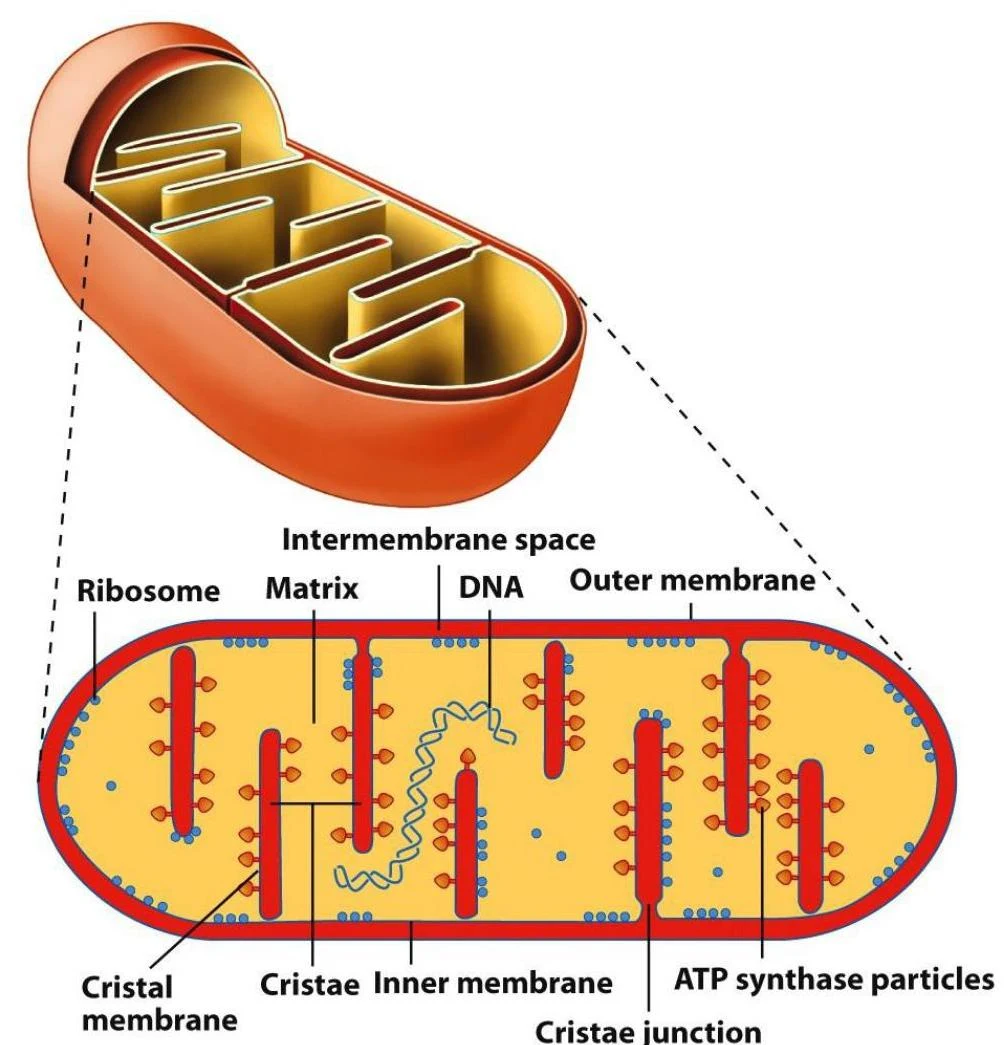
Explore the structure of mitochondria, including their double-membrane system, cristae, and matrix. Understand the key processes of oxidative metabolism: glycolysis, pyruvate decarboxylation, the citric acid cycle, and ATP synthesis via the electron transport chain and oxidative phosphorylation.
Mitochondria are essential organelles found in the cytoplasm of almost all eukaryotic cells. Often referred to as the "powerhouse" of the cell, they are responsible for the complex processes of oxidative metabolism that convert nutrients into usable chemical energy. While they are large enough to be visible under a light microscope, their intricate internal architecture—including the folds of the inner membrane and the enzymatic machinery of the matrix—can only be fully appreciated through electron microscopy.
Mitochondrial Structure and Membrane Systems
The mitochondrion is defined by a sophisticated double-membrane system that creates distinct compartments for specific chemical reactions.
The Outer and Inner Membranes
The outer mitochondrial membrane serves as the interface between the organelle and the rest of the cell. It is approximately 50% protein and is highly permeable to small molecules due to the presence of porins. Porins are large, pore-forming proteins that utilize a β-sheet barrel motif to allow the passage of moderate-sized molecules.
In contrast, the inner mitochondrial membrane is much more specialized, consisting of more than 75% protein. Unlike the outer membrane, the inner membrane is highly impermeable to polar and ionic substances, allowing the cell to maintain specific electrochemical gradients. A unique feature of this membrane is the presence of cardiolipin (diphosphatidylglycerol), a specialized phospholipid that is not found in the outer membrane.
Cristae and the Mitochondrial Matrix
To maximize the surface area available for energy production, the inner membrane is highly folded into structures known as cristae. These folds house the protein complexes responsible for the electron transport chain and the machinery for ATP synthesis, such as ATP synthase particles.
The innermost compartment is the mitochondrial matrix. The matrix is a dense environment containing:
Circular DNA molecules and ribosomes.
Enzymes for the citric acid cycle and fatty acid oxidation.
The pyruvate dehydrogenase complex.
Diagram of a mitochondrion, showing its outer membrane, inner membrane with cristae, intermembrane space, matrix, ribosomes, DNA, and ATP synthase particles.
Exam Tip: Remember that the outer membrane is permeable via porins, but the inner membrane is impermeable to ions. This distinction is crucial for maintaining the membrane potential required for ATP production.
The Pathway of Oxidative Metabolism
Oxidative metabolism is the process by which cells extract energy from organic molecules. This process involves a coordinated sequence of reactions starting in the cytosol and moving into the mitochondria.
Glycolysis: The Cytosolic Prelude
The first stage of carbohydrate metabolism is glycolysis, which occurs in the cytoplasm. During glycolysis, a single six-carbon glucose molecule is broken down into two three-carbon pyruvate molecules. This process yields a net gain of:
2 molecules of ATP (via substrate-level phosphorylation).
2 molecules of NADH (the reduced form of the coenzyme NAD+).
Pyruvate Decarboxylation and Acetyl CoA
For aerobic respiration to continue, pyruvate must enter the mitochondrion. It passes through the outer membrane via porins and is transported across the inner membrane by a specific pyruvate transporter.
Once inside the matrix, the pyruvate dehydrogenase complex catalyzes the oxidative decarboxylation of pyruvate. This reaction removes a carbon atom (released as CO2) and attaches the remaining two-carbon unit to Coenzyme A, forming acetyl CoA.
\text{Pyruvate} + \text{HS-CoA} + 2\text{NAD}^+ &\longrightarrow \text{Acetyl CoA} + \text{NADH} + \text{H}^+ + \text{CO}_2
\end{aligned}$$
### The Citric Acid Cycle (TCA Cycle)
Acetyl CoA serves as the entry point for the **citric acid cycle** (also known as the Krebs cycle or TCA cycle). The cycle begins when the two-carbon acetyl group from acetyl CoA condenses with the four-carbon molecule **oxaloacetate** to form the six-carbon molecule **citrate**.
Through a series of eight enzymatic steps, citrate is oxidized, eventually regenerating oxaloacetate to allow the cycle to continue. The net results of the cycle per acetyl CoA molecule include:
* The release of $2\text{CO}_2$.
* The reduction of electron carriers: $3\text{NADH}$ and $1\text{FADH}_2$.
* The production of $1\text{GTP}$ (or ATP).
The citric acid cycle is considered **amphibolic** because it serves both catabolic roles (degrading molecules for energy) and anabolic roles (providing intermediates for biosynthesis).
## ATP Synthesis and Electron Carriers
The ultimate goal of these metabolic pathways is the production of **ATP (Adenosine Triphosphate)**, the cell's primary energy currency.
### The Role of NADH and FADH₂
The energy harvested during glycolysis and the citric acid cycle is stored in the form of high-energy electrons carried by coenzymes:
1. **$\text{NAD}^+$ / $\text{NADH}$**: $\text{NAD}^+$ accepts two electrons and one proton to become the reduced form, $\text{NADH}$. $\text{NADH}$ then donates these electrons to the electron transport chain.
2. **$\text{FAD}$ / $\text{FADH}_2$**: $\text{FAD}$ accepts two electrons and two protons to become $\text{FADH}_2$.
### The Electron Transport Chain and Oxidative Phosphorylation
These reduced coenzymes ($\text{NADH}$ and $\text{FADH}_2$) deliver electrons to the **electron transport chain** located in the inner mitochondrial membrane. As electrons move through the chain, the energy released is used to pump protons across the membrane, creating a gradient. This gradient drives the final stage of **ATP synthesis** via the ATP synthase machinery located in the cristae.
While glycolysis only produces 2 ATP directly, the complete aerobic oxidation of one glucose molecule—utilizing the electron transport chain and oxidative phosphorylation—can yield a total of **30 to 32 ATP**.
*
$$$
$$$
Keep reading for free.
Create an account to finish this reading and make it part of your study routine.