Mitochondria are often referred to as the "powerhouses" of the cell, but they are far more than just simple energy generators. These specialized organelles possess a unique biological identity, containing their own distinct genetic material and protein synthesis machinery. While the vast majority of proteins required for mitochondrial function are encoded by the cell's nuclear DNA, a small, critical subset is encoded by the mitochondrial DNA (mtDNA) itself. This dual-genome system allows mitochondria to manage the complex task of energy production, specifically through the processes of oxidative phosphorylation and the electron transport chain.
The Engine of the Cell: Oxidative Phosphorylation
To understand mitochondrial disease, one must first understand how mitochondria produce energy. The primary goal of cellular respiration is to generate ATP (adenosine triphosphate), the universal energy currency of life. While glycolysis occurs in the cytoplasm and yields a modest 2 ATP per glucose molecule, the mitochondria are responsible for the "big payoff".
Through a process called oxidative phosphorylation, mitochondria use the energy stored in electron carriers like NADH and FADH2 to drive the production of approximately 34 ATP molecules. This process relies on the electron transport chain (ETC), a series of protein complexes located in the inner mitochondrial membrane.
The ETC works by passing electrons through a series of redox reactions. As electrons move through the complexes, they release energy that is used to pump protons ($H^+$) across the membrane, creating a proton gradient. This gradient acts like water behind a dam; when the protons flow back through a specialized enzyme called ATP synthase, the released energy is used to phosphorylate ADP into ATP.
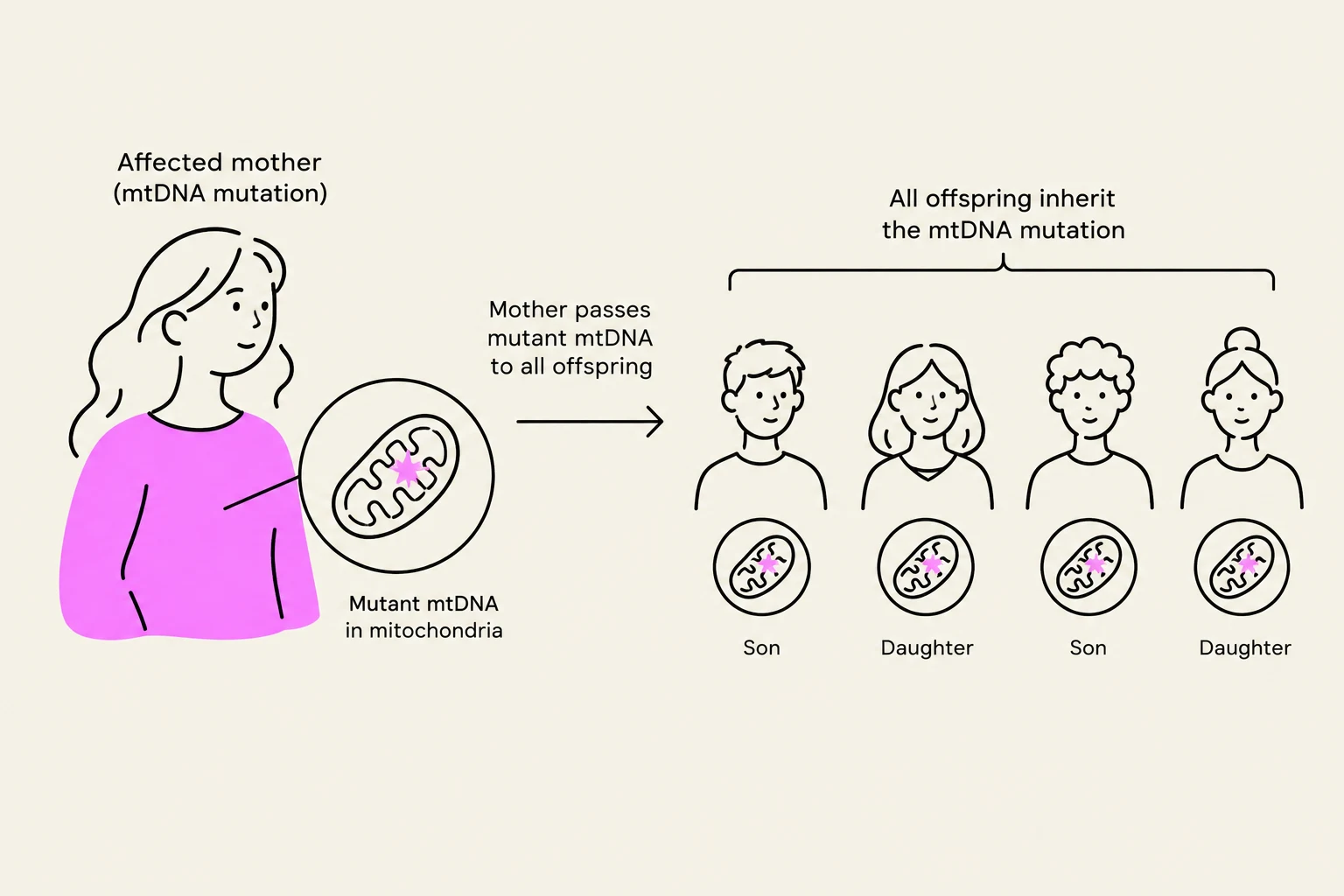
This diagram illustrates the inheritance of mitochondrial DNA (mtDNA) mutations. An affected mother, carrying a mutation in her mtDNA, passes this mutation to all of her offspring, regardless of their sex. The diagram shows a mitochondrion with mutant mtDNA being transmitted from the mother to her sons and daughters.
Enzyme Inhibition and the Danger of Cyanide
Because the electron transport chain relies on a precise sequence of chemical reactions, it is highly susceptible to interference. Certain substances act as enzyme inhibitors, effectively "clogging" the machinery and halting energy production.
One of the most lethal examples is cyanide. Cyanide is an enzyme inhibitor that specifically targets cytochrome c oxidase, also known as Complex IV. By binding to this complex, cyanide blocks the flow of electrons to the final electron acceptor—oxygen. When the ETC is blocked at Complex IV, the proton gradient collapses, ATP production ceases, and the cell can no longer sustain life.
Exam Tip: Remember that oxygen is the final electron acceptor in the ETC. If an inhibitor like cyanide prevents electrons from reaching oxygen, the entire chain backs up, much like a traffic jam, stopping the production of ATP.
Reductive Evolution and Genetic Mutations
The mitochondrial genome is a marvel of biological efficiency. Through a process known as reductive evolution, the mitochondrial genome has been significantly shrunken to approximately 16,569 base pairs. This streamlined genome primarily codes for the essential proteins required for the electron transport chain and oxidative phosphorylation.
Because these genes are so central to energy production, even small mutations can have catastrophic consequences. When the mtDNA is damaged or mutated, the cell's ability to produce ATP is compromised, leading to severe, multiorgan dysfunction.
One specific example is mitochondrial depletion syndrome. In this condition, mutations in the mtDNA prevent the synthesis of nucleosides, which are the essential building blocks required to create DNA. Without the ability to maintain its own genome, the mitochondria cannot function, leading to rapid clinical decline.
Clinical Manifestations: Mitochondrial Myopathies
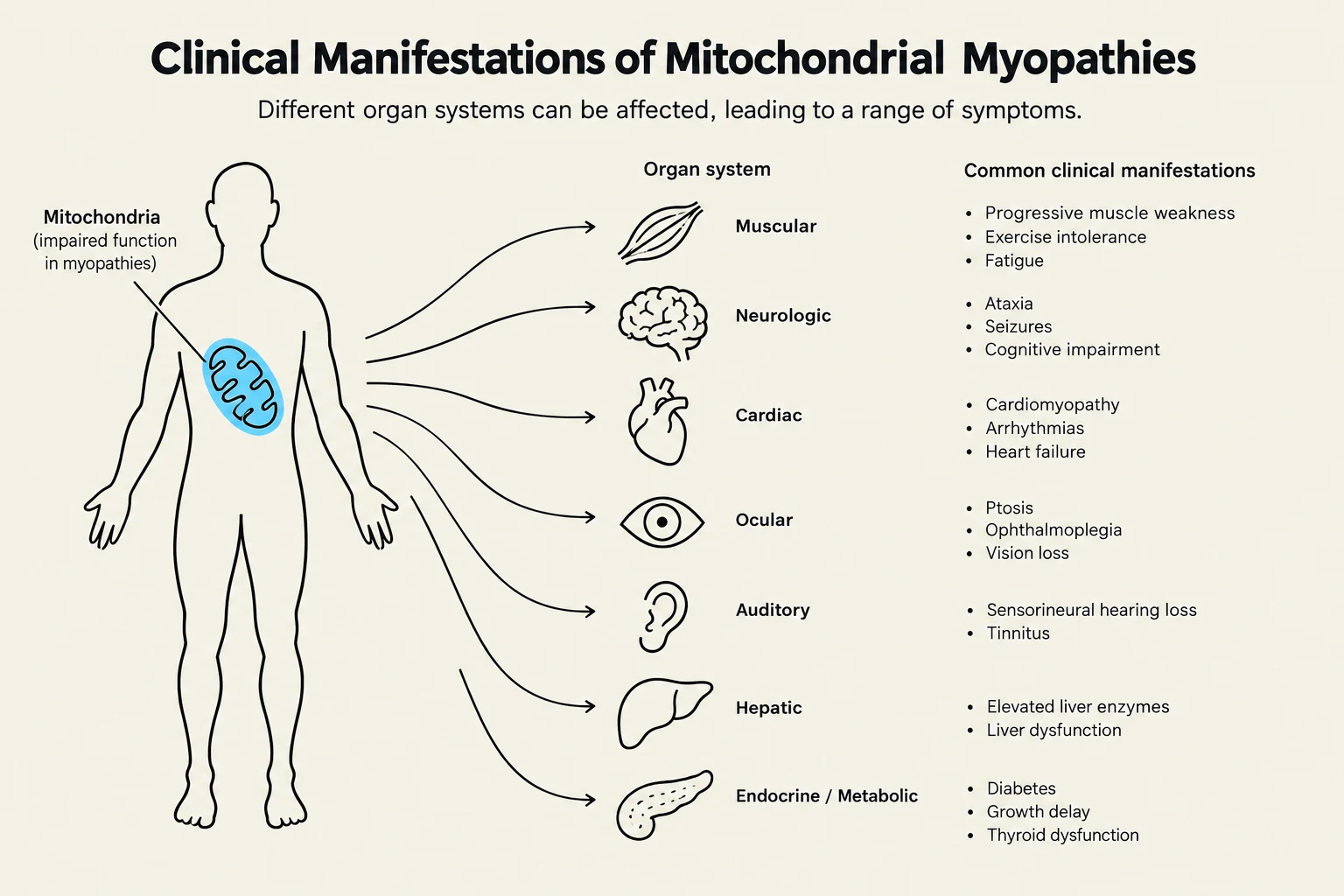
When mitochondria fail to meet the energy demands of the body, the resulting diseases are often categorized as mitochondrial myopathies. Because almost every cell requires ATP, these diseases are systemic, but they most heavily impact organs with high energy requirements, such as the brain, heart, and muscles.
The clinical features are widespread and can be categorized by organ system:
Neurological: Seizures, memory problems, attention difficulty, headaches, and sensitivities to light, noise, or smell.
Cardiovascular: Arrhythmia (irregular heartbeat) and fluctuations in blood pressure.
Musculoskeletal: Muscle weakness, cramping, and general pain.
Gastrointestinal: Nausea, vomiting, lack of appetite, and stomach cramps.
General: Constant fatigue (lack of energy) and shortness of breath.
This diagram illustrates the clinical manifestations of mitochondrial myopathies, showing how different organ systems are affected and the common symptoms associated with each.
Maternal Inheritance: A Unique Genetic Pattern
Perhaps the most distinctive feature of mitochondrial biology is its pattern of genetic inheritance. Unlike nuclear DNA, which is inherited from both parents, mitochondrial DNA is inherited exclusively from the mother (maternal inheritance).
This occurs because of the mechanics of fertilization. When a sperm and egg fuse, only the sperm nucleus is transferred into the egg; the mitochondria located in the sperm's mid-piece are not passed on to the offspring.
This creates a very specific inheritance rule:
If a mother has an mtDNA mutation, all of her children will inherit that mutation.
If a father has an mtDNA mutation, none of his children will inherit the condition.
This diagram illustrates the inheritance of mitochondrial DNA (mtDNA) mutations. An affected mother, carrying a mutation in her mtDNA, passes this mutation to all of her offspring, regardless of their sex. The diagram shows a mitochondrion with mutant mtDNA being transmitted from the mother to her sons and daughters.
Because this lineage is so stable and follows a clear maternal path, scientists use mtDNA as a vital tool to trace human migrations and evolutionary history across the globe.
Keep reading for free.
Create an account to finish this reading and make it part of your study routine.