Mitochondria and Cellular Respiration: The Engine of the Cell
Explore the structure and function of mitochondria, the powerhouse of the cell. This guide details the stages of cellular respiration, including glycolysis, the citric acid cycle, and oxidative phosphorylation, explaining how glucose is converted into ATP for cellular energy.
Cells require a constant supply of energy to perform biological work. This energy is primarily harvested through carbohydrate metabolism, a complex series of biochemical pathways that break down glucose to produce Adenosine Triphosphate (ATP). The central hub for this energy conversion in eukaryotic cells is the mitochondrion, an organelle specialized for aerobic respiration.
The Structure of the Mitochondrion
To understand how energy is produced, one must first understand the anatomy of the mitochondrion. It is defined by a double-membrane system that creates distinct compartments for different chemical reactions.
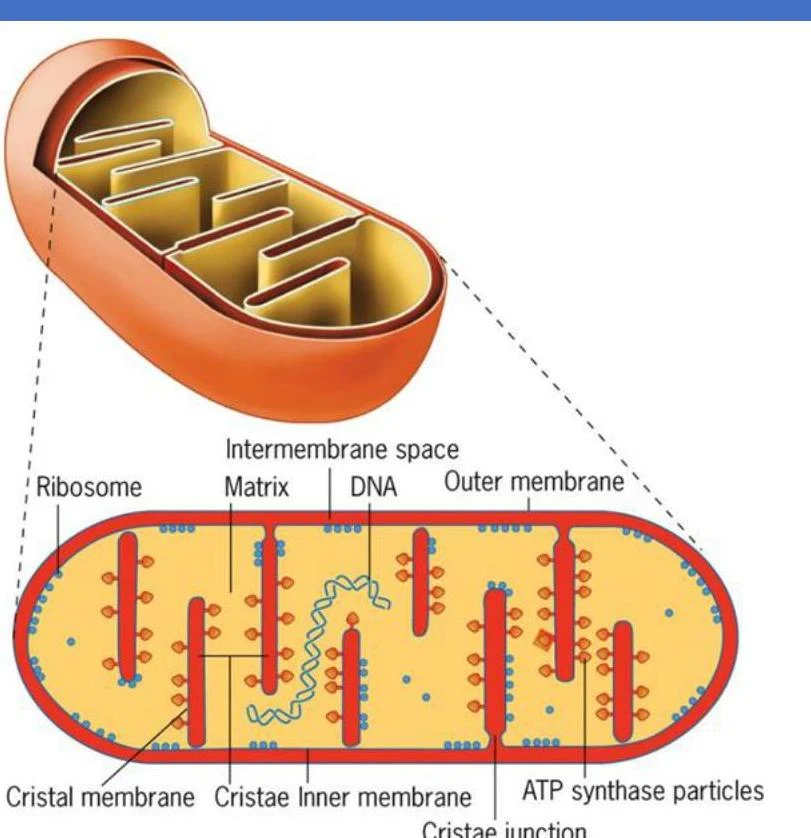
The outer mitochondrial membrane acts as a boundary, while the inner mitochondrial membrane is highly folded into structures called cristae. These folds significantly increase the surface area available for the proteins involved in energy production. The space enclosed by the inner membrane is known as the matrix, a dense fluid containing the enzymes necessary for the citric acid cycle.
Diagram of a mitochondrion, illustrating its outer and inner membranes, cristae, matrix, ribosomes, DNA, and ATP synthase particles.
The Stages of Cellular Respiration
Cellular respiration is a multi-step process that extracts energy from glucose through oxidation. This process can be broken down into three primary stages:
1. Glycolysis
The first stage, glycolysis, occurs in the cytosol of the cell. During this phase, a single molecule of glucose is broken down into two molecules of pyruvate. This process produces a small net gain of ATP through substrate-level phosphorylation—a method where a phosphate group is transferred directly from a substrate to ADP. Glycolysis also reduces NAD+ to NADH, which carries high-energy electrons to the later stages of respiration.
2. The Pyruvate Dehydrogenase Complex and the Citric Acid Cycle
Before entering the next major cycle, pyruvate must be transported into the mitochondrial matrix. Here, the pyruvate dehydrogenase complex converts pyruvate into Acetyl-CoA.
Acetyl-CoA then enters the citric acid cycle (also known as the TCA cycle). This cycle is a series of redox reactions that completely oxidize the acetyl group into CO2. As the cycle turns, it produces:
NADH and FADH2: Electron carriers that hold high-energy electrons.
ATP (or GTP): Produced via substrate-level phosphorylation.
The diagram illustrates the three main stages of cellular respiration: glycolysis, the citric acid cycle, and oxidative phosphorylation, showing how macromolecules are broken down to produce ATP.
3. Oxidative Phosphorylation
The final and most productive stage is oxidative phosphorylation, which takes place at the inner mitochondrial membrane. This stage consists of two tightly coupled processes: the electron transport chain (ETC) and ATP synthesis.
The Electron Transport Chain and the Proton Gradient
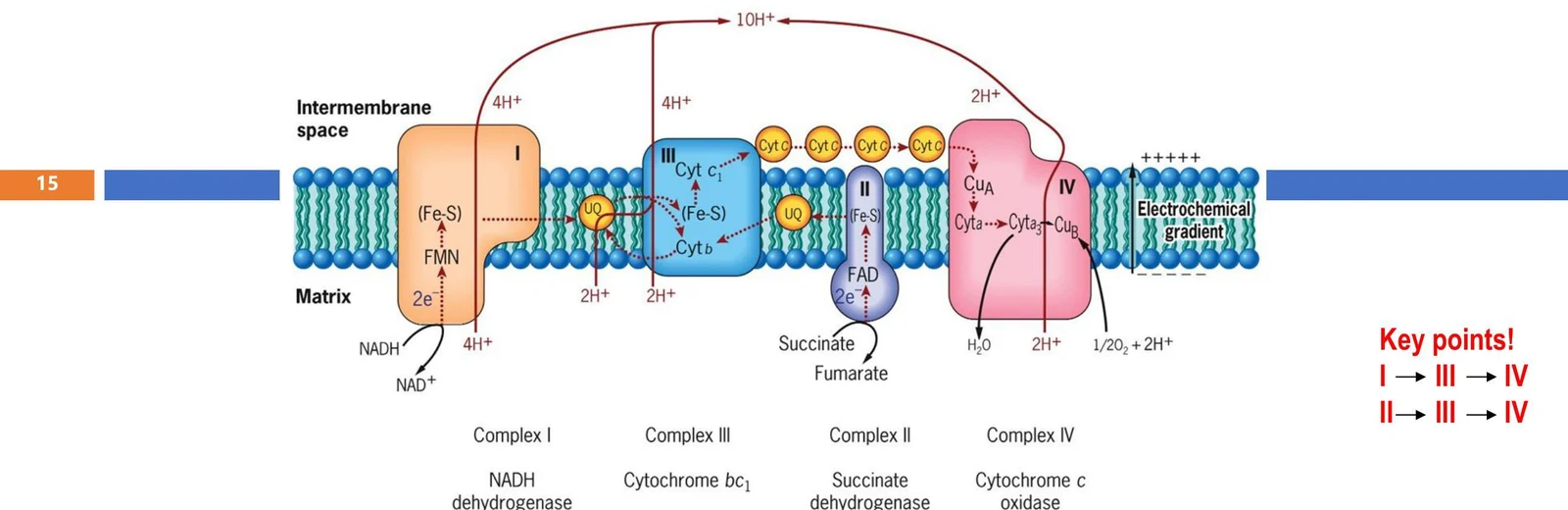
The electron transport chain is composed of four major protein complexes (Complex I through IV) and two mobile carriers: ubiquinone (Q) and cytochrome c.
Electrons from NADH enter at Complex I, while electrons from FADH2 enter at Complex II. These electrons move through the complexes in a specific order, driven by increasing redox potentials. As electrons move through the chain, the energy released is used by the complexes to pump protons (H+) from the mitochondrial matrix into the intermembrane space.
This pumping action creates a significant proton concentration gradient (also called an electrochemical gradient) across the inner membrane.
Diagram illustrating the electron transport chain in cellular respiration, showing the four complexes (I-IV) embedded in the inner mitochondrial membrane and their roles in proton pumping and ATP synthesis.
At the end of the chain, the electrons are transferred to the final electron acceptor, oxygen (O2), which combines with protons to form water (H2O).
ATP Synthesis via ATP Synthase
The potential energy stored in the proton gradient is harvested by a remarkable enzyme called ATP synthase (Complex V).
ATP synthase consists of two main parts:
F0 portion: An enzyme embedded in the inner membrane that acts as a channel for protons.
F1 portion: A catalytic subunit located in the matrix that synthesizes ATP.
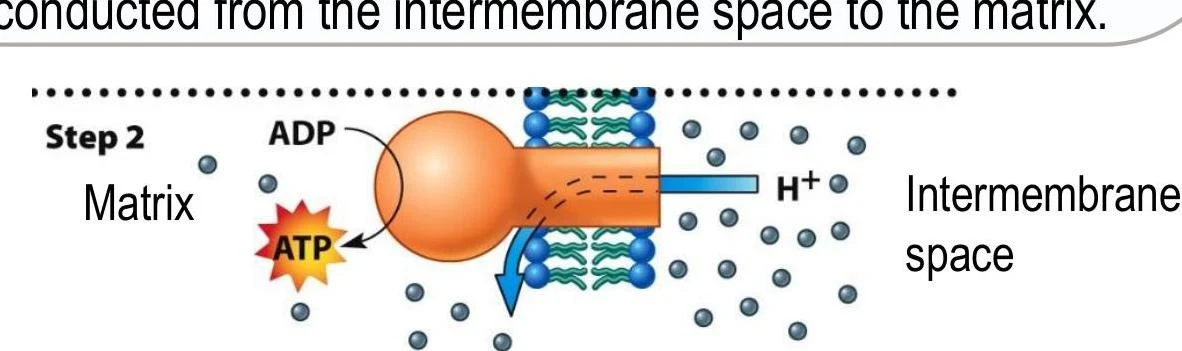
As protons flow down their concentration gradient from the intermembrane space back into the matrix through the F0 channel, they cause the c-ring of the F0 base to rotate. This rotation turns a central stalk (γ subunit), which induces conformational changes in the F1 head, driving the mechanical synthesis of ATP from ADP and inorganic phosphate.
Diagram illustrating the process of ATP synthesis from ADP and phosphate, involving the movement of protons (H+) across a membrane.
Exam Tip: Remember that the movement of electrons is driven by the difference in redox potentials. Electrons always move from carriers with a more negative redox potential to those with a more positive redox potential.
Summary of Energy Yield
The total amount of ATP produced from a single molecule of glucose depends on the efficiency of the electron shuttles used to move cytosolic NADH into the mitochondria. Generally, the aerobic oxidation of one glucose molecule yields between 30 and 32 ATP.
Process
Direct ATP/GTP
Reduced Coenzymes
Total ATP Yield (Approx)
Glycolysis
2 ATP
2 NADH
~3-5 ATP
Pyruvate Oxidation
0
2 NADH
~5 ATP
Citric Acid Cycle
2 GTP/ATP
6 NADH, 2 FADH2
~20 ATP
Total
30–32 ATP
Key Concept Check: The proton-motive force does more than just make ATP; it also drives the transport of ADP into the mitochondrion and ATP out of it.
Keep reading for free.
Create an account to finish this reading and make it part of your study routine.