Explores the essential roles of bacteria, yeast, and mold in food production, including fermentation processes and microbial growth factors relevant to food safety. Covers bacterial growth calculations and risk management strategies.
Microorganisms are often associated with food spoilage and illness, but they are also the essential biological engines behind many of the world's most beloved foods. From the airy crumb of a fresh loaf of bread to the complex tang of aged blue cheese, microbes like bacteria, yeast, and mold play indispensable roles in food production. By understanding how these organisms grow, reproduce, and transform nutrients, we can better appreciate both the culinary benefits of fermentation and the critical importance of food safety.
The Three Pillars: Bacteria, Yeast, and Mold
Microorganisms used in food production generally fall into three categories, each with distinct biological characteristics and applications.
Bacteria
Bacteria are single-celled organisms that come in various shapes, such as cocci (spherical), rods, or vibrio (comma-shaped). In the food industry, a specific group known as Lactic Acid Bacteria (including genera like Lactobacillus, Lactococcus, and Streptococcus) is vital. These bacteria convert simple sugars into lactic acid, a process used to produce yogurt, sour cream, butter milk, pickles, sauerkraut, and even dried-cured sausages like salami.
Growth in bacteria is influenced by both intrinsic factors (properties inherent to the food, such as pH and nutrient content) and extrinsic factors (the storage environment, such as temperature and humidity).
Exam Tip: Remember that most fresh-type foods have a water activity (aw) of about 0.96–0.99. Bacteria that cause food-borne illness generally require a water activity above 0.85 to grow.
Yeast
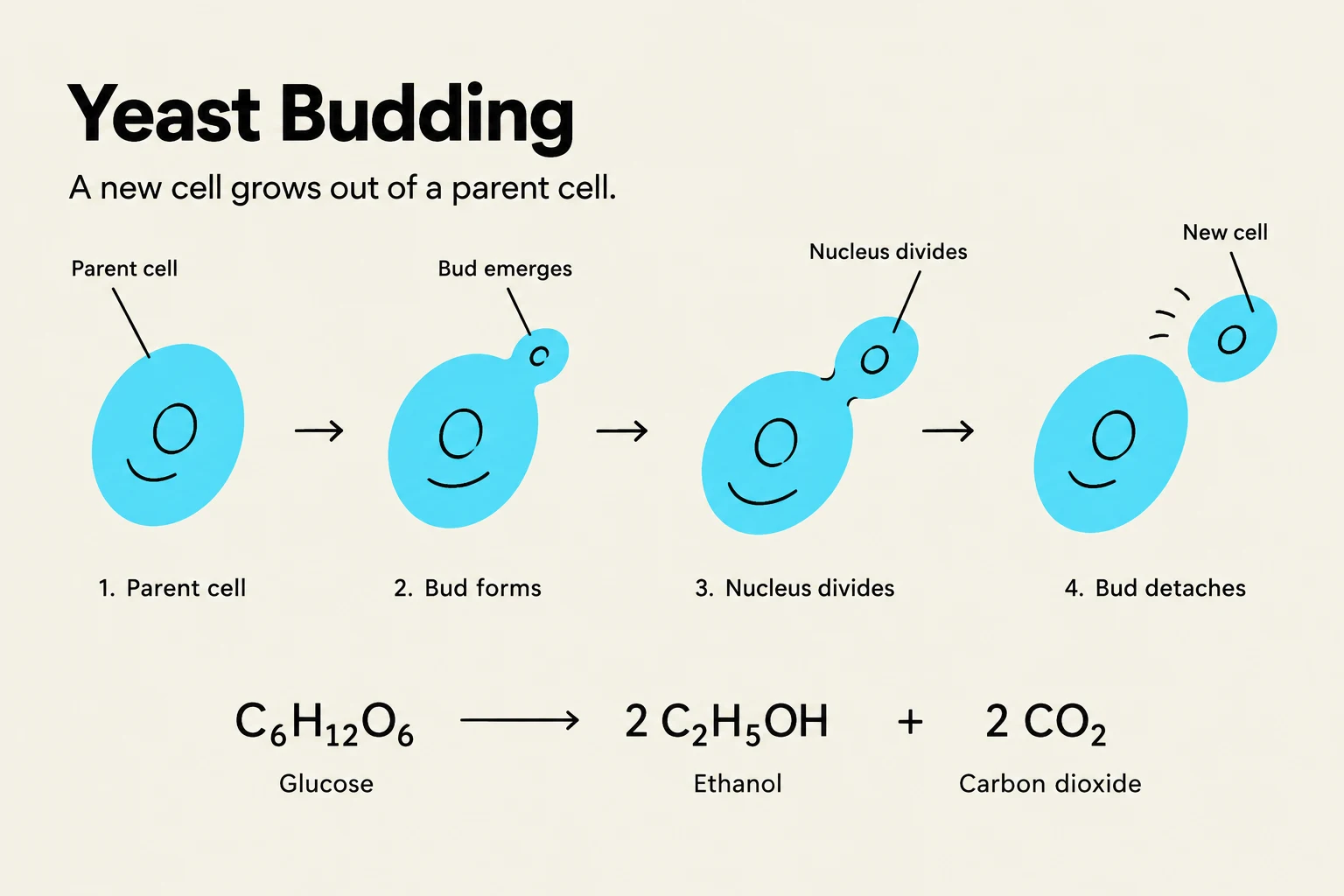
Yeasts are single-celled microorganisms that typically reproduce through a process called budding. They thrive in environments containing moisture, oxygen, sugar, and an acidic pH. While many yeasts prefer aerobic conditions, some "fermentative types" can grow anaerobically, albeit more slowly.
The primary application of yeast is alcoholic fermentation, where they convert sugars into alcohol and carbon dioxide (CO2). This is the fundamental process used to leaven bread and produce beverages like wine and beer. For example, Saccharomyces cerevisiae can produce CO2 through the breakdown of sucrose.
Diagram illustrating the process of yeast budding, where a new cell grows from a parent cell, and the chemical equation for the fermentation of glucose into ethanol and carbon dioxide.
Mold
Unlike bacteria and yeast, molds are multicellular and filamentous. They reproduce by producing spores and are capable of growing on dry foods like cereals and grains, as well as at both room and cold temperatures. Molds require oxygen for growth.
In food production, molds are used to create specific textures and flavors in products like soy sauce (using Aspergillus oryzae) and various cheeses, such as Roquefort, Gorgonzola, and Camembert.
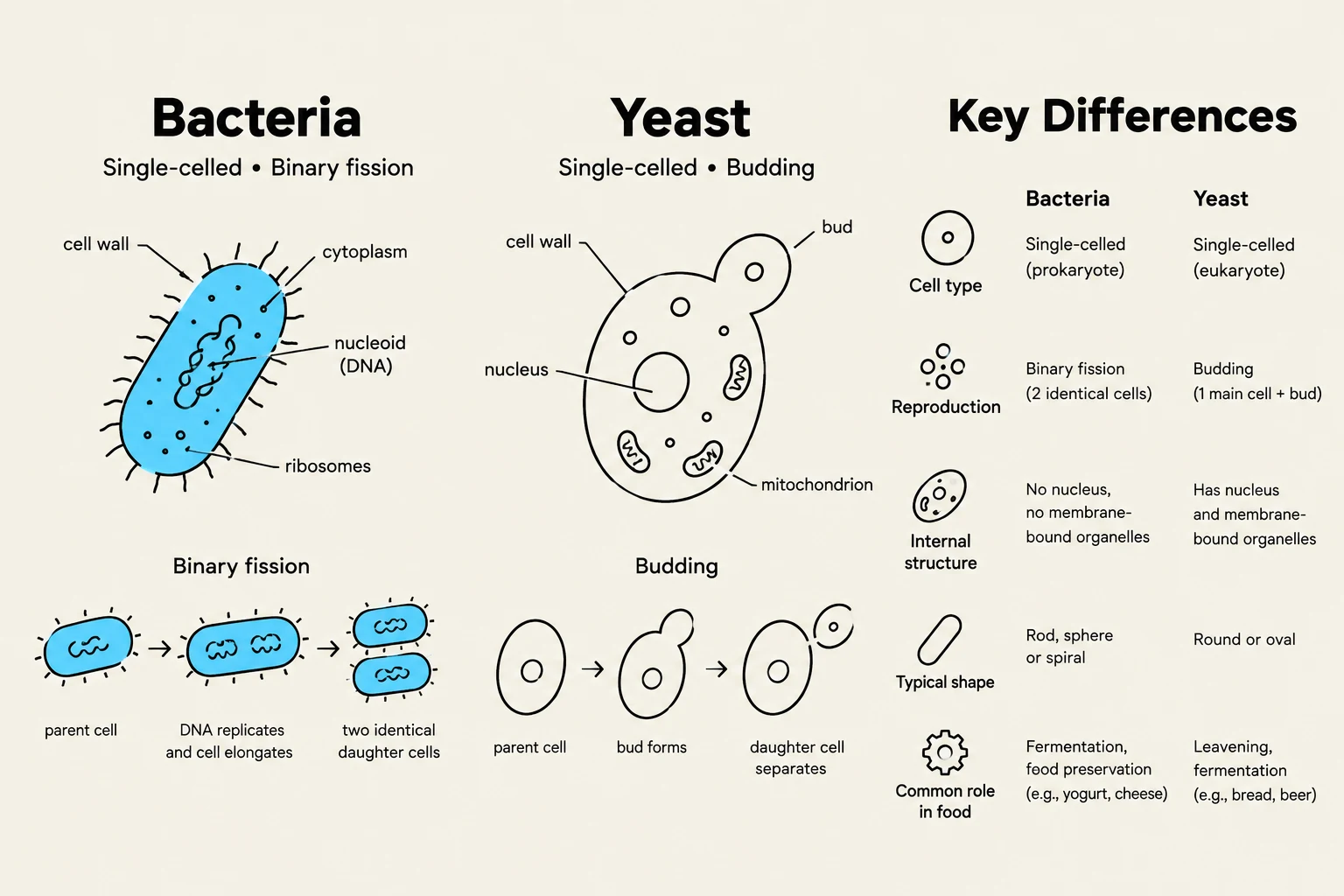
This illustration compares and contrasts bacteria and yeast, detailing their cell structures, modes of reproduction (binary fission for bacteria, budding for yeast), internal organization, typical shapes, and common roles in food production.
The Science of Fermentation
Fermentation is the biological breakdown of carbohydrates (CHO) by microorganisms. This process is used not only to create food but also to preserve it by reducing pH, producing alcohol, or reducing oxygen levels. Fermentation can significantly improve the flavor, texture, and nutritional value of food.
There are several key types of fermentation used in food science:
Alcoholic Fermentation: Converts sugars to ethanol and CO2 (e.g., wine, beer).
Acetic Acid Fermentation: Converts ethanol into acetic acid (CH3COOH) in the presence of oxygen.
C2H5OH+O2→CH3COOH+H2O
CO2 Fermentation: The production of carbon dioxide, essential for the rising of bread dough.
Microbial Growth and Food Safety
While microbes can be beneficial, they can also cause food spoilage or illness. Spoilage is indicated by changes in taste, smell, sight, or texture, such as the smell of ammonia or rotten eggs, or a slimy, mushy texture.
Bacterial Growth Calculations
Bacteria multiply through binary fission, where one cell divides into two. This leads to exponential growth. To predict how much bacteria will be present after a certain time, we use the concept of generation time (GT), which is the time it takes for the population to double.
Worked Example:
A small piece of chicken (100 g) has an initial E. coli load of 800 CFU/g. If the generation time is 20 minutes, what is the total bacteria count after 2 hours?
Convert total time to minutes: 2 hours=120 minutes.
Calculate the number of generations (G):
G=20 min/gen120 min=6 generations
Calculate the final count per gram using the formula Initial Count×2G:
800×26=800×64=51,200 (or 5×10⁴) CFU/g
Managing Risks
Food-borne illnesses can be caused by bacteria (like E. coli), viruses, or parasites. Some molds even produce dangerous toxins, such as Aspergillus flavus producing aflatoxin.
To prevent illness, strict food handling is required:
Workers with communicable diseases or skin lesions must not handle food.
Frequent hand washing and wearing clean clothing/head covers are essential.
Proper temperature control is vital. For example, the "Danger Zone" for food is between 40∘F and 140∘F (4∘C to 60∘C).
This diagram illustrates temperature zones for food safety, including hot holding, the danger zone where bacteria grow rapidly, refrigeration, and freezing, with corresponding temperature ranges and their effects on bacterial growth.
Critical Concept: Pathogens may be present in food in numbers too low to cause disease initially. However, if food is mishandled or left at room temperature, these microorganisms can grow to dangerous levels.
Keep reading for free.
Create an account to finish this reading and make it part of your study routine.