An overview of microorganisms, pathogens, and the chain of infection, including types of pathogens, modes of transmission, and infection control practices.
Understanding the biological agents that cause disease and the mechanisms by which they spread is fundamental to infection control and patient safety. Microorganisms, or microbes, are diverse biological entities that can range from microscopic single-celled organisms to multicellular parasitic worms. When these organisms cause disease, they are referred to as pathogens. By studying the specific characteristics of these pathogens and the "chain" they must complete to infect a host, healthcare providers can implement effective interventions to break the cycle of transmission.
Microorganisms and Pathogens
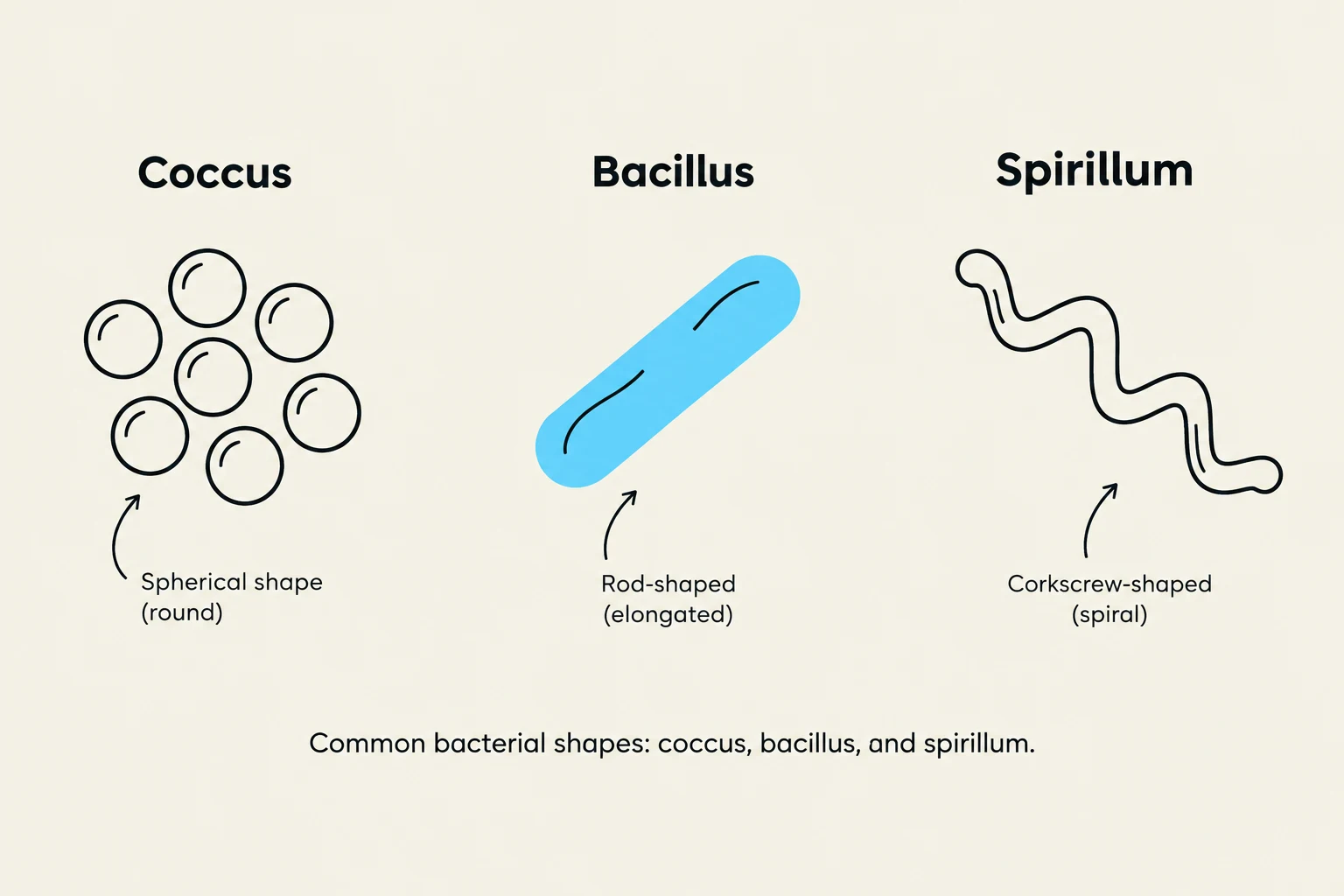
Common bacterial shapes: coccus, bacillus, and spirillum.
Pathogens are categorized into several distinct groups based on their cellular structure and biological characteristics.
Bacteria
Bacteria are single-celled organisms that can be identified by their shape and their reaction to a Gram stain.
Shapes of Bacteria
Bacteria are commonly classified into three primary shapes:
Coccus: Spherical or dot-like shapes.
Bacillus: Elongated, rod-shaped organisms.
Spirillum: Spiral or corkscrew-shaped bacteria.
Bacteria identified by shapes (Magnification x 2,000)Figure 14.1 - Bacteria identified by shapes (Magnification x 2,000).
The Gram Stain
To further identify bacteria, clinicians use a dark purple stain called a Gram stain.
Gram-positive: These organisms appear purple or blue under the microscope.
Gram-negative: These organisms appear pink or red.
Clinical Examples of Bacteria
Bacteria can cause a wide range of illnesses, from localized skin infections to life-threatening systemic conditions.
MRSA (Methicillin-resistant Staphylococcus aureus): A significant nosocomial (hospital-acquired) infection. There are two types: HA-MRSA (healthcare-associated), which often affects immunocompromised patients following invasive procedures, and CA-MRSA (community-associated), which affects healthy individuals in crowded settings or contact sports. MRSA is often resistant to penicillin and may require treatment with vancomycin.
Clostridium difficile (C. diff): A Gram-positive, spore-forming bacillus that causes severe diarrhea and is a significant nosocomial pathogen. It is often treated with vancomycin or metronidazole.
Escherichia coli (E. coli): A Gram-negative bacillus that is a common cause of nosocomial infections, particularly in the urinary tract.
Viruses
Viruses are non-cellular, tiny parasites that are too small to be seen with a standard microscope. Unlike bacteria, they cannot reproduce on their own; they must live within the cells of a host to replicate. Because they are not cellular, antibiotics are ineffective against viruses. Management typically involves antiviral medications (such as acyclovir for Herpes) or supportive care.
Protozoa
Protozoa are single-celled animals that typically inhabit water. Humans can ingest them through contaminated food or water, leading to intestinal illnesses. Examples include Plasmodium (which causes malaria) and Giardia lamblia (which causes giardiasis).
Fungi
Fungi can be unicellular or multicellular. While some are easily visible, such as mold or mushrooms, others require a microscope. Fungal infections can occur through skin contact or by entering through cuts. In immunocompromised individuals, these infections can become systemic. A common example is Candida albicans (yeast), which can cause thrush or pneumonia, often following antibiotic use that kills off normal flora.
Helminths
Helminths are parasitic worms that inhabit the human digestive tract. They often enter the body via contaminated food. Examples include pinworms (Enterobius), which are common in the U.S. and cause anal itching, and tapeworms (Taenia), which attach to the intestinal wall. These are treated with medications known as anthelmintics.
The Chain of Infection
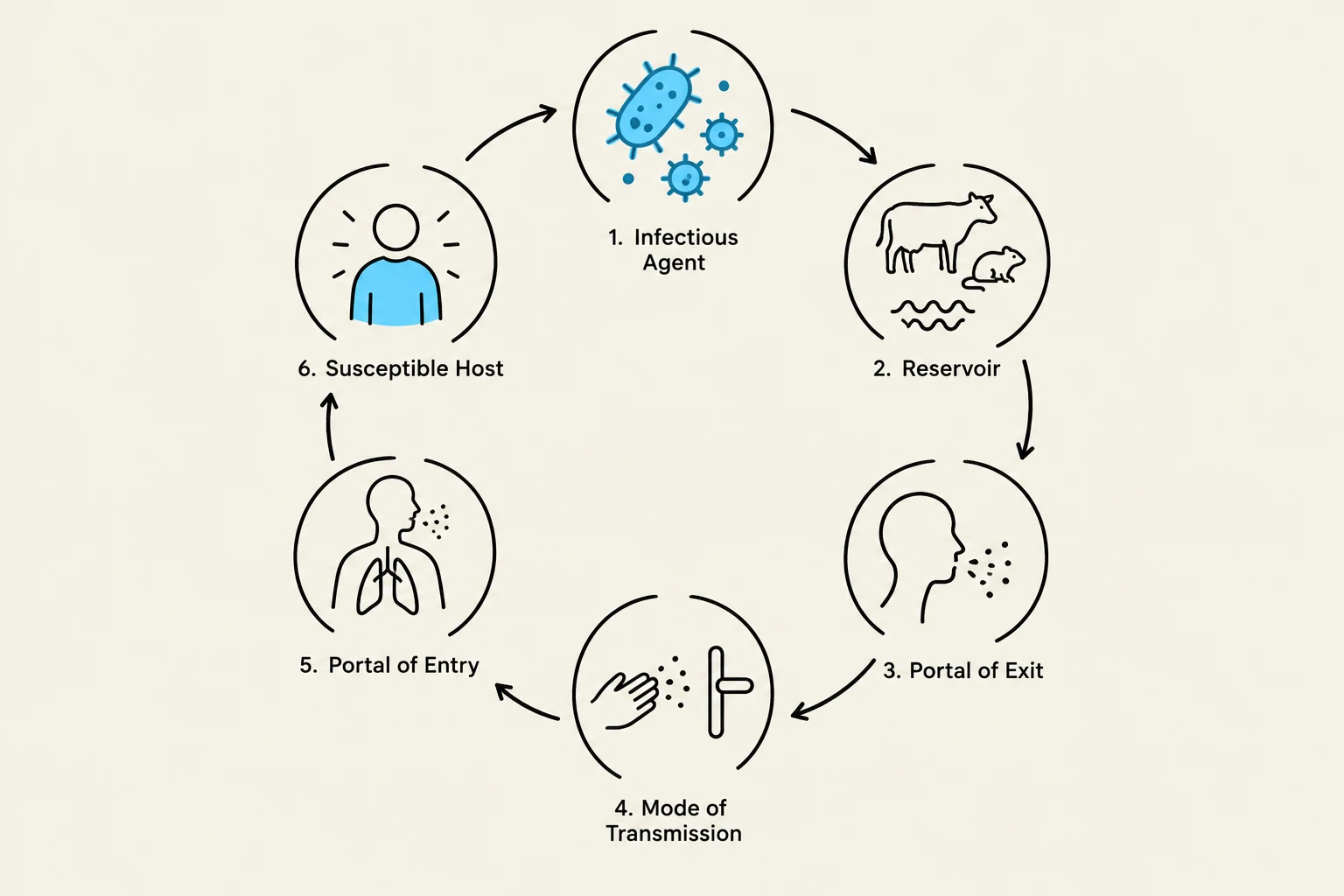
Diagram illustrating the chain of infection, including the infectious agent, reservoir, portal of exit, mode of transmission, portal of entry, and susceptible host.
For an infection to spread from one person to another, a specific sequence of interconnected events must occur. This is known as the Chain of Infection. If any single link in this chain is broken, the transmission of the disease is prevented.
Infectious Agent: The causative organism (e.g., bacteria, virus, fungi, or parasite).
Reservoir: The habitat where the organism lives, grows, and multiplies. This can include people, water, soil, insects, animals, or medical devices.
Portal of Exit: The route by which the agent leaves the reservoir (e.g., a sneeze, coughing, or through body fluids).
Mode of Transmission: The method by which the agent moves from the reservoir to a new host:
Contact: Can be Direct (touching, biting, kissing) or Indirect (touching a contaminated object).
Droplet: Respiratory droplets traveling through the air to the mucosa of a host.
Airborne: Small particulates that float in the air and can be inhaled.
Vector-borne: Transmitted by living sources other than humans, such as ticks or mosquitoes.
Portal of Entry: The means by which the agent enters the new host, such as through the respiratory tract, skin, or mucous membranes.
Susceptible Host: A person at risk for infection. Factors that increase susceptibility include being very old or very young, being malnourished, having chronic disease, or being immunocompromised.
Exam Tip: Breaking the Chain
To prevent the spread of infection, healthcare workers must "break" the chain. The most effective way to break the chain of transmission is through frequent and proper handwashing.
Immunity and the Stages of Infection
The Body's Defenses
The human body employs several layers of defense to combat pathogens:
Nonspecific Immunity: This involves phagocytes (such as neutrophils and macrophages) that "eat" and destroy microorganisms during the inflammatory response.
Specific Immunity: This utilizes lymphocytes (B and T cells) and antibodies (immunoglobulins) to target specific infectious agents.
Physical Barriers: The skin (the body's largest organ) and mucous membranes serve as the first line of defense.
Stages of Infection
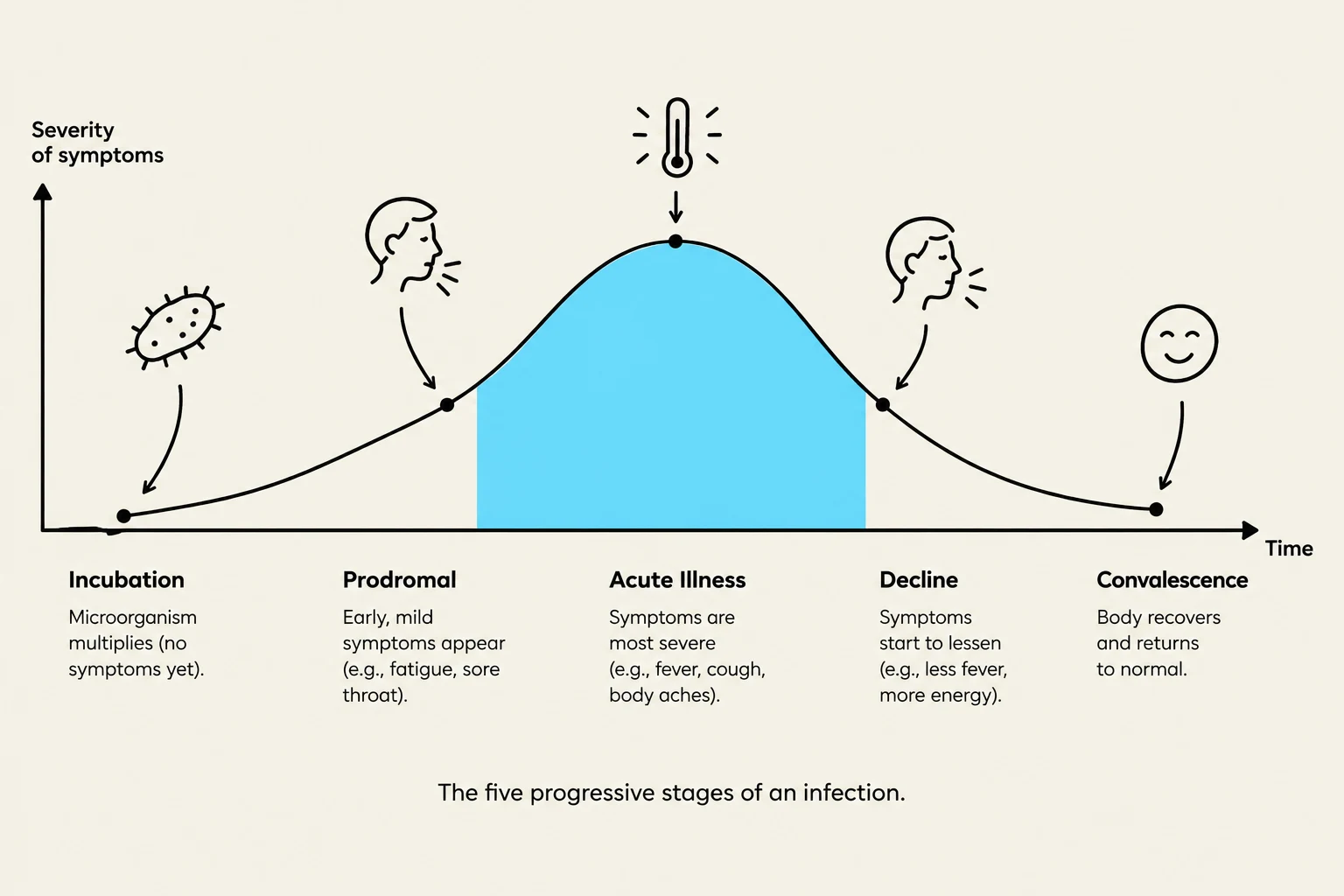
The five progressive stages of an infection: Incubation, Prodromal, Acute Illness, Decline, and Convalescence, illustrating the severity of symptoms over time.
An infection typically progresses through five distinct stages:
Incubation: The pathogen enters the host and begins to multiply.
Prodromal: The client begins to experience vague, non-specific symptoms.
Acute Illness: The specific manifestations of the disease become obvious and may become severe.
Decline: Symptoms begin to wane as the infectious disease decreases.
Convalescence: The client recovers and returns to a state of health.
Types of Infection
Localized: The infection is confined to a specific part of the body (e.g., a boil) and presents with local symptoms like redness, swelling, and warmth.
Systemic: The pathogen spreads through the bloodstream to infect the entire body, often causing symptoms like fever, headache, and muscle aches.
Infection Control Practices
In clinical settings, two main types of aseptic techniques are used:
Medical Asepsis (Clean Technique): Refers to practices used to eliminate or reduce the number of disease-causing microorganisms, such as hand hygiene and maintaining a clean environment.
Surgical Asepsis (Sterile Technique): Refers to the total absence of all microorganisms. This is used during invasive procedures like surgery or inserting tubes.
Standard Precautions are infection prevention practices applied to all clients, regardless of whether they are known to be infected. This includes hand hygiene and the use of Personal Protective Equipment (PPE) such as gloves, gowns, masks, and eye protection when exposure to body fluids is possible.
Keep reading for free.
Create an account to finish this reading and make it part of your study routine.