An overview of microbial fermentation as a catabolic pathway, contrasting it with aerobic and anaerobic respiration. It details the process of glycolysis, NAD+ regeneration, and common types like alcoholic and lactic acid fermentation, along with their commercial and clinical significance.
In the diverse world of microbial metabolism, organisms have evolved various strategies to extract energy from nutrients. While many organisms rely on complex respiratory chains to maximize energy yield, others utilize a more streamlined, albeit less efficient, process known as fermentation. Understanding fermentation is essential not only for biology students but also for clinicians and industrial microbiologists, as the metabolic byproducts of this process are used to identify pathogens and manufacture essential goods ranging from antibiotics to food products.
The Three Major Catabolic Pathways
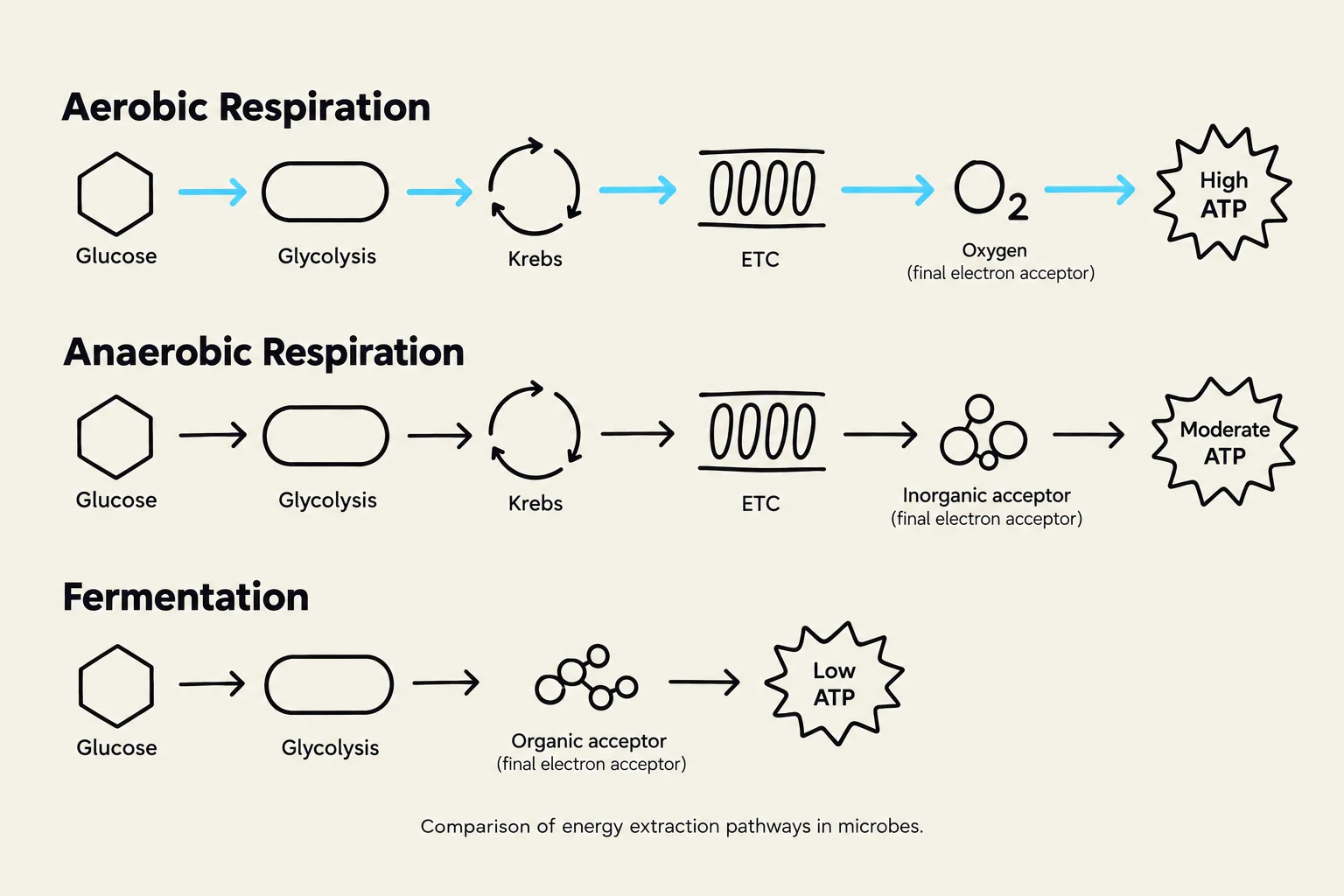
Comparison of energy extraction pathways in microbes, illustrating Aerobic Respiration, Anaerobic Respiration, and Fermentation, detailing their respective processes from glucose to ATP production.
To understand fermentation, one must first place it in the context of the three primary catabolic pathways used by microbes to extract energy from carbohydrates:
Aerobic Respiration: This is the most efficient method, utilizing oxygen (O2) as the final electron acceptor. It involves glycolysis, the Krebs cycle, and an electron transport chain (ETC), yielding a high amount of energy (approximately 36–38 ATP per glucose).
Anaerobic Respiration: This pathway also utilizes a Krebs cycle and an ETC, but it uses inorganic molecules other than oxygen (such as sulfate, nitrate, or carbonate) as the final electron acceptor. The ATP yield varies depending on the organism but is generally between 2–36 ATP.
Fermentation: Unlike the respiratory pathways, fermentation is characterized by the incomplete oxidation of glucose. It relies exclusively on glycolysis and does not utilize a Krebs cycle or an electron transport chain.
Feature
Aerobic Respiration
Anaerobic Respiration
Fermentation
Pathways Used
Glycolysis → Krebs → ETC
Glycolysis → Krebs → ETC
Glycolysis only
Final $e^-$ Acceptor
$O_2$
Inorganic non-O2
Organic molecule
Needs O2?
Yes
No
No
Max Net ATP
36–38
2–36
2
End Products
CO2+H2O
Varies (e.g., H2S)
Alcohols & acids
The Mechanism: Redox and NAD+ Regeneration
The core of fermentation lies in the principles of oxidation and reduction (often remembered by the mnemonic OIL RIG: Oxidation Is Loss, Reduction Is Gain).
During the process of glycolysis, a single molecule of glucose (6C) is broken down into two molecules of pyruvic acid (3C). This process results in a net maximum yield of only 2 ATP. However, glycolysis also requires a steady supply of NAD+ to function. As glucose is oxidized, NAD+ is reduced to NADH.
If a cell lacks an electron transport chain (or represses it due to a lack of oxygen), it faces a metabolic crisis: the pool of NAD+ will eventually be depleted as it all converts to NADH, causing glycolysis—and thus all ATP production—to stop.
Exam Tip: The primary biological purpose of fermentation is not to produce large amounts of ATP. Instead, the goal is to regenerate NAD+ from NADH so that glycolysis can continue to run and provide a small, steady supply of 2 ATP.
In fermentation, the cell solves this problem by using an organic molecule (such as pyruvic acid or a derivative) as the final electron acceptor. By transferring electrons from NADH to this organic molecule, the NADH is oxidized back into NAD+, allowing the cycle to repeat.
Common Types of Fermentation
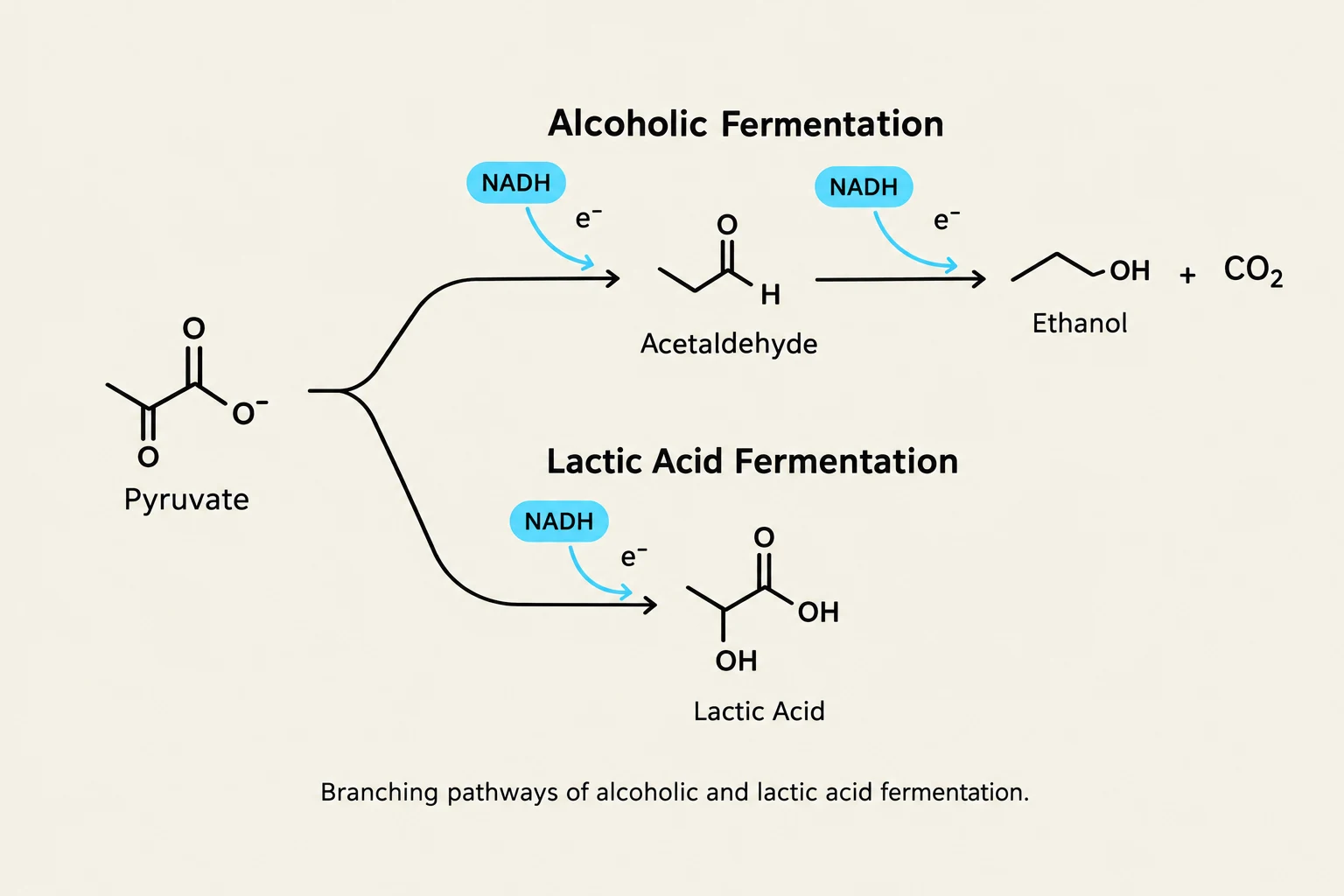
Branching pathways of alcoholic and lactic acid fermentation.
Depending on how the pyruvic acid is processed, different end products are released. Two of the most biologically and commercially significant types are:
1. Alcoholic Fermentation
In this pathway, pyruvic acid is first converted into an intermediate called acetaldehyde. This intermediate then accepts electrons from NADH, resulting in the production of ethanol and CO2.
Common Examples: This is the process used by yeast in bread making (where CO2 causes the dough to rise) and in the production of beer and wine.
2. Lactic Acid Fermentation
In lactic acid fermentation, pyruvic acid is converted directly into lactic acid without the acetaldehyde intermediate.
Common Examples: This process is responsible for the production of yogurt, cheese, and sauerkraut, and it is also the cause of sore muscles in humans during intense exercise.
Commercial and Clinical Importance
The diverse array of end products generated by different microbes makes fermentation a powerful tool in both industry and medicine.
Commercial Products:
Microbes are "farmed" to produce a variety of substances, including:
Alcohols and Acids: Ethanol, lactic acid, acetic acid, butanol, and propionic acid.
Solvents: Acetone.
High-Value Compounds: Vitamins, hormones, and antibiotics.
Clinical/Laboratory Importance:
In a diagnostic laboratory, identifying the specific fermentation end products of a bacterial sample is a vital method for identifying unknown microbial species. Because different bacteria produce different acids or alcohols, observing these chemical "fingerprints" allows scientists to categorize and identify pathogens accurately.
Summary Check
To ensure you have mastered the topic, verify your knowledge of these key points:
ATP Yield: Fermentation yields only 2 ATP per glucose.
Electron Acceptor: The final acceptor is an organic molecule.
Key Intermediate: Acetaldehyde is an intermediate in alcoholic fermentation.
Main Goal: To recycle NAD+.
Keep reading for free.
Create an account to finish this reading and make it part of your study routine.