Methods of Biological Inquiry: Logic, Reasoning, and the Scientific Process
An exploration of the classic scientific method, logical arguments, and the use of inductive, hypo-deductive, and abductive reasoning to explain observations. Covers observational studies, causation, scientific certainty, and effective science writing.
In the study of biology, we are often driven by a single, fundamental question: "Why is it like this?" To answer this, scientists do not simply guess; they employ structured methods to move from raw observations to meaningful conclusions. While many versions of the "scientific method" exist, they all share a common goal: to use empirical evidence to determine if a claim about the natural world is likely to be true.
The Classic Scientific Method
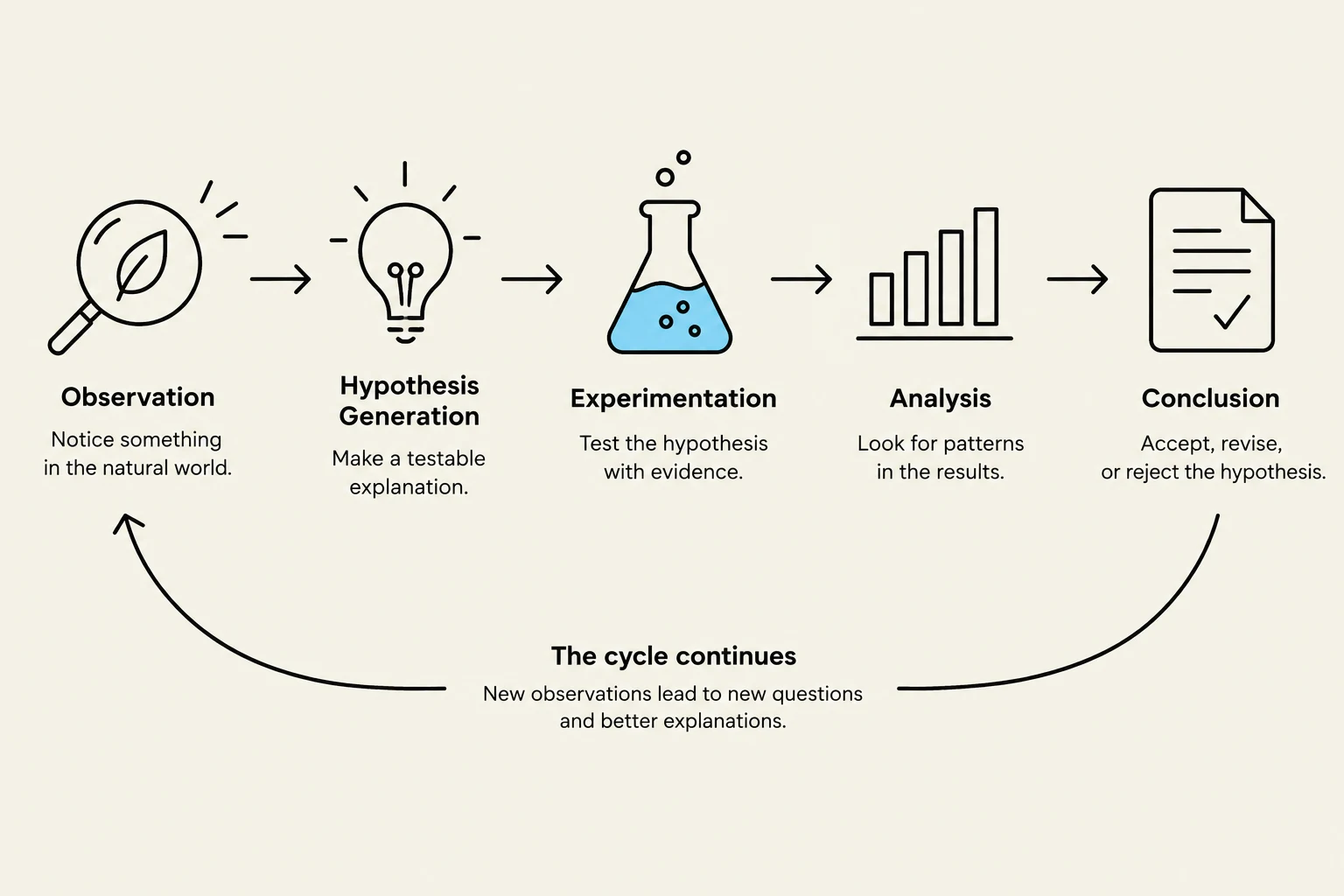
The "classic" version of the scientific method is favored because it is logical, explicit, and applicable across all branches of science. Rather than being a rigid set of rules, it is a cycle of inquiry that follows a specific progression:
Make Observations: Notice a pattern or a phenomenon in the natural world.
Hypothesize: Propose an explanation for the observation.
Deduce a Prediction: Determine what should happen in a specific test if your hypothesis is correct.
Collect Data: Perform an experiment or an observational study.
Compare and Conclude: Match your results against your predictions to see if the hypothesis is supported or not.
A well-designed test must be relevant to the hypothesis, use a clearly defined response variable, be controlled to isolate specific effects, and be replicated across multiple subjects.
The scientific method is a cyclical process involving observation, hypothesis generation, experimentation, analysis, and conclusion.
The Logic of Scientific Arguments
Science is not just about collecting data; it is about building arguments. A scientific argument uses reasoning to provide support for a conclusion. Every argument consists of two fundamental components:
Premises: The supporting reasons or evidence (often signaled by words like because, since, or due to the fact that).
Conclusions: The final claim being made (often signaled by words like therefore, thus, or consequently).
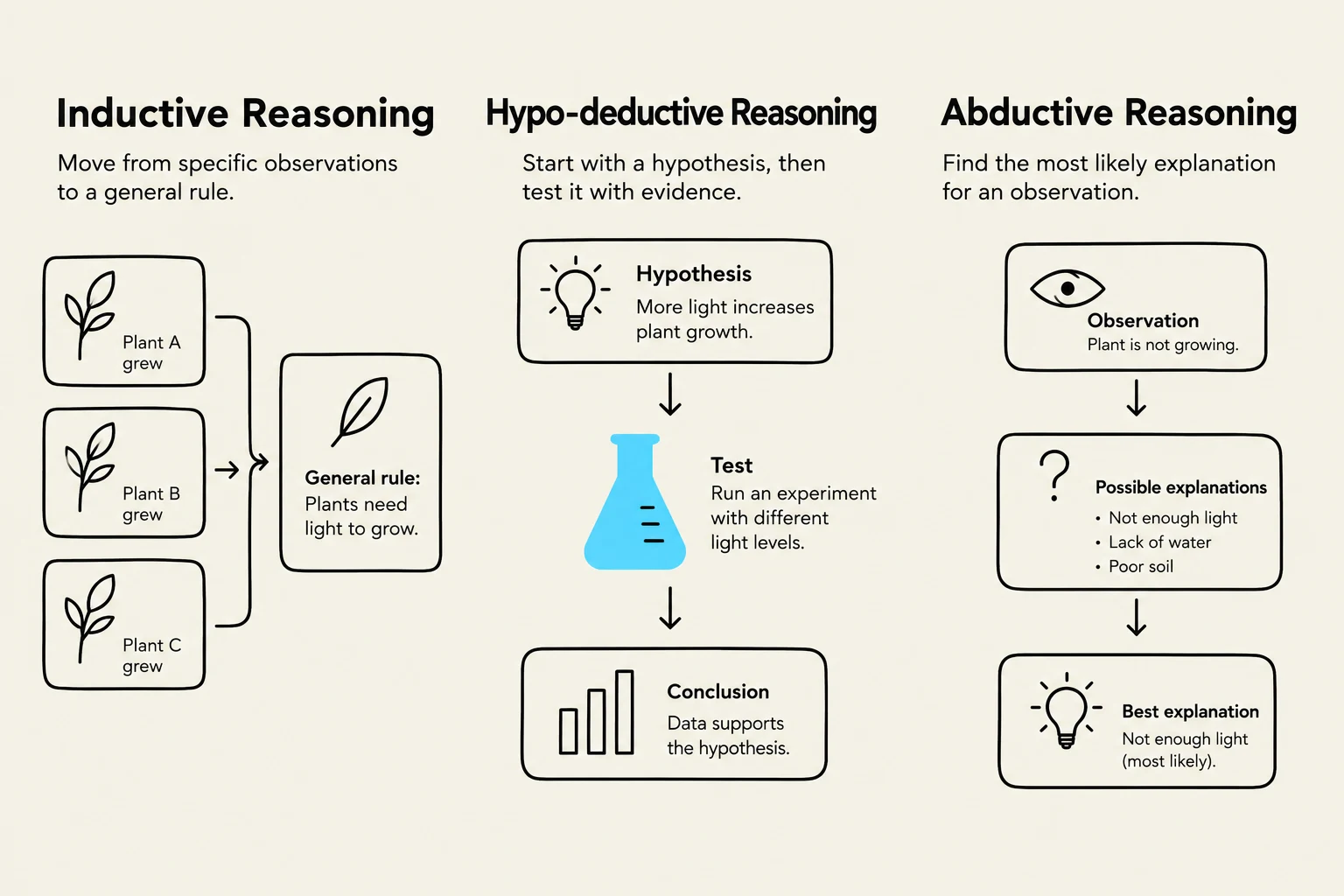
To understand how scientists reach these conclusions, we must distinguish between three primary types of reasoning: inductive, hypo-deductive, and abductive.
Inductive Reasoning
Inductive reasoning involves using observations of a specific pattern to produce a generalized rule. For example, if you observe that your dog is brown, and all other dogs on your street are also brown, you might induce that "all dogs are brown."
However, inductive reasoning is not truth-preserving. This means that even if all your premises are true, your conclusion might still be false because your sample might not be representative of the whole population. In science, induction is often used to create generalizations from samples, but it cannot provide absolute proof.
Hypo-deductive Reasoning
This is the engine of the classic scientific method. It starts with a hypothesis and uses it to produce a specific, testable prediction. Unlike induction, this process is truth-preserving in its logical structure: If the hypothesis is true, then a specific result must follow.
Exam Tip: Remember that hypo-deductive reasoning is used to generate predictions. If the prediction fails, the hypothesis is not supported.
Abductive Reasoning (Inference)
Abductive reasoning, often called inference, is the process of asking: "Given all the available evidence, what explanation is most likely to be correct?". Scientists use this when they compare their collected results against their initial predictions to judge the utility of a hypothesis. It does not claim absolute truth, but rather identifies the most plausible explanation among many possibilities.
This illustration explains and contrasts three types of reasoning: inductive, hypo-deductive, and abductive, using examples related to plant growth and scientific experimentation.
Observational Studies and Causation
Not all biological questions can be answered with controlled experiments. For instance, you cannot ethically force humans to smoke to see if they develop cancer, nor can you easily manipulate historical events like glaciation. In these cases, scientists use observational tests.
Observational studies collect data on existing conditions without active manipulation. While highly useful, they face the criticism that "correlation does not equal causation". Because researchers cannot control all variables, an observed relationship might be caused by an unmeasured "confounder".
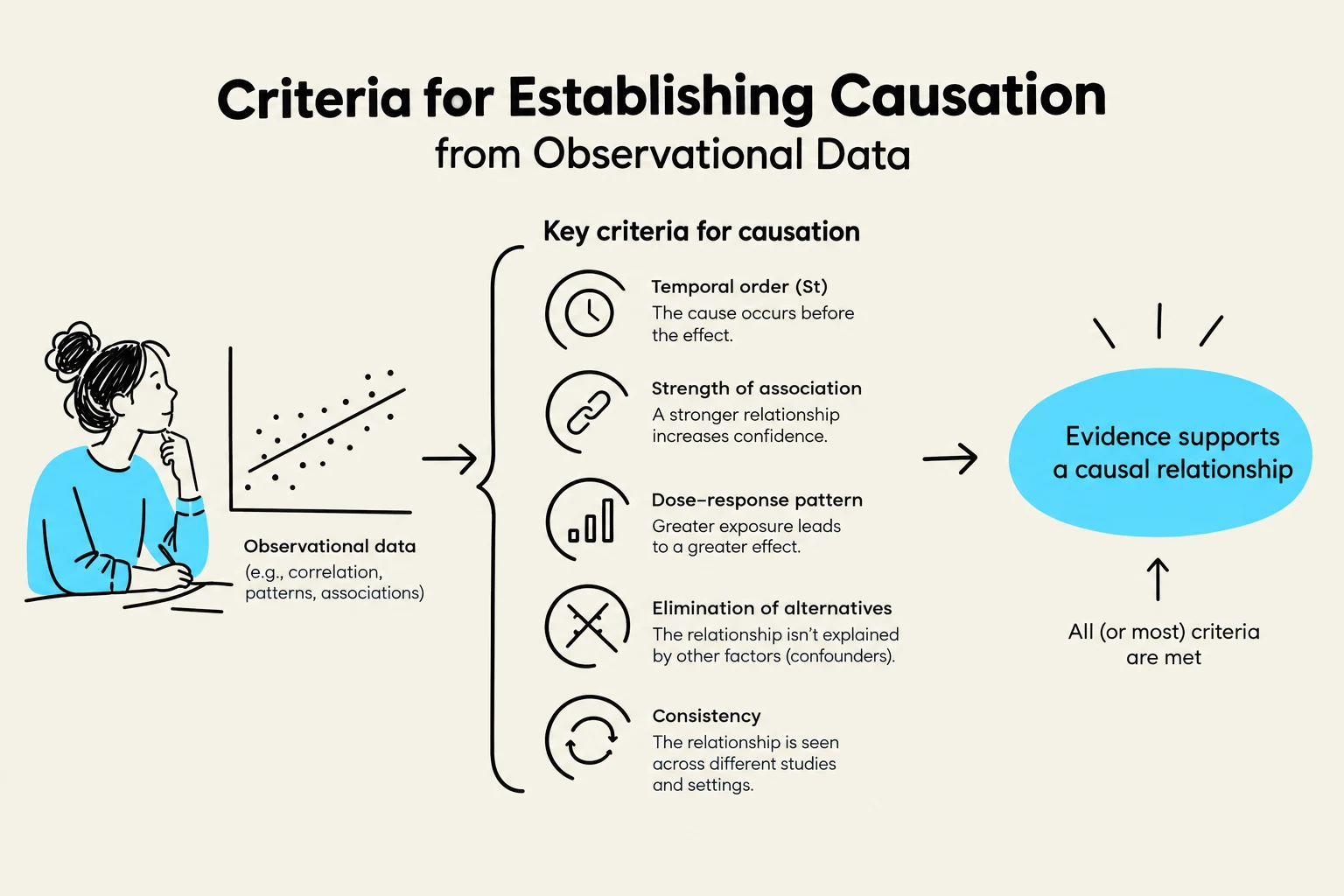
To move from an observed association toward a claim of causation, scientists look for several criteria (often referred to as Hill's criteria):
Theoretical Plausibility: Is there a known biological mechanism that explains the link?
Consistency: Have different studies in different places found the same thing?
Temporality: Did the cause actually happen before the effect?
Strength of Association: How large is the difference between the groups?
Dose-Response Relationship: Does increasing the "dose" of the cause increase the effect?
This diagram outlines the key criteria for establishing causation from observational data, including temporal order, strength of association, dose-response pattern, elimination of alternatives, and consistency.
Scientific Certainty and Communication
A crucial realization in biology is that nothing is known with absolute certainty. Our understanding of the world is limited by our senses and our tools. Therefore, scientists avoid words like "proven" or "fact" unless they are heavily qualified. Instead, we speak in terms of varying degrees of certainty—from "definitely true" to "perhaps false".
Finally, the way we communicate these findings is vital. Effective science writing requires clarity:
Voice: Both active and passive voice are acceptable; choose the one that best fits the context.
Person: First-person ("I" or "we") and third-person are both usable depending on the situation.
Structure: Avoid separating subjects from their verbs with long, interruptive phrases, as this makes the text harder to read.
Referencing: Proper referencing serves two purposes: it prevents plagiarism and it places your work within the context of previous studies, providing strength to your scientific argument.
Summary Note: Science is a process of refining our understanding. As we get better data, our "certainty" shifts, but the logical framework of inquiry remains the same.
Keep reading for free.
Create an account to finish this reading and make it part of your study routine.