This guide explains the principles and methods used to control microbial growth, including terminology, physical and chemical control agents, and their mechanisms of action. It covers sterilization, disinfection, antisepsis, and factors influencing the choice of control methods.
In microbiology, controlling the growth of microorganisms is essential for preventing disease, ensuring food safety, and maintaining sterile environments in medical settings. Because different microbes possess varying levels of resistance, we use a range of methods—from simple hand washing to high-pressure steam—to manage their presence. Understanding these methods requires a clear grasp of specific terminology and the biological mechanisms by which we disrupt microbial life.
Terminology of Control: Static vs. Cidal
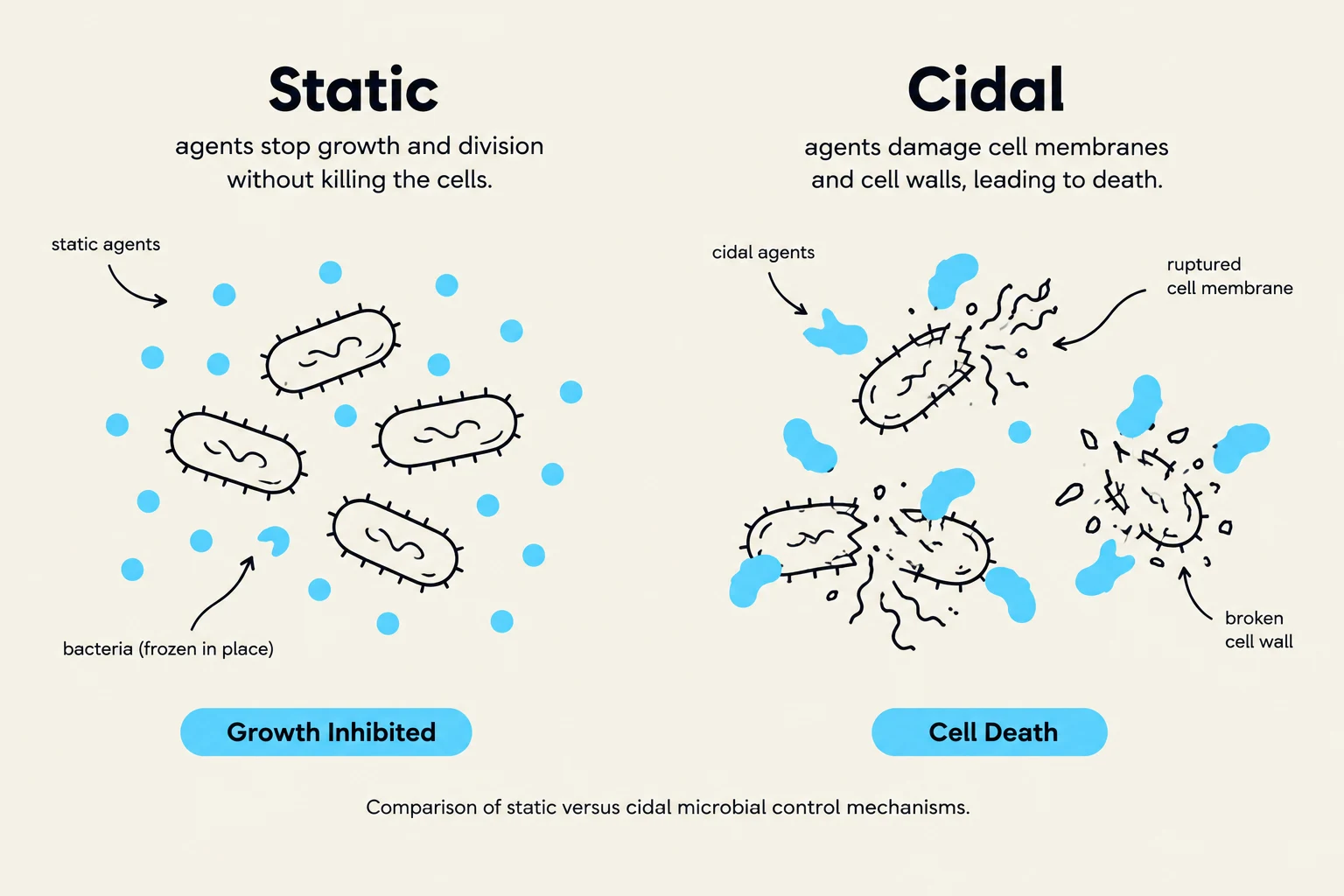
Comparison of static versus cidal microbial control mechanisms.
When discussing antimicrobial agents, it is vital to distinguish between whether an agent merely stops a microbe from growing or actually kills it.
Static Agents: These agents inhibit or stop microbial growth and reproduction without necessarily killing the organism.
Bacteriostatic: Stops bacteria from growing or reproducing.
Fungistatic: Inhibits fungal growth.
Cidal Agents: These agents actively kill the microorganisms.
Exam Tip: Use the memory trick: Static = STOP and Cidal = KILL.
Levels of Microbial Control
Microbial control is categorized by its intensity and the target of application. The choice of method depends on whether the surface is living or nonliving, the nature of the material, and the susceptibility of the microbes involved.
Sterilization and Disinfection
Sterilization is the most extreme form of control, destroying or removing all microorganisms, including viruses and highly resistant bacterial endospores. In contrast, disinfection reduces the number of harmful microbes on nonliving objects but may not eliminate endospores.
Disinfectants are often classified by their effectiveness:
High-level: Destroys nearly all microorganisms and may destroy endospores.
Intermediate-level: Kills many bacteria, fungi, and viruses, but not reliably endospores.
Low-level: Kills most vegetative bacteria and enveloped viruses.
Antisepsis, Degerming, and Sanitization
For living tissue, we use antisepsis, which involves reducing or killing microbes on the skin (e.g., an antiseptic before an injection). This is distinct from a disinfectant, which is used on nonliving surfaces like countertops.
Degerming refers to the physical removal of microbes, such as through hand washing. Sanitization is the process of reducing microbial levels to a point considered safe by public health standards. Finally, pasteurization uses controlled heat to reduce microbes in liquids (like milk or juice) without significantly damaging the product, though it does not necessarily achieve sterilization. An environment that is aseptic is one that is free from contamination by disease-causing microorganisms.
How Antimicrobial Agents Work
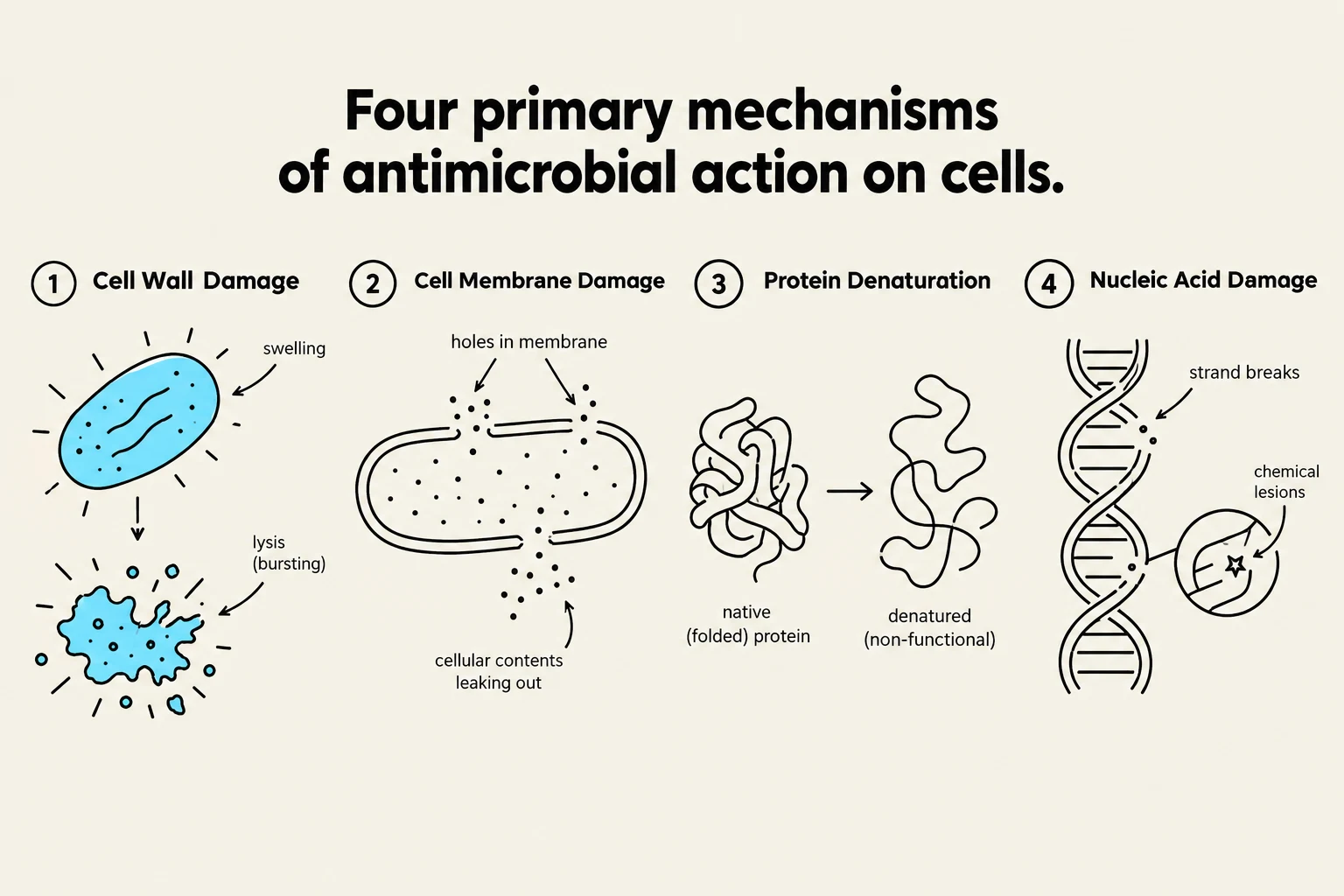
This diagram illustrates four primary mechanisms by which antimicrobial agents can harm cells: damage to the cell wall, damage to the cell membrane, denaturation of proteins, and damage to nucleic acids.
Antimicrobial agents (or germicides) function by targeting and damaging essential cellular components. There are four primary mechanisms of action:
Cell Wall Damage: The cell wall protects bacteria from osmotic pressure. When the wall is weakened, water enters the cell and causes it to burst, a process known as lysis.
Cell Membrane Damage: The membrane controls the movement of substances in and out of the cell. Damage causes essential cellular contents to leak out.
Protein Denaturation: Proteins are vital for metabolism and structure. Heat and chemicals can cause proteins to unfold and lose their functional 3D shape, a process called denaturation.
Nucleic Acid Damage: Heat, radiation, and chemicals can damage DNA and RNA, which interferes with genetic information and protein synthesis.
Physical Methods of Control
Physical methods utilize environmental factors like temperature, moisture, and radiation to control microbes.
Heat
Heat is highly effective because it denatures proteins and damages membranes.
Moist Heat: Generally more efficient than dry heat because it transfers heat better and denatures proteins more effectively.
Boiling: Kills many vegetative cells and viruses but is not a dependable sterilization method because it does not reliably destroy endospores.
Autoclaving: Uses pressurized steam to achieve sterilization. Standard conditions are 121°C, 15 psi, for 15 minutes.
Dry Heat: Used when moist heat would damage the material. It requires higher temperatures or longer exposure and works through oxidation.
Cold, Drying, and Filtration
Refrigeration: Slows microbial metabolism and reproduction but usually does not kill them.
Desiccation: The process of drying, which removes water and inhibits growth.
Lyophilization: Also known as freeze-drying, this is used for the long-term preservation of microbial cultures.
Filtration: Physically removes microbes from liquids or gases by passing them through pores too small for the organisms to enter.
Osmotic Pressure and Radiation
Osmotic pressure can inhibit growth by manipulating water movement. In a hypertonic solution, water leaves the cell and the cell shrinks; in a hypotonic solution, water enters the cell and it may burst.
Radiation is divided into two types:
Ionizing Radiation (e.g., Gamma rays, X-rays): High-energy radiation that creates ions and free radicals, causing extensive DNA and protein damage.
Non-Ionizing Radiation (e.g., UV light): Lower energy with poor penetration. It damages DNA by forming thymine dimers, where neighboring thymine bases bond abnormally, distorting the DNA.
Chemical Methods of Control
Chemical agents are categorized by their specific mechanism of action:
Chemical Category
Main Action
Key Fact
Phenols
Damage proteins and membranes
Used for surface disinfection
Alcohols
Denature proteins and damage membranes
Not effective against endospores
Halogens
Oxidation
Includes Chlorine and Iodine
Oxidizing Agents
Oxidation
Includes Hydrogen peroxide and Peracetic acid
Surfactants
Mechanical removal or membrane damage
Soaps (removal) and Quats (membrane damage)
Heavy Metals
Interfere with proteins and enzymes
Silver and Copper
Enzymes
Specific molecular breakdown
Lysozyme breaks down peptidoglycan
Notable Chemical Details
Alcohols: Typically used at 60–90% concentrations; water is actually necessary to help the alcohol denature proteins.
Halogens: Iodine is often used in iodophors, which are preparations that release iodine gradually to reduce irritation.
Oxidizing Agents: Hydrogen peroxide (H2O2) produces oxygen bubbles when broken down by the enzyme catalase:
2H2O2→2H2O+O2
Surfactants: Soaps contain hydrophilic (water-loving) and hydrophobic (water-fearing) ends. The hydrophobic end associates with oils and dirt, allowing the hydrophilic end to be rinsed away by water.
Lysozyme: A natural enzyme found in tears and saliva that breaks down the peptidoglycan in bacterial cell walls.
Summary Note: When choosing a control method, always consider the nature of the site (living vs. nonliving), the susceptibility of the microbes (prions and endospores are the hardest to kill), and the environmental conditions like temperature and pH.
Keep reading for free.
Create an account to finish this reading and make it part of your study routine.