An overview of metabolic pathways, including catabolic and anabolic processes, cellular respiration, glycolysis, and the citric acid cycle, explaining how cells generate energy (ATP) and synthesize essential molecules.
Every living cell is a bustling chemical factory. To stay alive, grow, and reproduce, cells must constantly manage their energy resources. This management is achieved through metabolic pathways—series of chemical reactions that transform organic molecules into usable energy and structural building blocks. These pathways are generally categorized into two types: catabolic pathways, which break down complex molecules to release energy, and anabolic pathways, which use energy to build complex molecules.
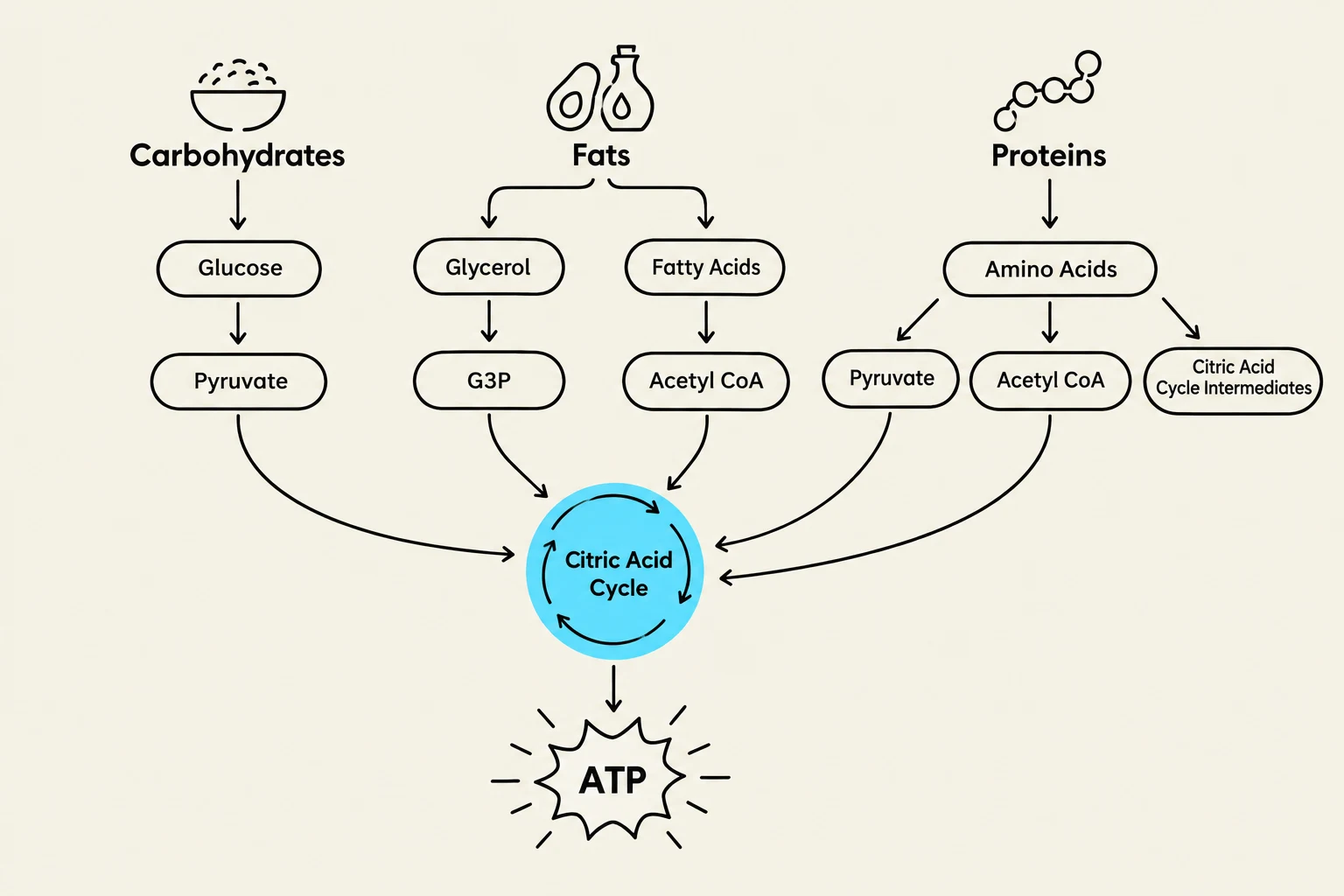
This diagram illustrates the metabolic pathways of carbohydrates, fats, and proteins, showing how they converge to the Citric Acid Cycle and ultimately produce ATP.
The Fuel of Life: Cellular Respiration
Cells do not just rely on one type of fuel. While glucose (a carbohydrate) is the most common model used in biology, cells can also utilize fats and proteins to power their functions.
As shown in the diagram below, different fuel molecules enter the metabolic network at various stages:
Pathways that break down various fuel molecules
Carbohydrates are typically broken down into glucose, which then proceeds through glycolysis to become pyruvate.
Fats are broken down into glycerol (which enters as G3P) and fatty acids (which enter as Acetyl CoA).
Proteins are broken down into amino acids, which can enter the pathway at several points, including as pyruvate, Acetyl CoA, or even as intermediates of the citric acid cycle.
The ultimate goal of these catabolic processes is cellular respiration, a multi-stage process that extracts chemical energy from these fuels to produce ATP (adenosine triphosphate), the cell's primary energy currency.
Glycolysis: The Ancient Foundation
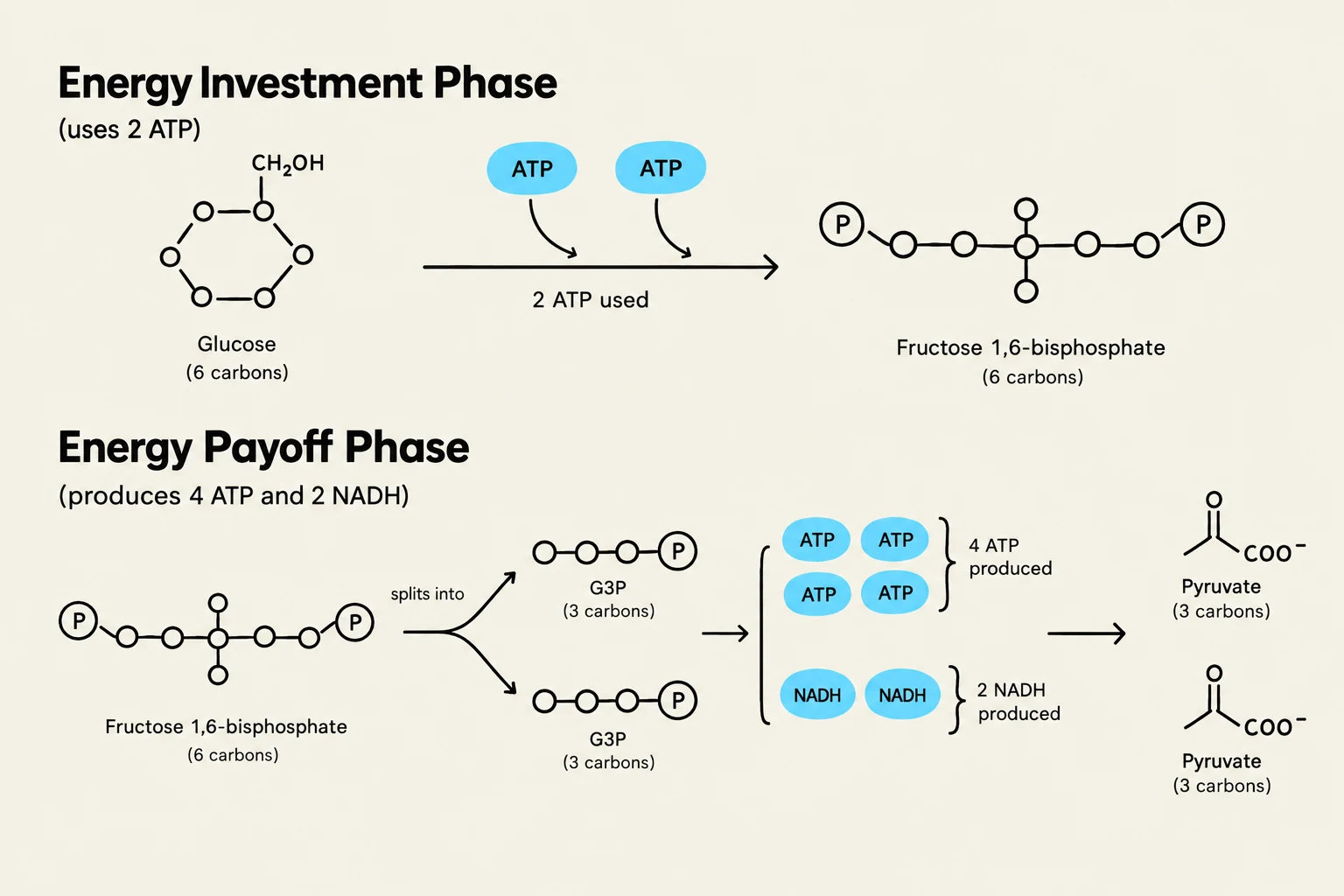
This diagram illustrates the two phases of glycolysis: the energy investment phase, where 2 ATP are used to convert glucose into fructose 1,6-bisphosphate, and the energy payoff phase, where fructose 1,6-bisphosphate is broken down into pyruvate, producing 4 ATP and 2 NADH.
Glycolysis is a fundamental metabolic pathway that occurs in the cytosol of almost all living cells. Because it does not require oxygen, scientists believe glycolysis is one of the most ancient metabolic pathways, likely evolving in a primitive, oxygen-free atmosphere and being passed down from a common ancestor to nearly all life forms.
Glycolysis consists of ten enzyme-catalyzed reactions that oxidize one molecule of the six-carbon sugar glucose into two molecules of the three-carbon compound pyruvate. This process is divided into two distinct phases:
1. The Energy Investment Phase
In this initial stage, the cell actually "spends" energy to prepare the glucose molecule for breakdown.
Step 1: The enzyme hexokinase uses one molecule of ATP to phosphorylate glucose, forming glucose 6-phosphate.
Step 2: Glucose 6-phosphate is rearranged into fructose 6-phosphate.
Step 3: The enzyme phosphofructokinase uses a second ATP to phosphorylate the molecule, producing fructose 1,6-bisphosphate.
Step 4: The six-carbon sugar is split into two three-carbon molecules: glyceraldehyde 3-phosphate (G3P) and dihydroxyacetone phosphate (DHAP). The DHAP is rapidly converted into a second G3P, meaning the process now proceeds with two G3P molecules per original glucose.
2. The Energy Payoff Phase
In the second phase, the cell recovers its initial investment and generates a net profit of energy.
Step 6: Each G3P molecule is oxidized, which reduces the electron carrier NAD+ to NADH.
Steps 7–10: Through a series of transformations, the two G3P molecules are converted into two pyruvate molecules. During these steps, four molecules of ATP are generated via substrate-level phosphorylation.
Net Yield of Glycolysis:1 Glucose→2 Pyruvate+2 ATP (net)+2 NADH
Exam Tip: Remember that while glycolysis produces ATP, it is relatively inefficient compared to the later stages of respiration. The majority of a cell's ATP is produced later during oxidative phosphorylation.
From Pyruvate to ATP: The Full Respiratory Pathway
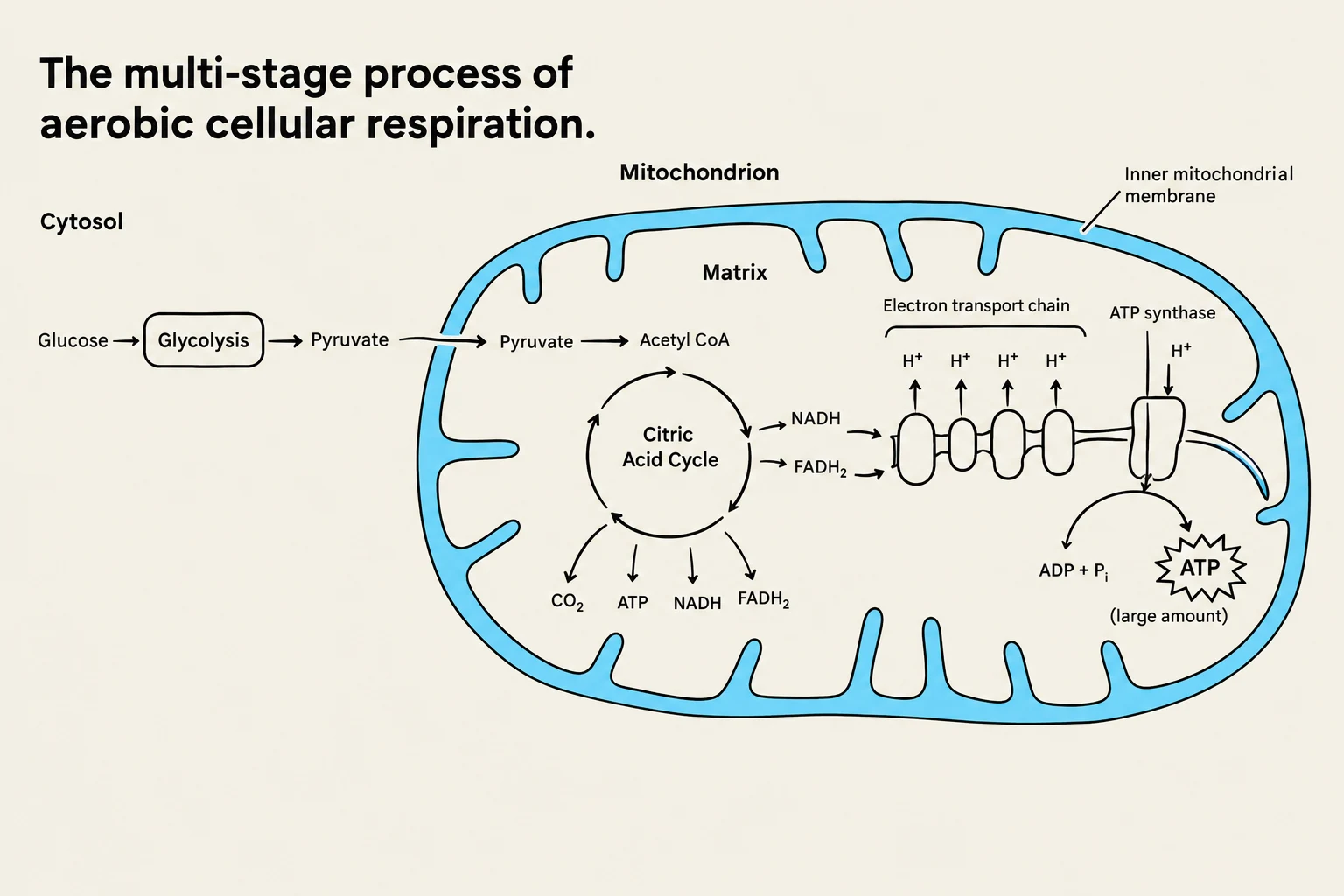
Diagram illustrating the multi-stage process of aerobic cellular respiration within a mitochondrion, including glycolysis, the citric acid cycle, and the electron transport chain, leading to ATP production.
Once glycolysis is complete, the fate of the pyruvate depends on the availability of oxygen. In aerobic organisms, pyruvate moves into the mitochondrion to undergo further oxidation.
The complete process of aerobic cellular respiration follows these stages:
Glycolysis: Occurs in the cytosol.
Pyruvate Oxidation: Pyruvate enters the mitochondrial matrix and is converted into Acetyl CoA, releasing CO2 and producing NADH.
Citric Acid Cycle (Krebs Cycle): Acetyl CoA enters this cycle in the mitochondrial matrix, producing CO2, ATP, NADH, and FADH2.
Oxidative Phosphorylation: This final stage occurs in the inner mitochondrial membrane. NADH and FADH2 deliver electrons to an electron transport chain. The energy from these electrons is used to pump protons ($H^+$) across the membrane, creating a gradient. As protons flow back through the protein ATP synthase, a massive amount of ATP is produced.
The stages of cellular respiration
If oxygen is absent, cells may rely on fermentation to regenerate NAD+ so that glycolysis can continue to produce at least a small amount of ATP. This includes lactic acid fermentation (common in muscle cells) and alcohol fermentation (common in yeast).
Metabolism as a Biosynthetic Network
Metabolism is not just about breaking things down (catabolism); it is also about building things up (anabolism). The intermediates produced during the breakdown of glucose are often diverted to serve as raw materials for biosynthesis.
The cell functions as an integrated network where the products of one pathway become the building blocks for another:
Biosynthesis of organic molecules from intermediates of cellular respiration
Proteins: Pyruvate and intermediates from the citric acid cycle (such as α-ketoglutarate and oxaloacetate) are used to synthesize amino acids.
Lipids:Acetyl CoA serves as a precursor for fatty acids, which are used to build lipids for cell membranes.
Carbohydrates & Nucleic Acids: Intermediates are used to construct sugars (like cellulose) and nucleotides, which are the essential components of DNA and RNA.
By balancing these catabolic and anabolic pathways, the cell ensures it has both the energy required to function and the structural components required to grow and maintain itself.
Keep reading for free.
Create an account to finish this reading and make it part of your study routine.