An overview of mental health and mental illness, including definitions, diagnostic systems like DSM-5 and ICD-11, and various theoretical perspectives used in psychology.
Understanding mental health requires moving beyond the simple idea of "being happy" or "not being crazy." It involves a complex interplay of biological processes, psychological patterns, and social environments. This article explores how we define mental well-being, how we categorize mental illness, and the various theoretical lenses used to understand the human mind.
Defining Mental Health and Well-being
Mental health is not merely the absence of mental illness; it is a proactive state of being. The World Health Organization (2022) defines it as a state of mental well-being that enables individuals to cope with life's stresses, realize their potential, learn well, work well, and contribute to their communities.
Similarly, the Surgeon General's Report (2000) describes it as the successful performance of mental functions. This includes the ability to maintain fulfilling relationships, adapt to change, and cope with adversity. Essentially, mental health serves as the fundamental springboard for emotional growth, resilience, and self-esteem throughout a person's life.
Illustration depicting emotional states, with a cloud and lightning symbolizing distress and a smiley face representing happiness.
A stylized illustration of a family unit, with two adults and one child, each with a heart symbol on their chest, representing love and unity.
Understanding Mental Illness and Disorders
While mental health refers to well-being, mental illness (MI) refers to a collective group of mental disorders. These are health conditions characterized by alterations in thinking, mood, or behavior (or a combination of these) that are associated with distress and/or impaired functioning.
Key Distinctions
Mental Disorders (or Psychiatric Disorders): These are syndromes involving clinically significant disturbances in cognition, emotion regulation, or behavior that reflect a dysfunction in psychological, biological, or developmental processes.
Serious Mental Illness (SMI): This is a smaller, more severe subset of mental illnesses that substantially interferes with or limits major life activities. SMI often involves psychosis.
Exam Tip: Remember that "mental illness" is the umbrella term, while "mental disorder" is the specific clinical description of the dysfunction.
Prevalence and Statistics
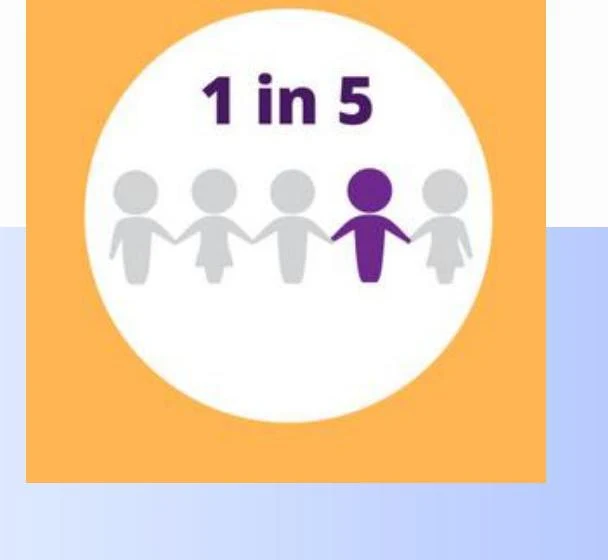
Mental health challenges are widespread. In Canada, approximately 1 in 5 people experience mental illness or addiction in any given year. Furthermore, by the age of 40, it is estimated that 1 in 2 people will have experienced a mental illness.
One in five people are represented by a purple figure, while the rest are gray.
Diagnosis and Classification Systems
Because there are currently no definitive biological tests (like a blood test) to diagnose most mental health conditions, clinicians rely on psychiatric interviews, observation, and interpretation. A primary tool used during these assessments is the Mental Status Exam (MSE), which provides objective, descriptive information about a patient's dynamic state, including:
Psychomotor behavior
Mood and affect
Level of consciousness
Thought patterns and cognition
Psychiatric Taxonomy
To organize these conditions, clinicians use classification systems, also known as psychiatric taxonomy. These systems categorize disorders based on sets of symptoms rather than their underlying cause (pathogenesis).
System
Publisher
Primary Use
ICD-11
World Health Organization (WHO)
Global standard for mortality/morbidity; used for international reporting and resource allocation
DSM-5
American Psychiatric Association (APA)
Extensively used in the USA and Canada by clinicians, researchers, and legal systems
The ICD-11
The International Classification of Diseases (ICD) is a global health information standard. It is used to monitor disease rates, manage healthcare, and allocate resources—in fact, roughly 70% of the world's health expenditures are allocated using ICD codes.
The DSM-5
The Diagnostic and Statistical Manual of Mental Disorders (DSM-5) provides specific diagnostic criteria for each disorder. It organizes disorders into 20 categories, including Neurodevelopmental Disorders, Schizophrenia Spectrum, Bipolar Disorders, Depressive Disorders, and Anxiety Disorders.
Critical Perspective: Classification is controversial. Critics argue that it relies too heavily on subjective observation, that mental health should be viewed as a continuous dimension rather than distinct categories, and that some illnesses are social constructs. For example, homosexuality was once classified as a disorder but was removed as societal values evolved.
Theoretical Perspectives on Mental Illness
Psychologists use different "lenses" to explain why mental illness occurs and how it should be treated.
Biological Perspective: Focuses on physical causes such as genetics, neurotransmitter imbalances (excesses or deficiencies), hormones, and infections.
Psychodynamic Perspective: Rooted in the work of Freud, this view emphasizes unconscious conflicts and unresolved childhood issues that interfere with the balance of the id, ego, and superego.
Humanistic Perspective: Focuses on the individual's drive toward self-actualization. Mental illness is seen as a result of environmental factors blocking this drive or a lack of congruence between one's "actual self" and "ideal self".
Existential Perspective: Views mental disturbances as a failure to act authentically—that is, failing to live in accordance with one's own goals and values.
Sociocultural Perspective: Examines how social, economic, and cultural factors impact health. For instance, poverty, unemployment, and rapid social change are linked to increased risks of mental illness.
Cognitive Perspective: Focuses on how a person's thoughts—how they reason, perceive, and solve problems—impact their feelings and behavior.
Behavioural Perspective: Views behavior as a learned response to environmental stimuli. This includes Operant Conditioning (learning through rewards and punishments) and Classical Conditioning (learning through association). It also includes the concept of Learned Helplessness, where a person stops trying to escape aversive stimuli after repeated failed attempts.
Keep reading for free.
Create an account to finish this reading and make it part of your study routine.