


In the study of biology, understanding how life reproduces is fundamental. While some organisms reproduce by making exact copies of themselves, sexual reproduction introduces a level of complexity that ensures no two individuals (except identical twins) are exactly alike. This diversity is driven by a specialized form of cell division known as meiosis. By shuffling genetic material and reducing the number of chromosomes, meiosis creates the biological variety that allows populations to adapt and evolve.
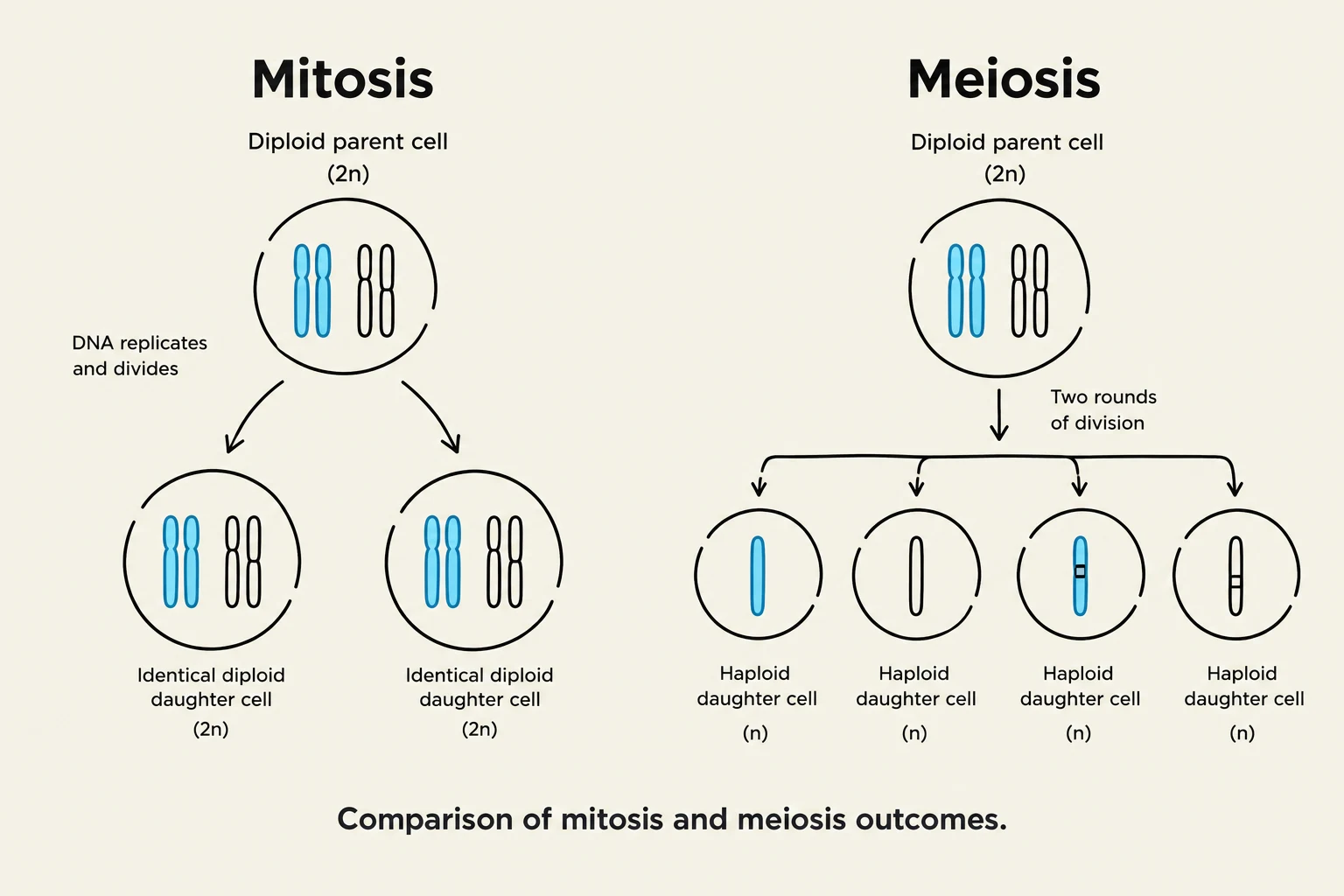
Mitosis vs. Meiosis: Understanding the Difference
To understand meiosis, it is helpful to first contrast it with mitosis. Mitosis is the process of cell division used for growth, tissue repair, and asexual reproduction. It results in two daughter cells that are genetically identical to the parent cell, maintaining the same diploid ($2n$) number of chromosomes.
Meiosis, however, serves a completely different purpose: sexual reproduction. Instead of making clones, meiosis produces four genetically unique haploid () cells, known as gametes (such as sperm or egg cells). When two haploid gametes fuse during fertilization, they form a zygote, restoring the diploid number and starting the life of a new organism.
Key Concept: Ploidy
- Diploid ($2n$): A cell containing two complete sets of chromosomes, one from each parent.
- Haploid (): A cell containing only one set of chromosomes.
The Mechanics of Meiosis
Meiosis consists of two successive nuclear divisions: Meiosis I and Meiosis II. Before either division begins, the cell undergoes interphase, where DNA is replicated, creating sister chromatids—identical copies of a chromosome joined at a centromere.
Keep reading for free.
Create an account to finish this reading and make it part of your study routine.
Continue reading freeAlready have an account? Log in
Updated