Media Contract Law and Digital Censorship in Canada
An overview of contract law principles as they apply to media creators and users in the digital age, examining the regulatory landscape in Canada and comparing it with international models like Germany's approach to digital censorship and freedom of expression.
In the modern digital era, the act of clicking "I Agree" is far more than a mere formality; it is the execution of a legally binding contract. For media creators, journalists, and everyday social media users, the intersection of contract law and digital regulation creates a complex landscape where private platform rules often clash with fundamental concepts of expression. Understanding how these agreements are formed, how they are regulated by different levels of government, and how they impact our ability to communicate is essential for navigating the contemporary media environment.
Foundations of Media Contract Law
At its core, contract law governs how legally binding agreements between two or more parties are created, interpreted, and implemented. For media professionals, this might involve employment contracts for journalists, non-disclosure agreements (NDAs), or intellectual property assignment clauses.
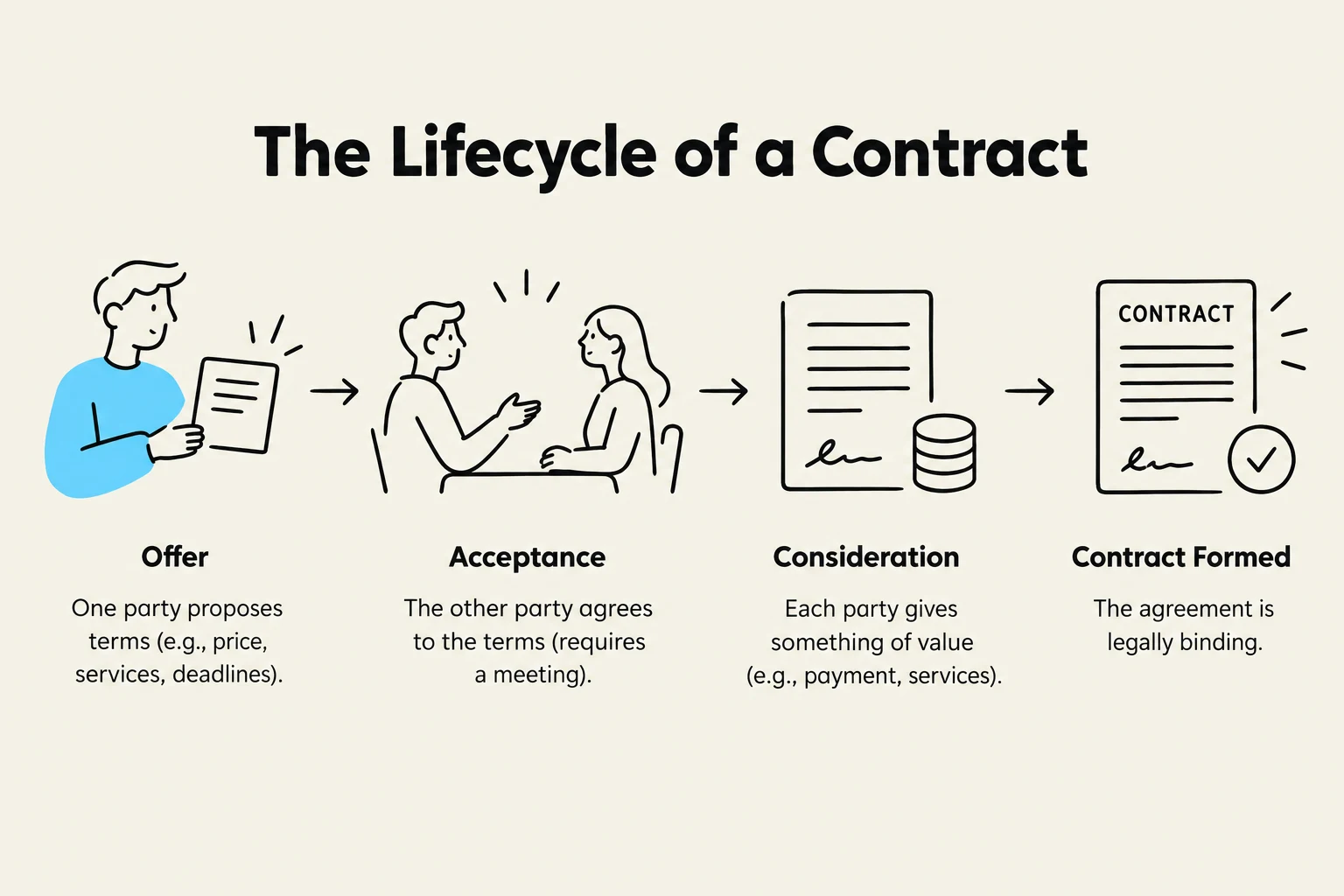
To be legally enforceable, a contract requires four essential elements:
Offer: A clear proposal of terms.
Acceptance: An unconditional agreement to those terms.
Consideration: An exchange of value (which can be money or services).
Capacity and Legality: The parties must be of sound mind, legal age, and the subject must be legal.
It is important to distinguish an "offer" from an "invitation to treat." An invitation to treat is merely an expression of willingness to negotiate, such as a price tag on a retail shelf.
Exam Tip: Pay close attention to the distinction between an offer and an invitation to treat. Remember the case of Pharmaceutical Society v. Boots Cash Chemists, which established that a customer makes the offer at the cash register, not the shopkeeper via the shelf price.
A foundational case in understanding when an offer can be withdrawn is Dickinson v Dodds (1867). In this case, the court established the Dickinson v Dodds ratio: an offeror can withdraw an offer at any point before the offeree has accepted it, provided there is no consideration to keep the offer open. Without a "meeting of the minds" or an option agreement (where the offeree pays to keep the offer open), the offeror remains free to revoke.
This diagram illustrates the four stages of a contract lifecycle: Offer, Acceptance, Consideration, and Contract Formed.
The Regulatory Landscape: Provincial vs. Federal
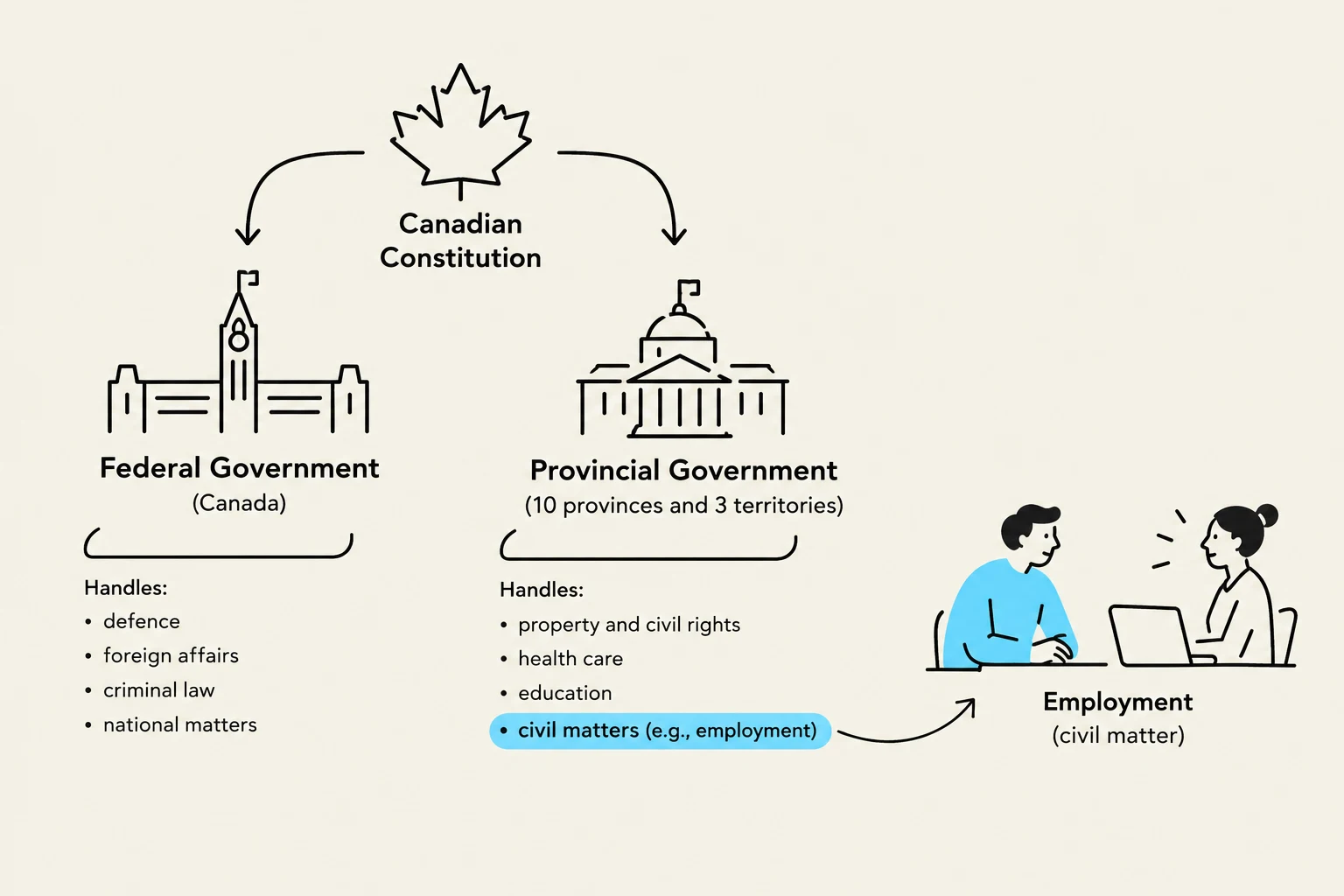
In Canada, the regulation of media is divided between provincial and federal jurisdictions.
Provincial Jurisdiction: Generally governs "Property and Civil Rights." This includes most media-related contracts, such as a journalist's employment contract, licensing agreements for music, or NDAs. If a user suffers harm to their reputation via a platform, they would typically seek remedies like defamation through the provincial court system.
Federal Jurisdiction: Governs matters like banking, trade, and the regulation of the media industry as a whole. Key federal bodies and acts include:
CRTC: Regulates TV, radio, and digital media.
Online News Act: Requires tech giants to enter into fair compensation contracts with Canadian news outlets.
Online Streaming Act: Subjects streaming platforms to federal requirements.
Personal Information Protection and Electronic Documents Act (PIPEDA): Governs privacy rights and how data is collected and sold.
This diagram illustrates the division of powers between the Federal Government and Provincial Governments in Canada, as outlined by the Canadian Constitution. It also shows how employment falls under civil matters handled by provincial governments.
Digital Censorship and the Contractual Trap
While the government regulates the "boundaries" of what is legal, the day-to-day management of content is governed by content moderation dictated by a platform's Terms and Conditions. This has led to the rise of "private digital censorship," where platforms act as cultural gatekeepers.
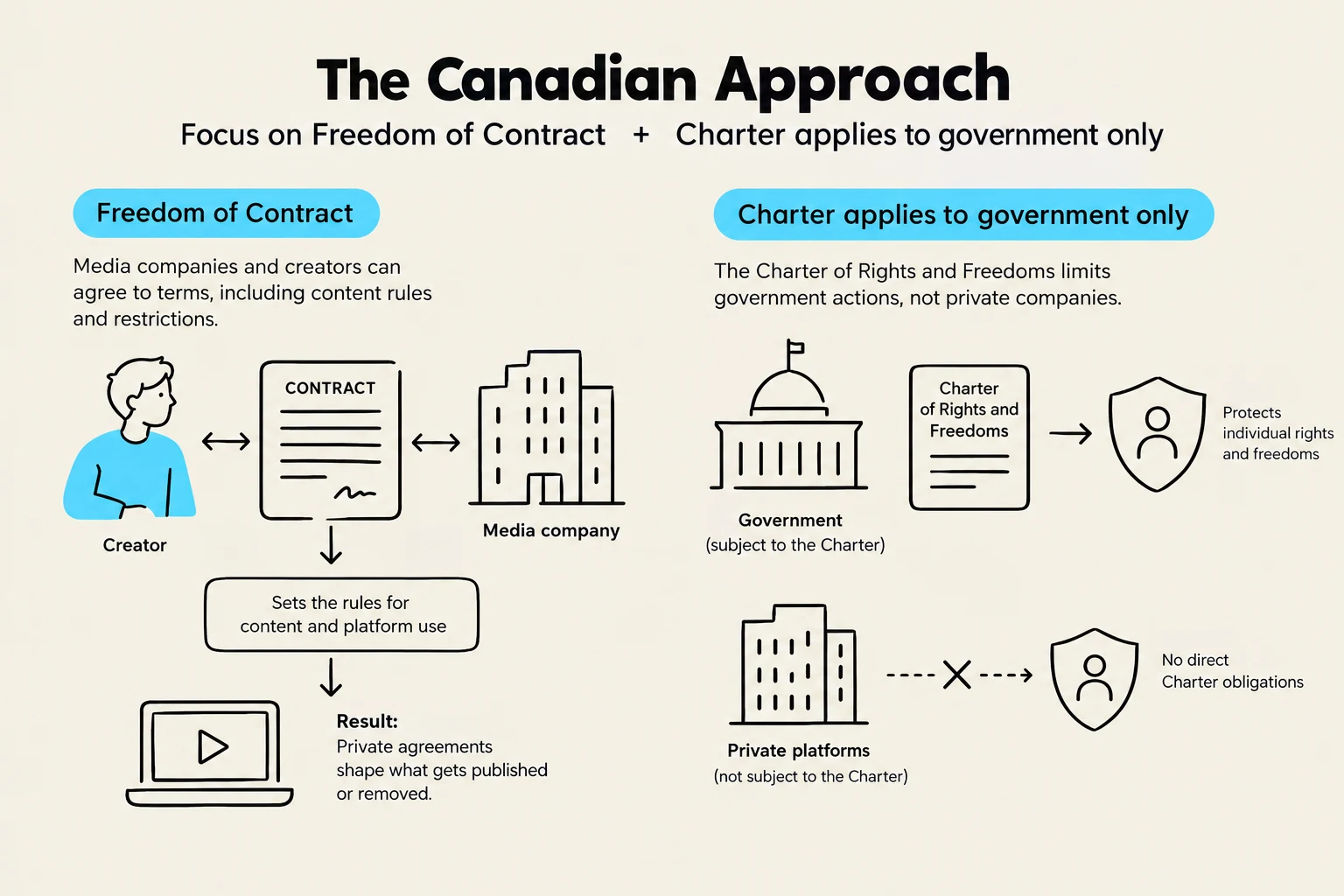
In Canada, social media terms are often contracts of adhesion—agreements where one party (the platform) dictates all terms and the other party (the user) has no power to negotiate. Because the Canadian Charter of Rights and Freedoms applies only to government action, not private businesses, it is very difficult to challenge a platform's decision to remove content based on constitutional freedom of expression. Canadian courts generally uphold the freedom of contract, meaning they rarely interfere with these private agreements unless they meet the extremely high bar of unconscionability.
Critical Thinking Question: If you have no power to negotiate a platform's terms, do you truly have a choice when you click "I Agree"? Is the "consideration" you provide (your data and content) worth the service you receive?
International Comparisons: The German Model
To address the lack of user protection, some scholars look to the German Basic Law (GG). Article 5 of the German Basic Law explicitly states that "there shall be no censorship" regarding the dissemination of opinions.
Unlike Canada, German courts do not treat platform standards as absolute or untouchable. They employ a two-step process:
Fact Check: Does the content actually violate the platform's Community Standards?
Fairness Check: Even if it violates the rules, are those rules valid, non-abusive, and proportionate?
In Germany, platforms must balance their right to control their private property with the users' constitutional rights to freedom of expression. This creates a focus on "freedom from contract exploitation," whereas Canada remains focused on "freedom of contract".
This diagram illustrates the Canadian approach to freedom of contract and the application of the Charter of Rights and Freedoms, distinguishing between government and private entities.
Summary Table for Study Review
Concept
Canadian Context
German Context
Primary Focus
Freedom of Contract
Freedom from exploitation
Censorship View
Private matter; platforms are businesses
Constitutional right to express; no censorship
Legal Remedy
Hard to sue; requires "unconscionability"
Two-step check: Fact and Fairness
Regulation
Provincial (Civil) & Federal (Industry)
Constitutional/Basic Law (GG)
Keep reading for free.
Create an account to finish this reading and make it part of your study routine.