


The biological membrane is far more than a simple container for cellular contents; it is a sophisticated, semipermeable barrier that regulates the internal environment of the cell. By controlling the movement of ions, nutrients, and waste products, the membrane enables essential processes such as electrical signaling, nutrient uptake, and osmotic balance. Understanding how solutes move across this barrier requires an analysis of the membrane's composition and the physical forces driving molecular movement.
Selective Permeability
The cell membrane is composed of a phospholipid bilayer embedded with various proteins and cholesterol. This structure dictates selective permeability, meaning the membrane allows certain substances to pass more easily than others.
The ease with which a solute crosses the membrane is governed by three primary factors: size, polarity, and charge.
- Lipid Solubility: Solutes that can dissolve in the lipid core (such as , , and steroid hormones) cross the bilayer easily.
- Size: Small molecules diffuse more readily than large macromolecules.
- Charge and Polarity: Highly polar or charged ions (such as , , or ) cannot cross the hydrophobic lipid core on their own and require specialized membrane proteins.

Passive Transport
Passive transport refers to the movement of solutes down their electrochemical gradient—from an area of higher concentration to an area of lower concentration—without the expenditure of metabolic energy (ATP).
Simple Diffusion
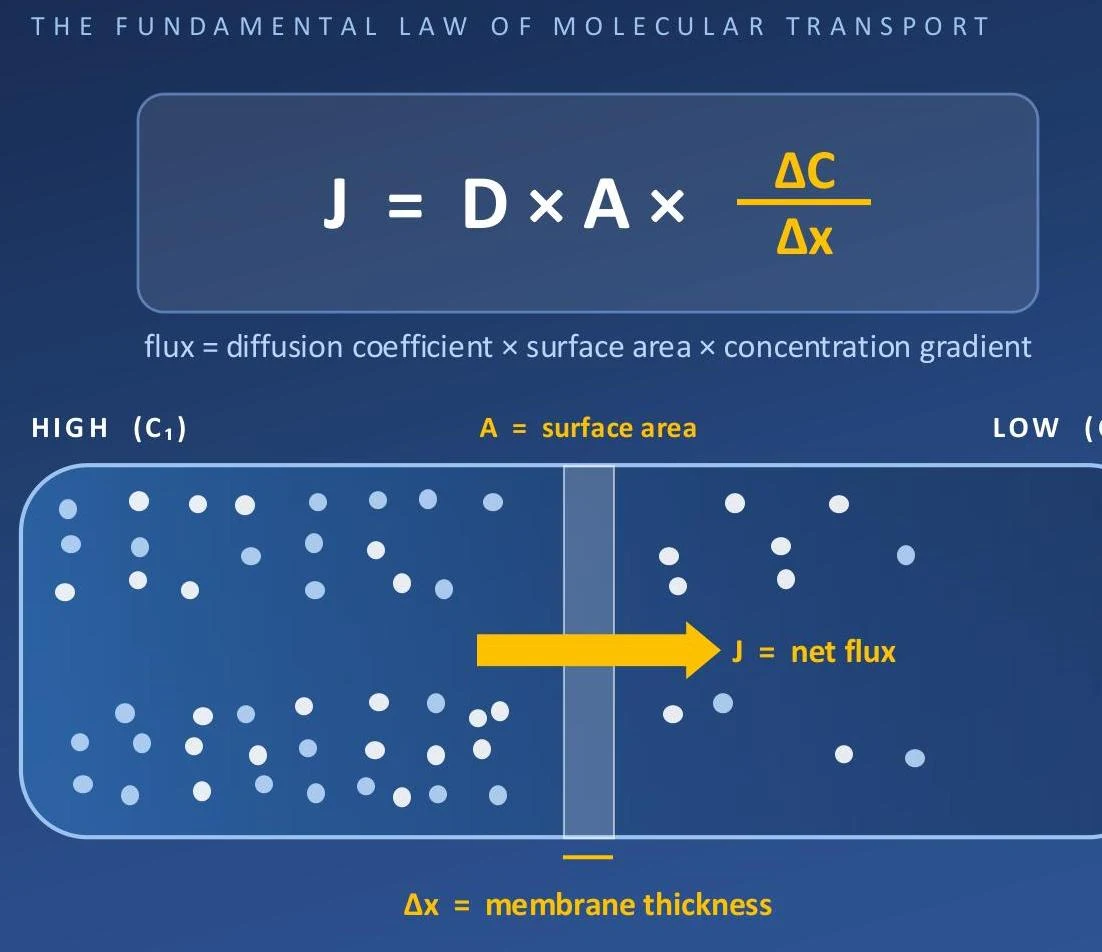
In simple diffusion, solutes move directly through the lipid bilayer without the assistance of a protein. This process is non-saturable because there are no specific binding sites to occupy; the rate of movement simply increases as the concentration gradient becomes steeper. The movement of these particles is described by Fick's Law, which states that the flux () is proportional to the permeability (), the surface area (), and the concentration gradient ():

Keep reading for free.
Create an account to finish this reading and make it part of your study routine.
Continue reading freeAlready have an account? Log in
Updated