Explains how hormones, as chemical messengers, interact with target cells through specific receptors. Differentiates between steroid and protein hormones based on their chemical nature, solubility, and mechanisms of action, detailing their effects on cellular processes and response speed.
Hormones are the body's long-distance chemical messengers. Once released from a gland, they are secreted into the bloodstream and travel throughout the entire body. However, despite being present in almost every tissue, hormones do not cause every cell to react. To understand how the body coordinates complex processes like growth, metabolism, and reproduction, we must look at the relationship between hormone chemistry and cellular receptors.
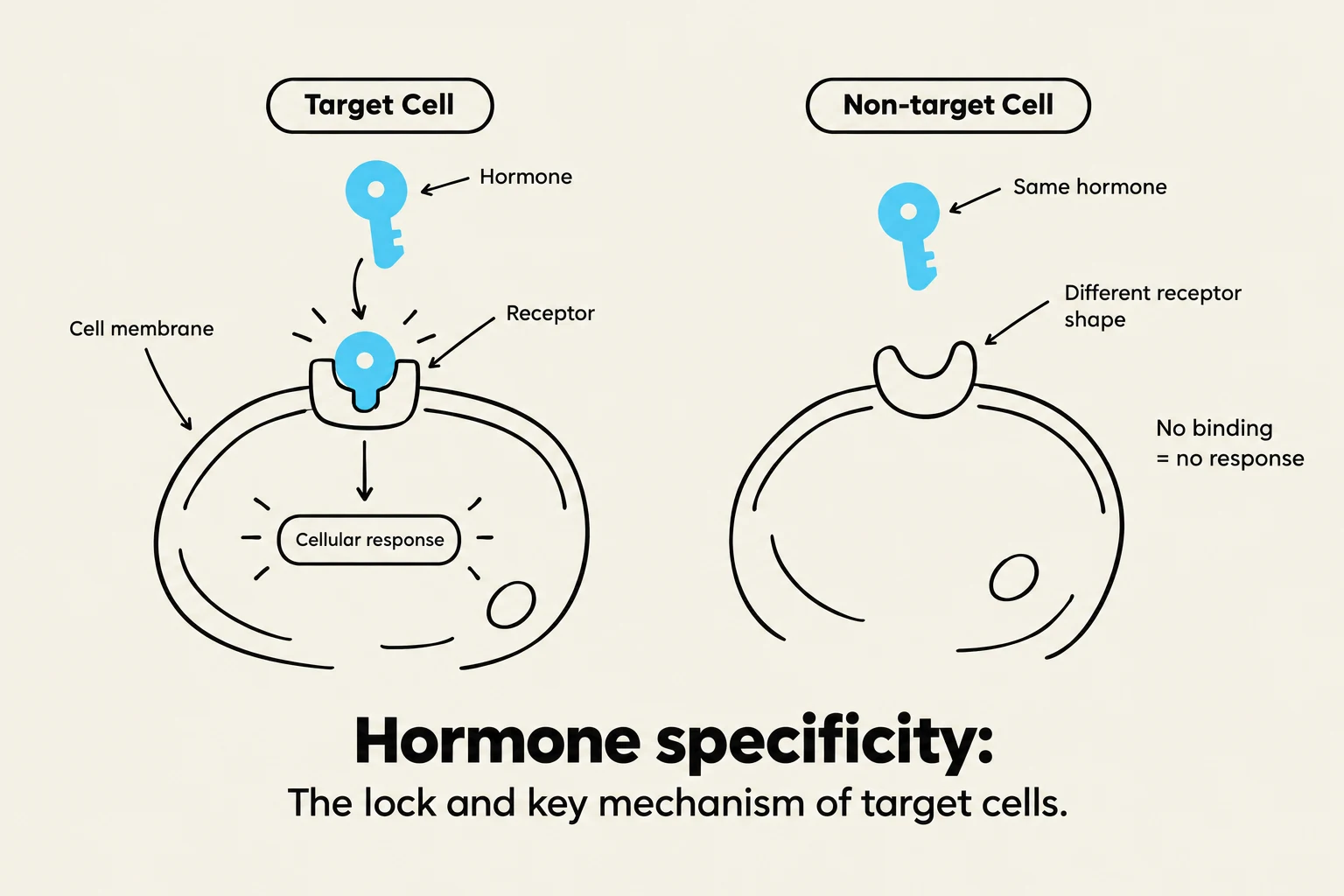
This diagram illustrates hormone specificity using the lock and key mechanism. A target cell has a receptor that fits a specific hormone, leading to a cellular response. A non-target cell, with a differently shaped receptor, does not bind to the same hormone, resulting in no response.
The Concept of Specificity: Target Cells and Receptors
A common question in endocrinology is: "If a hormone travels through the blood to the entire body, why doesn't it affect every cell it touches?". The answer lies in the concept of target cells.
A cell only responds to a hormone if it possesses a specific receptor designed to bind with that particular hormone. You can think of the hormone as a "key" and the receptor as a "lock." Even if the key is floating through the entire house (the body), it will only open the specific doors (cells) that have the matching lock. If a cell lacks the specific receptor, there will be no physiological response, even if the hormone concentration is high.
Exam Tip: If a question asks why a specific tissue is unaffected by a circulating hormone, the answer is almost always the absence of the specific receptor on those target cells.
The Role of Chemical Nature
The mechanism by which a hormone works—and how fast it works—is fundamentally determined by its chemical structure. Hormones are generally categorized into three classes: steroids (built from cholesterol), proteins/peptides (built from amino acids), and amines (built from tyrosine).
The most critical distinction for understanding cellular action is whether a hormone is lipophilic (fat-loving) or hydrophilic (water-loving).
1. Steroid Hormones: The Slow and Steady Approach
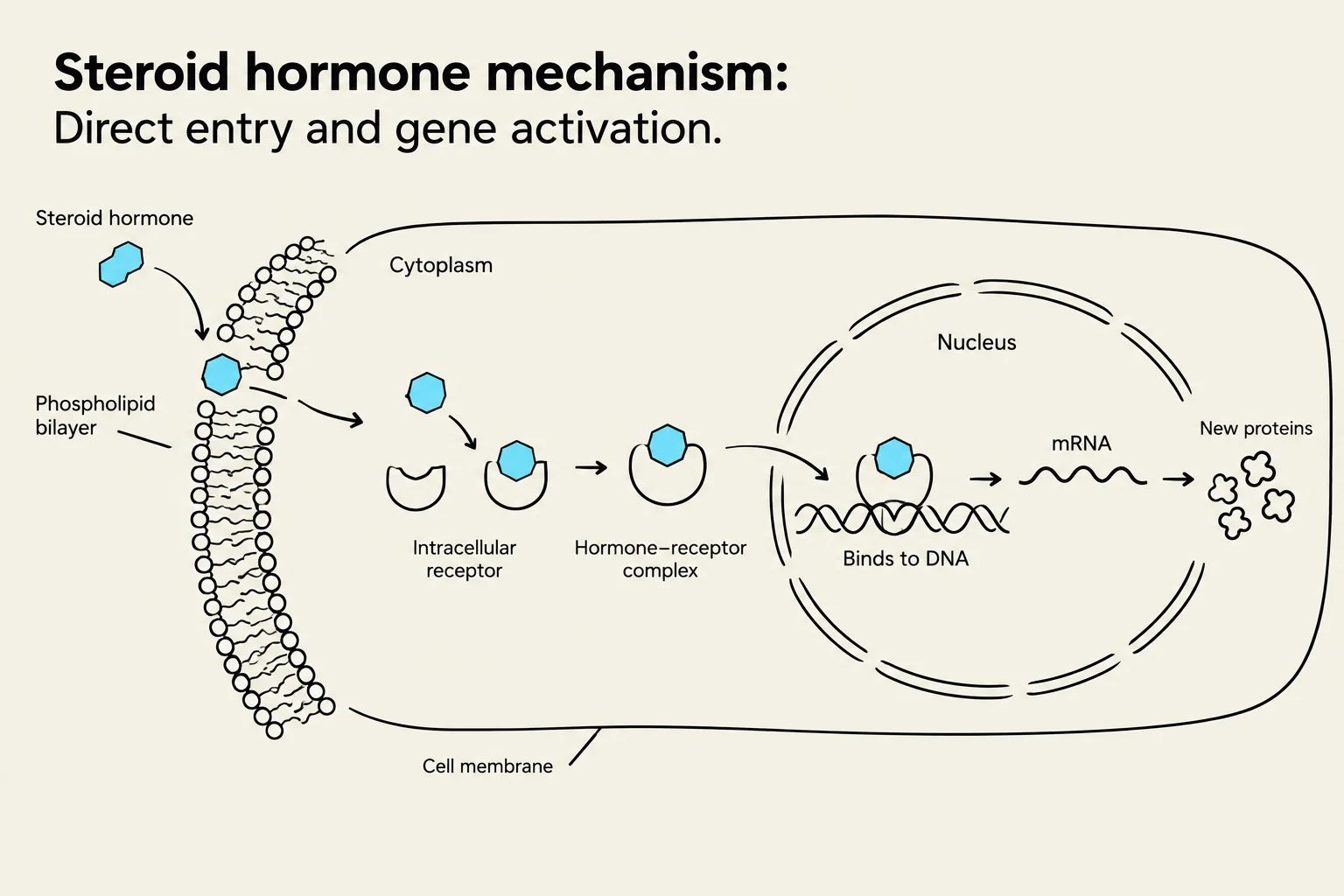
Diagram illustrating the mechanism of steroid hormones, showing their direct entry into the cell, binding to intracellular receptors, and subsequent gene activation within the nucleus to produce new proteins.
Steroid hormones, such as testosterone, estrogen, progesterone, and cortisol, are derived from cholesterol. Because they are lipophilic, they are soluble in lipids (fats).
Since the cell membrane is composed of a lipid bilayer, lipophilic hormones can easily dissolve through it and travel directly into the cell. Once inside, they bind to intracellular receptors located in the cytoplasm or the nucleus.
The mechanism of action for steroids follows these steps:
The hormone crosses the cell membrane.
It binds to an intracellular receptor.
The hormone-receptor complex enters the nucleus.
The complex acts as a transcription factor, switching specific genes "on" or "off".
This triggers the production of new proteins.
Because this process requires the machinery of gene expression and protein synthesis, the effects are slow, often taking hours to manifest. However, because they change the actual protein composition of the cell, these effects tend to be long-lasting. Because they do not dissolve well in water, steroid hormones often travel through the blood attached to carrier proteins.
2. Protein Hormones: The Rapid Response
This diagram illustrates how a protein hormone binds to a receptor protein on the cell membrane, initiating a signaling cascade involving second messengers that ultimately leads to a rapid cellular response by activating a pre-existing enzyme.
In contrast, protein and peptide hormones—such as insulin, glucagon, oxytocin, and luteinizing hormone (LH)—are hydrophilic. Being water-soluble, they dissolve easily in the blood and do not require a carrier protein to travel.
However, their hydrophilic nature prevents them from passing through the fatty cell membrane. Instead, they must bind to surface receptors located on the exterior of the cell membrane.
When a protein hormone binds to its surface receptor, it does not enter the cell itself. Instead, it triggers a second-messenger cascade inside the cell. This cascade uses proteins and enzymes that already exist within the cell to amplify the signal.
The mechanism of action for protein hormones follows these steps:
The hormone binds to a receptor on the cell membrane.
This binding activates a signal transduction pathway (the second messenger).
The signal activates existing cellular machinery.
Because the cell is simply "switching on" machinery it already has, the response is incredibly fast, occurring within seconds to minutes. The trade-off is that these responses are typically brief and short-lived.
Summary Comparison
The following table summarizes the key differences between these two major classes of hormones:
Feature
Steroid Hormones
Protein Hormones
Chemical Base
Cholesterol
Amino Acids
Solubility
Lipophilic (Oil-loving)
Hydrophilic (Water-loving)
Blood Transport
Requires carrier proteins
Dissolves in water (no carrier)
Receptor Location
Intracellular (Inside cell)
Surface (Cell membrane)
Primary Mechanism
New protein synthesis (Gene expression)
Second-messenger cascade (Existing proteins)
Speed of Action
Slow (Hours)
Fast (Seconds to minutes)
Duration of Effect
Long-lasting
Short-lived
Key Takeaway: The speed of a hormone's effect is fundamentally linked to whether it requires the cell to build something new (steroids) or simply use what is already there (proteins).
Keep reading for free.
Create an account to finish this reading and make it part of your study routine.