Explains the fundamental biological process of DNA replication, detailing the roles of enzymes like helicase, primase, and DNA polymerase, and its regulation within the cell cycle. Covers leading and lagging strand synthesis, Okazaki fragments, and the management of torsional strain by topoisomerase.
Before a cell can divide to create new life or repair tissue, it must perform a monumental task: copying its entire library of genetic instructions with near-perfect precision. This process, known as DNA replication, is tightly regulated by the cell cycle to ensure that each daughter cell receives an exact complement of DNA. Understanding how enzymes work together to unwind, copy, and stabilize these massive molecules is fundamental to biology.
The Cell Cycle: Timing the Replication
DNA replication does not happen at random; it is a choreographed event within the cell cycle. The cell cycle is a series of phases that govern growth and division.
G1 Phase (Gap 1): The cell grows and prepares for DNA synthesis. At this stage, the cell contains one copy of each maternal and paternal chromosome.
S Phase (Synthesis): This is the critical window where DNA replication actually occurs.
G2 Phase (Gap 2): After replication, the cell undergoes further growth. Because the DNA has been doubled, the cell now contains two copies of each chromosome.
M Phase (Mitosis): The cell undergoes division, physically splitting the duplicated genetic material into two new cells.
G0 Phase: Some cells enter a resting phase where they stop cycling and perform their specialized functions without dividing.
Exam Tip: If a question asks when the amount of DNA in a cell doubles, the answer is during the S phase, which follows G1 and precedes G2.
Initiation: Opening the Double Helix
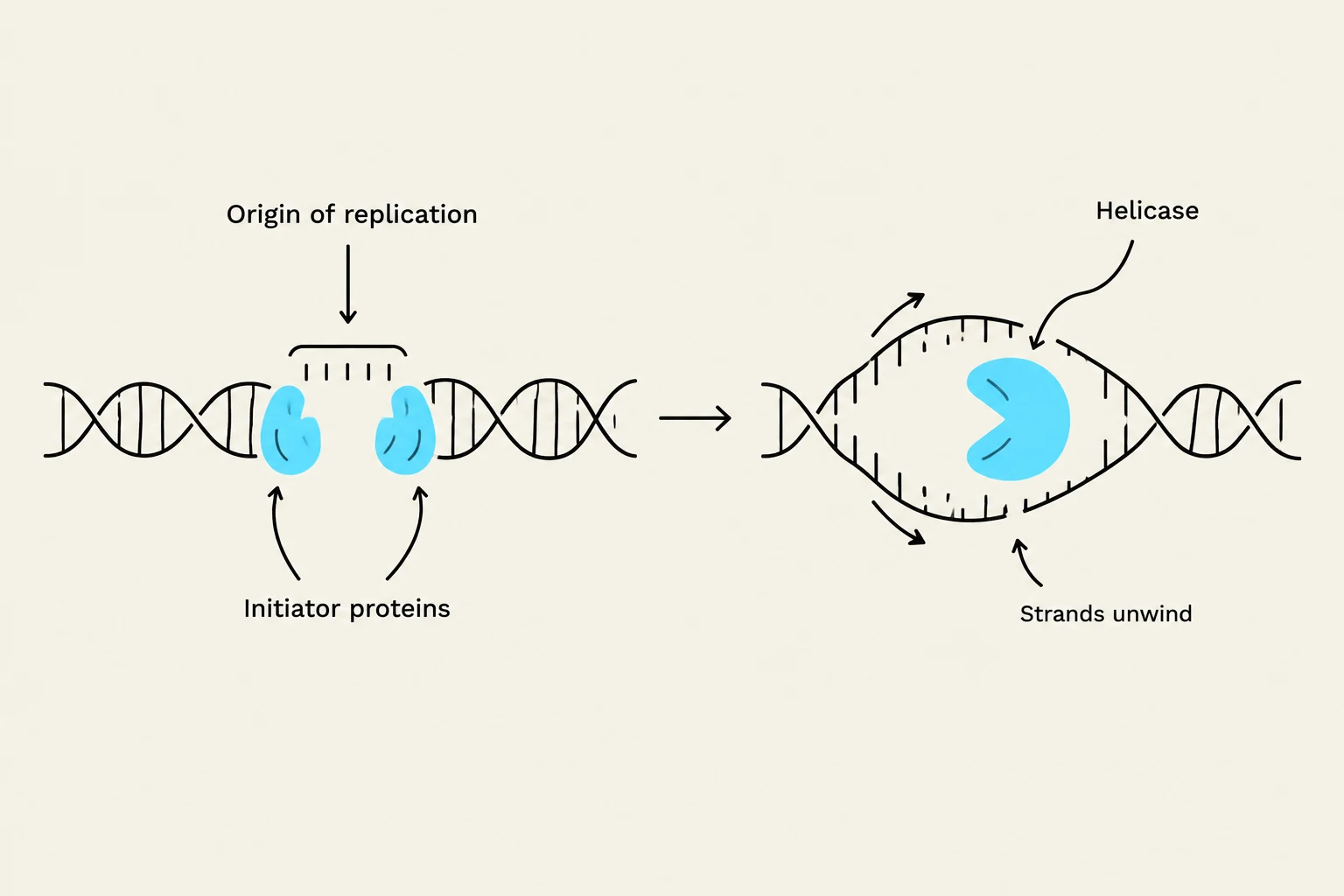
Replication begins at specific locations on the DNA called the origin of replication (or replicator). The process starts when an initiator protein binds to the origin, causing the two strands to "melt" or separate slightly on their own.
Once the strands have begun to separate, specialized enzymes are recruited to the site:
Helicase: This enzyme actively unwinds the two strands, breaking the hydrogen bonds between them.
SSBs (Single-Strand Binding Proteins): Once the strands are separated, they have a natural tendency to "snap" back together. SSBs coat the single strands to keep them stable and separated.
Diagram illustrating the initiation of DNA replication, showing initiator proteins binding to the origin of replication and helicase unwinding the DNA strands.
As the helicase moves forward, it creates a structure known as a replication fork. Because replication proceeds in both directions away from the origin, this is referred to as bidirectional replication.
The Replication Fork: Leading and Lagging Strands
The most complex part of replication is the actual synthesis of the new strands. This is performed by DNA polymerase, the enzyme responsible for adding nucleotides to build the new strand. However, DNA polymerase has a strict limitation: it can only synthesize DNA in a 5' to 3' direction.
Because the two strands of the original DNA helix run in opposite directions (anti-parallel), the two new strands must be built using different strategies:
The Leading Strand
On one strand, the direction of synthesis matches the direction the replication fork is moving. This allows DNA polymerase to add nucleotides continuously as the DNA unzips.
The Lagging Strand
The other strand runs in the opposite direction. As the fork opens, the polymerase must wait for a segment of DNA to be exposed, then jump back toward the fork to build a small piece, then jump again. This results in discontinuous synthesis. These small, disconnected pieces are called Okazaki fragments.
To manage this, the cell uses a specialized complex:
Primase: Since DNA polymerase cannot start from scratch, primase creates a short RNA primer to provide a starting point for each fragment.
The Primasome: The combination of DNA helicase and DNA primase working together is often called the primasome.
Sliding Clamp: A ring-shaped protein that holds the DNA polymerase onto the DNA, preventing it from falling off during the process.
Managing Torsional Strain: Topoisomerase
As helicase unwinds the DNA, it creates a massive physical problem: supercoiling. Imagine twisting a piece of rope; as you pull the strands apart in the middle, the rope becomes extremely tight and knotted at the ends. This "torsional strain" can become so intense that it blocks the replication machinery from moving forward.
To solve this, the cell employs Topoisomerase. This enzyme acts like a safety valve: it cuts the DNA backbone, allows the DNA to rotate and relieve the tension, and then rejoins the strands. Without topoisomerase, the DNA would become so tangled that replication would grind to a halt.
Scaling Up: Replicating a Whole Chromosome
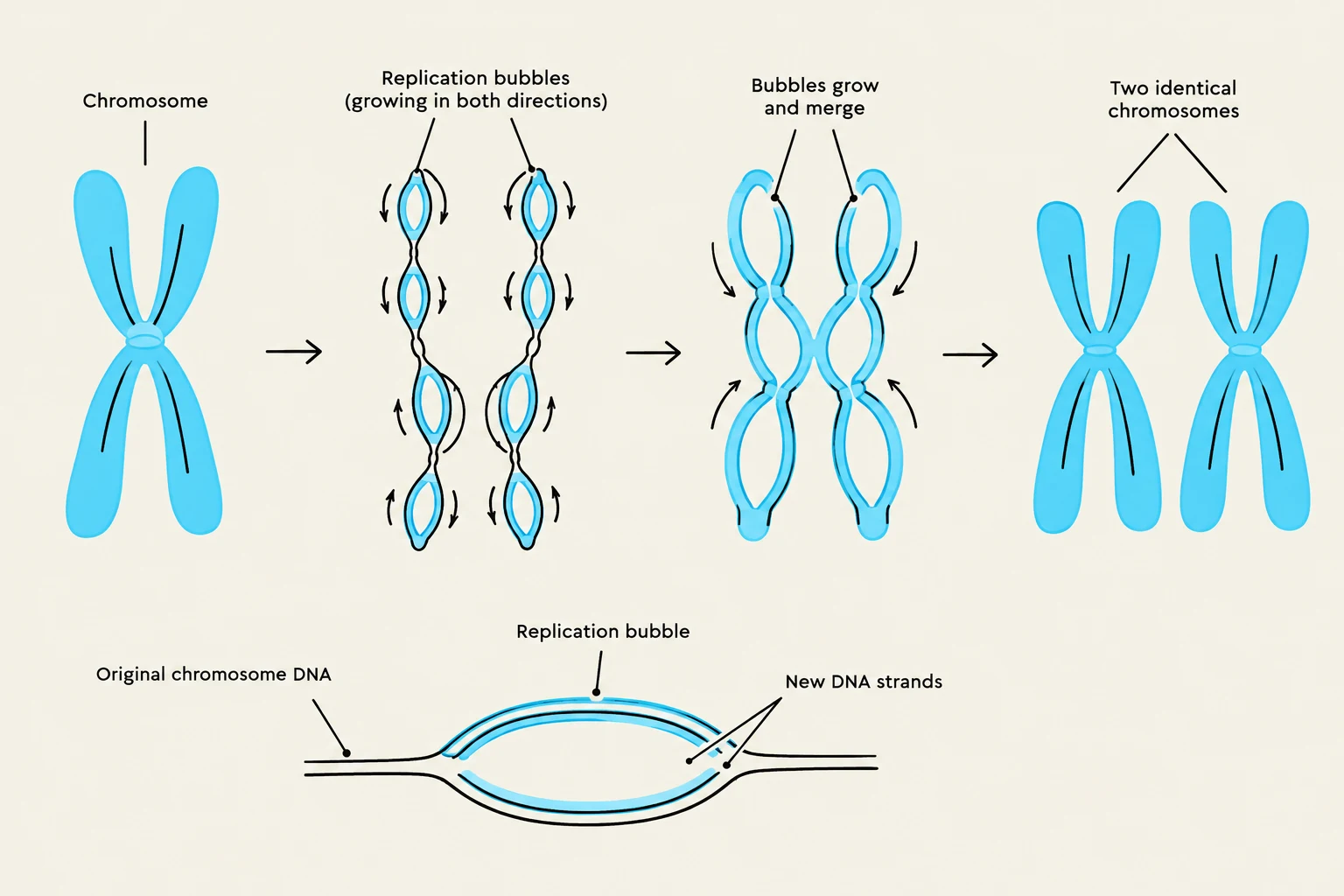
If a cell tried to replicate a massive chromosome from a single starting point, it would take an incredibly long time. To increase efficiency, eukaryotic cells use multiple origins of replication.
Each origin opens into a "replication bubble." These bubbles grow in both directions until they eventually merge with neighboring bubbles. This allows the cell to copy its entire genome much faster. The size of chromosomes varies, but the principle remains the same: many small bubbles working in tandem to create two complete double strands.
Diagram illustrating the process of DNA replication in a chromosome, showing the formation and merging of replication bubbles to produce two identical chromosomes.
Summary Table of Key Players
Enzyme/Protein
Primary Function
Helicase
Unwinds the DNA double helix
Primase
Synthesizes RNA primers to start synthesis
DNA Polymerase
Adds nucleotides to build the new DNA strand
Topoisomerase
Relieves torsional strain and supercoiling
SSBs
Stabilizes single strands to prevent re-annealing
Sliding Clamp
Holds DNA polymerase onto the template
Keep reading for free.
Create an account to finish this reading and make it part of your study routine.