Explores the fundamental principles of evolution by natural selection, including variation, heritability, and differential fitness. It details the three main types of natural selection—directional, stabilizing, and disruptive—and distinguishes evolution as a change in allele frequencies. Other evolutionary forces like
Evolution is often misunderstood as a process that always moves toward "perfection" or a specific goal. In reality, evolution is a statistical process defined by changes in the genetic makeup of a population over time. While many factors can influence these changes, natural selection is the primary mechanism that drives adaptive evolution by favoring specific traits that enhance survival and reproduction in a given environment.
The Foundations of Natural Selection
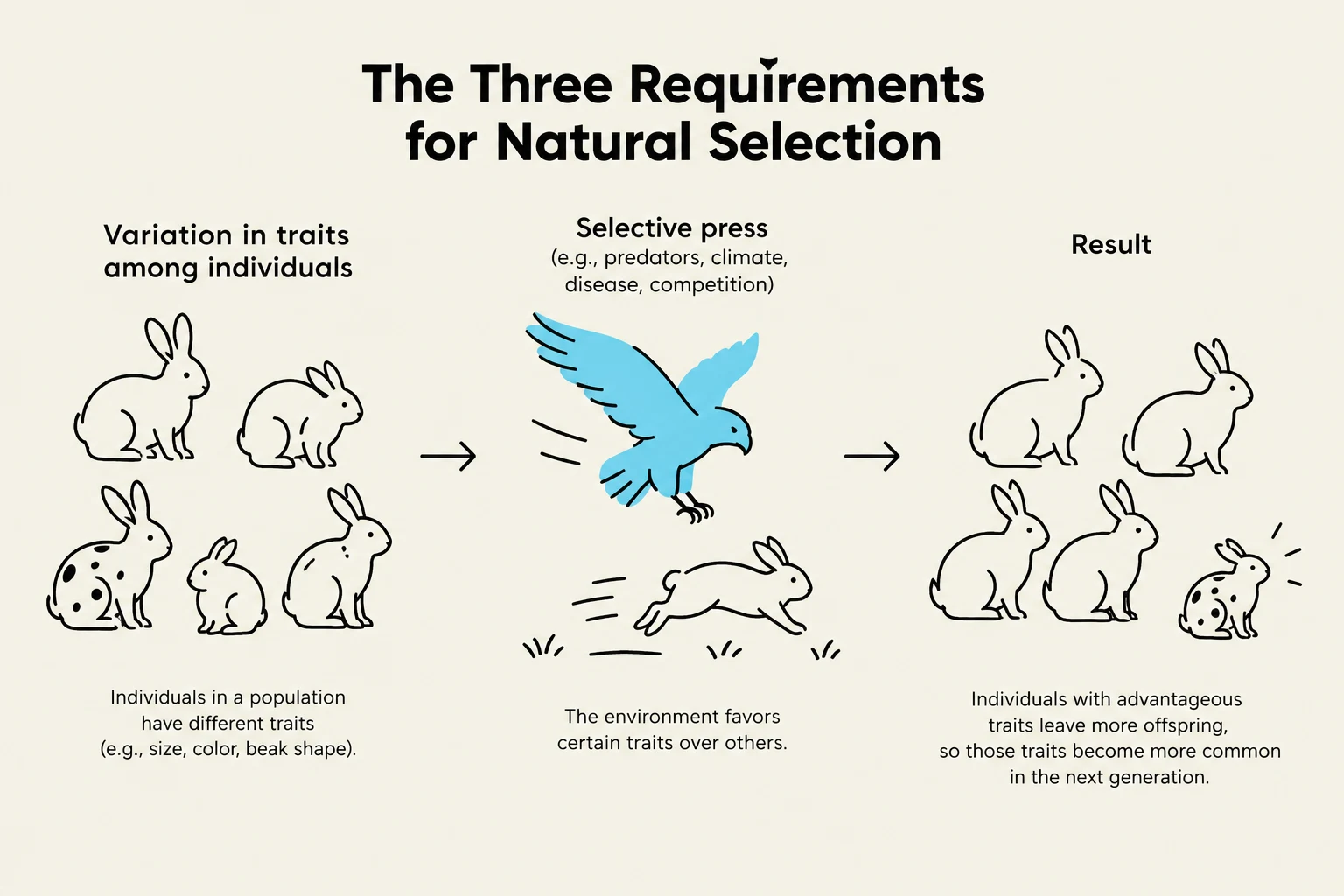
For natural selection to occur and drive evolutionary change, three essential components must be present within a population:
Variation within a population: Individuals must possess different versions of traits. This variation can be continuous (like height or bill depth) or discrete/discontinuous (like blood type or specific color patterns).
Selection: There must be a selective event or environmental pressure that results in differential, non-random fitness. This means some individuals are more likely to survive and reproduce than others due to their specific traits.
Heritability: The traits being selected must be capable of being passed from parents to offspring via genes.
It is vital to distinguish between phenotypes and genotypes. A phenotype is the observable expression of a trait (e.g., the depth of a finch's beak), while a genotype is the underlying genetic makeup. Natural selection acts directly on phenotypes, but evolution only occurs if those phenotypic differences are rooted in heritable genetic differences.
Exam Tip: If a question asks whether a change in a population is "evolution," look for changes in allele frequencies. A change in phenotype alone (e.g., a plant growing taller due to better fertilizer) is not evolution if the underlying genetics do not change.
This diagram illustrates the three requirements for natural selection: variation in traits among individuals, selective pressure from the environment, and the resulting change in trait frequency in the next generation.
Defining Evolution: Allele Frequencies
The most precise definition of evolution is a change in allele frequencies within a population over time. An allele is a specific version of a gene. While we often observe changes in genotypes (the combination of alleles) or phenotypes (the physical trait), these do not constitute evolution unless the proportion of alleles in the gene pool shifts.
For example, in a population of butterflies with two alleles for wing color—Red (R) and Blue (B)—the population might have an allele frequency of 0.5 for R and 0.5 for B. If a selective event causes the frequency of R to rise to 0.7, the population has evolved.
Interestingly, you can have a change in genotype frequencies without evolution. This occurs in assortative mating, where individuals choose mates with similar phenotypes (e.g., red butterflies only mating with red butterflies). This can increase the number of homozygotes (RR and BB) and decrease heterozygotes (RB), but if the total number of R and B alleles remains the same, no evolution has occurred.
The Three Types of Natural Selection
Natural selection shifts the distribution of phenotypes in a population in different ways. These shifts are categorized based on how they affect the population mean (the average value of the trait) and the variance (the spread of the trait).
1. Directional Selection
Directional selection occurs when environmental changes favor individuals at one extreme of the phenotypic range. This process causes the population mean to shift toward that favored extreme.
A classic example is the work of the Grants on medium ground finches in the Galapagos. During a severe drought, birds with deeper bills were better able to crack the hard seeds available, leading to higher survival rates. Consequently, the average bill depth in the population increased in the following generation.
The image illustrates three types of natural selection: directional, stabilizing, and disruptive selection, showing how trait distributions change over time.
2. Stabilizing Selection
Stabilizing selection occurs when the environment favors intermediate phenotypes and acts against both extremes. Instead of shifting the mean, this type of selection reduces phenotypic variation and maintains the "status quo" by narrowing the distribution around the existing average.
An example is the selection on juvenile body mass in sociable weavers; individuals that are too small or too large may have lower survival rates, keeping the population mass within a specific range.
3. Disruptive Selection
Disruptive selection is the opposite of stabilizing selection. It occurs when individuals at both extremes of the phenotypic range are favored over those with intermediate phenotypes. This creates a bimodal distribution (two peaks) and is a key driver of diversification, potentially leading to the formation of new species (speciation).
Beyond Natural Selection: Other Evolutionary Forces
It is a misconception that natural selection is the only way populations evolve. Other mechanisms can also change allele frequencies:
Genetic Drift: This refers to random changes in allele frequencies due to chance events, such as sampling error. Genetic drift has a much larger impact in small populations and can even cause harmful (deleterious) mutations to become fixed in a population.
Sexual Selection: A specific type of natural selection where fitness is determined by competition for mates or mate choice. Sexual selection can sometimes oppose survival-based selection; for example, a male bird might evolve bright, heavy plumage to attract females, even if that plumage makes him more vulnerable to predators.
Because evolution is driven by a combination of selection, drift, and mutation, it is often described as a "drunkard's walk"—it is not a purposeful march toward perfection, but a complex, often unpredictable movement through genetic space.
Keep reading for free.
Create an account to finish this reading and make it part of your study routine.