Measuring Patient Vital Signs in Veterinary Medicine
A comprehensive guide to measuring and interpreting vital signs in veterinary patients, including temperature, pulse, respiration rate, heart rate, and capillary refill time. Covers common methods, normal ranges for various species, and documentation in medical records.
In veterinary clinical practice, the assessment of vital signs is a fundamental component of every patient encounter. These measurements provide a baseline of the patient's physiological status and are essential for detecting illness, monitoring recovery, or identifying acute distress. While clinicians often focus on the "big four"—temperature, pulse, respiration, and heart rate—a complete assessment also begins with the patient's weight, a critical metric for calculating drug dosages and monitoring long-term health.
Patient Weight: The Essential Baseline
Although weight is not technically classified as a vital sign, it must be recorded at the beginning of every single visit. Accurate weight documentation is vital because almost all medical interventions, from anesthesia protocols to antibiotic dosages, are weight-dependent.
When recording weight, ensure it is documented in either pounds (lbs) or kilograms (kg). If a patient's weight is provided in ounces, you must convert them to pounds before recording to maintain consistency in the medical record.
Temperature Assessment
Temperature is one of the primary indicators of a patient's metabolic and systemic health. There are two main methods for obtaining a temperature: aural (ear) and rectal.
Rectal Temperature
The rectal route is considered the "Gold Standard" for accuracy. When using a rectal thermometer, always use a lubricant and a disposable cover if available.
Clinicians may encounter different types of thermometers:
Digital Thermometers: These are preferred because they provide a reading in less than 10 seconds.
Mercury Thermometers: While still found in some older clinics, these are glass and pose a risk of breaking inside a struggling animal. They also require a full 60 seconds to provide an accurate reading.
Aural Temperature
Aural thermometers are less invasive but can be less accurate due to variations in ear canal shape, the presence of hair or wax, or improper placement. To ensure accuracy, the probe should be inserted into the ear canal and pointed diagonally down toward the opposite bottom jaw.
Clinical Note: For dogs and cats, the normal temperature range is typically between 99.5∘F and 102.2∘F.
Heart Rate and Auscultation
Heart rate (HR) measures the number of times the heart beats per minute (bpm). To measure this, clinicians use auscultation, which involves listening to the heart sounds using a stethoscope. For the most accurate reading, place the stethoscope on the left side of the animal's chest, just below the elbow.
Sometimes, environmental or behavioral factors can interfere with auscultation. If a patient is panting, purring, or growling, it may be difficult to hear the heartbeat clearly. In these cases, you may need to gently hold the mouth closed or tap the animal's nose to help them settle.
Normal Heart Rate Ranges
Heart rates vary significantly based on species, age, and body size:
Species/Group
Normal Heart Rate (bpm)
Dogs (Large Breed)
70–100
Dogs (Medium Breed)
100–130
Dogs (Small Breed)
130–160
Dogs (Puppies)
150–200
Cats (Adult)
150–210
Cats (Kittens)
150–225
Horses
25–45 (Rates >50 indicate distress)
Pulse Rate and the Pulse Deficit
While the heart rate measures the electrical/mechanical contraction of the heart, the pulse rate measures the physical movement of blood through a vessel. This is measured by palpating (feeling with the hands) a major artery.
It is a critical clinical requirement to always compare the Heart Rate to the Pulse Rate. In a healthy patient, these two numbers should be synchronous. If the heart is beating but no pulse is felt at the extremity, this discrepancy is known as a pulse deficit.
Common Pulse Locations
The location used for palpation depends on the species:
Dogs and Cats: The femoral artery, dorsal pedal artery, or axillary artery.
Horses: The facial artery (the most common site) or the digital artery.
Respiration Rate
Respiration rate (RR) is the number of breaths per minute. This can be measured by visually observing the rise and fall of the chest or by lightly palpating the chest to feel the breaths. Accuracy increases the longer you count the breaths.
Normal resting respiratory rates are:
Dogs: 10–30 breaths/min (Note: Panting can reach up to 150 bpm).
Cats: 24–42 breaths/min.
Clinical Documentation and Abnormal Findings
When recording vital signs, they are typically placed in the Objective section of the medical record (SOAP: Subjective, Objective, Assessment, Plan). The Objective section is reserved for quantifiable measurements like vitals and physical exam findings.
Critical Action Step: If you obtain a vital sign that is not within the normal range, take it again. If the second reading is also abnormal, document it in the chart and immediately bring it to the attention of the DVM.
Capillary Refill Time (CRT) and Mucous Membranes
As part of the vital sign assessment, clinicians also check the mucous membranes (MMs) and the Capillary Refill Time (CRT). CRT is the time it takes for capillaries to refill after being pressed.
Normal CRT: 1–2 seconds.
<1 second: May indicate early shock.
>2 seconds: May indicate poor blood perfusion.
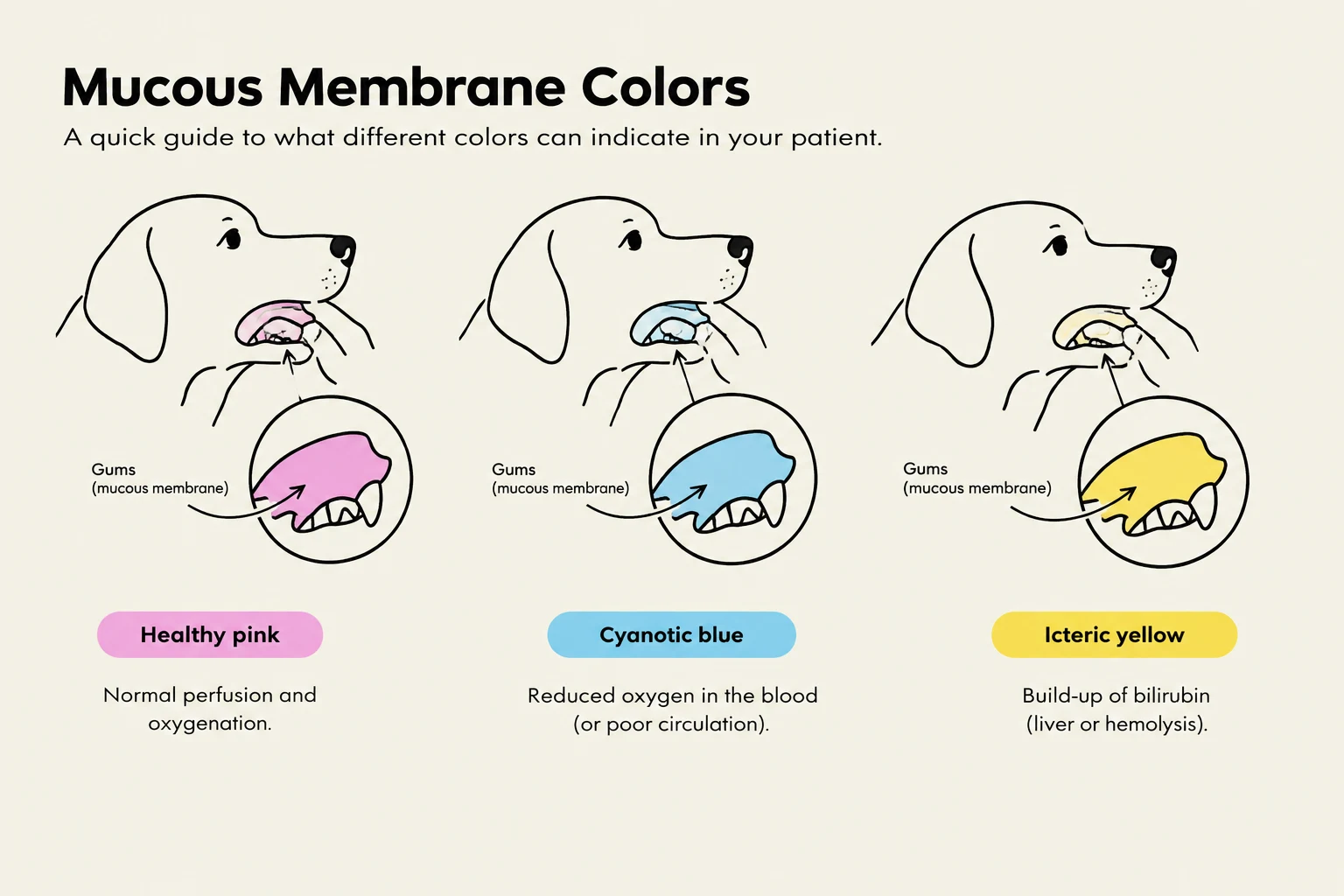
The color of the mucous membranes provides further diagnostic clues:
Pink: Normal.
Pale (White/Grey): May indicate anemia or hypothermia.
Red (Injected): May indicate hyperthermia, toxicity, or early shock.
Cyanotic (Blue): Indicates low oxygen in the blood.
Icteric (Yellow): Indicates jaundice or liver damage.
This illustration shows the normal and abnormal colors of a dog's mucous membranes, indicating different health conditions. Healthy pink gums suggest normal perfusion and oxygenation. Cyanotic blue gums indicate reduced oxygen in the blood or poor circulation. Icteric yellow gums suggest a build-up of bilirubin due to liver issues or hemolysis.
Keep reading for free.
Create an account to finish this reading and make it part of your study routine.