


In the study of ecology and mycology, one of the most fundamental challenges is answering the question: "How much life is here?" This is not a simple question of counting individuals. To truly understand an ecosystem, scientists must look beyond mere numbers and delve into the complexity of genetic variability, the chemical signatures left by microscopic organisms, and the evolutionary lineages that define species boundaries. This article explores the multi-faceted approaches used to measure diversity, the chemical indicators used to estimate fungal presence, and the ongoing debate regarding the true scale of fungal species richness.
Measuring Diversity Levels
To quantify the health and complexity of an ecosystem, ecologists use several distinct metrics. It is not enough to know how many organisms live in a sample; we must understand how they are distributed and what roles they play.
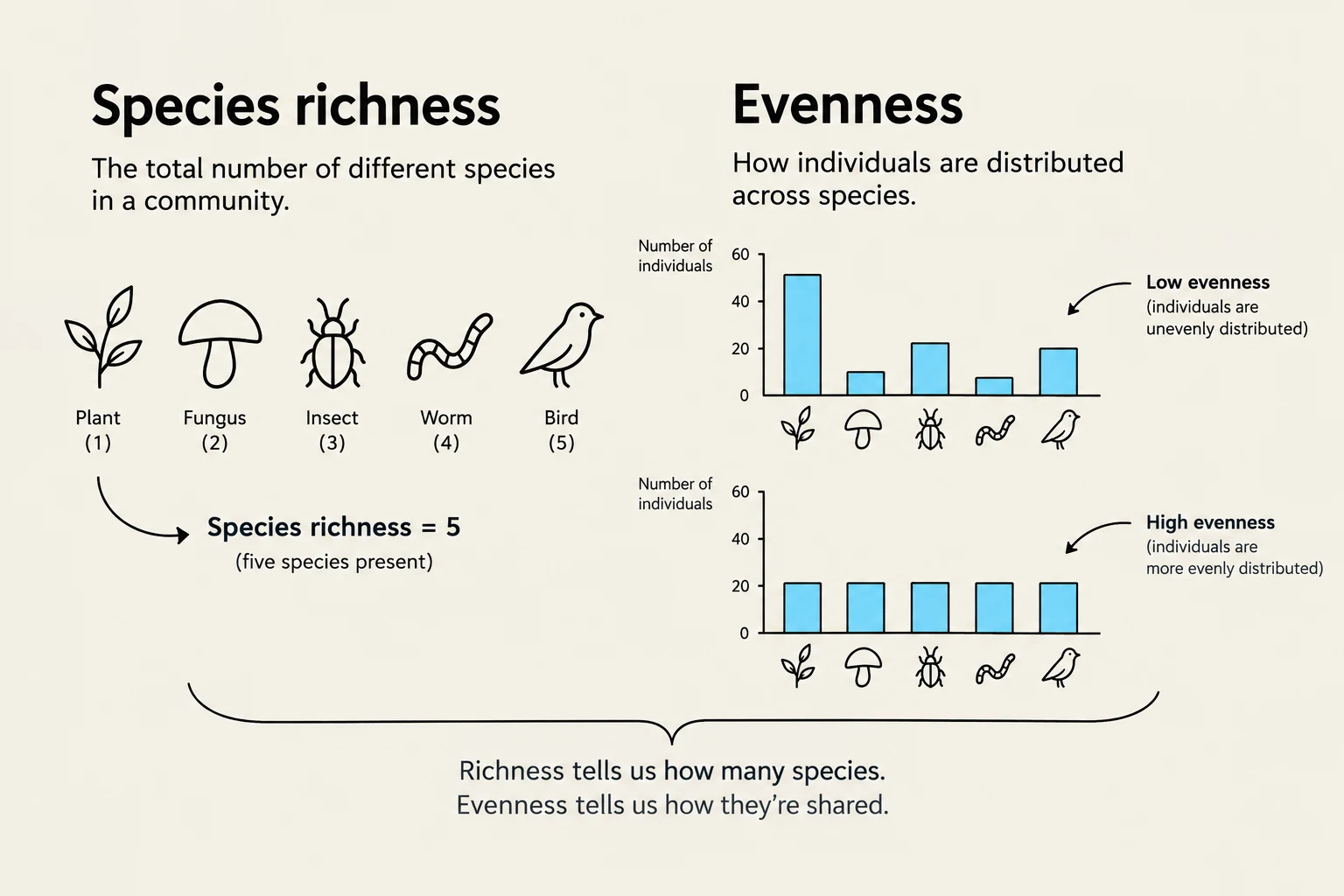
First, we consider species richness, which is the simplest measure: the total number of different species present in a defined area. However, richness alone can be misleading. For example, an area with 100 individuals of one species and an area with 1 individual of 100 different species both have high "counts," but their ecological implications are vastly different. This leads us to relative abundance, often referred to as evenness. Evenness describes how close in numbers each species in an environment is. A high-evenness community has populations that are relatively equal in size, whereas a low-evenness community is dominated by a single species.
Beyond species counts, we look at genetic variability, which measures the diversity of alleles within a population, and functional groups, which categorize organisms based on their ecological roles (e.g., decomposers, pathogens, or mutualists).

Keep reading for free.
Create an account to finish this reading and make it part of your study routine.
Continue reading freeAlready have an account? Log in
Updated