An exploration of fundamental algebraic concepts including relations, functions, domain, range, function evaluation, piecewise functions, and function composition.
In mathematics, understanding how different quantities relate to one another is fundamental. Whether we are modeling the trajectory of a projectile or the growth of a population, we rely on the concepts of relations and functions to describe these connections. This article explores the foundational building blocks of algebra: how we define these relationships, how we restrict their inputs and outputs, and how we manipulate them through evaluation and composition.
Relations vs. Functions
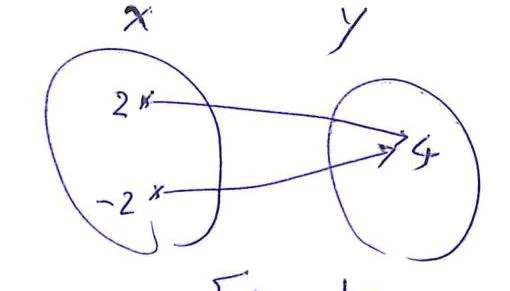
Before we can define a function, we must understand a relation. A relation is simply a set of ordered pairs that connects elements from one set to another. In a mapping diagram, a relation is visualized by drawing arrows from elements in a starting set (often called X) to elements in a target set (often called Y).
A diagram illustrating a function where inputs 2 and -2 both map to the output 4.
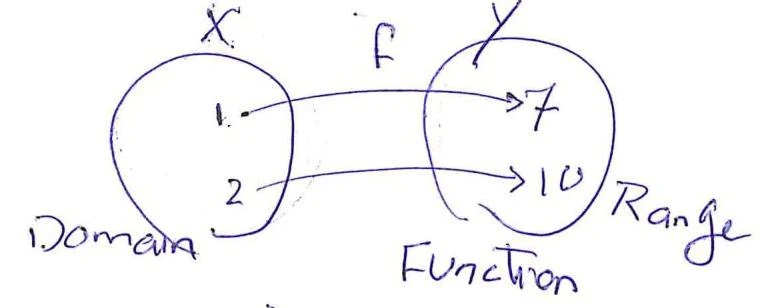
While all functions are relations, not all relations are functions. The defining characteristic of a function is that for every input, there is exactly one output.
A diagram illustrating a function mapping elements from a domain set X to a range set Y.
If a single input maps to multiple different outputs, the relation fails the definition of a function. For example, consider the relation y2=x. If we input x=4, y could be 2 or −2. Because one input leads to two different outputs, this is a relation, but not a function.
A diagram illustrating a function mapping elements from set X to set Y. Specifically, the element 4x in set X is mapped to 2 in set Y, and also to -2 in set Y.
Domain and Range
Every function is defined by two critical sets of values: the Domain and the Range.
Domain (D): The set of all possible input values (usually x) for which the function is defined.
Range (R): The set of all resulting output values (usually y) that the function produces.
When working with square roots or fractions, we must be careful to identify restrictions. For instance, the square root of a negative number is not defined in the set of real numbers. Consider the function:
y=x−2
To find the domain, we must ensure the expression inside the radical is non-negative:
x−2≥0⟹x≥2
Thus, the domain is D={x∈R∣x≥2}, or in interval notation, [2,∞). The resulting range for this specific function is R={y∈R∣y≥0}, or [0,∞).
If we change the function to y=x−21, the domain changes because the denominator cannot be zero. In this case, x−2 must be strictly greater than zero, so D=(2,∞).
Exam Tip: When finding the domain of a rational function (a fraction), always set the denominator to not equal zero. When finding the domain of a square root, always set the radicand (the part inside) to be greater than or equal to zero.
Function Evaluation
Function evaluation is the process of determining the output value of a function for a specific input. We often use the notation f(x), where x is the input.
If we have a function f(ξ)=ξ2+2ξ−1, and we want to evaluate it at ξ=−1, we substitute −1 everywhere we see ξ:
f(−1)=(−1)2+2(−1)−1=1−2−1=−2
We can also evaluate functions using algebraic expressions instead of just single numbers. For example, if g(ξ)=ξ2, then evaluating g(3x+4) means replacing the ξ with the entire expression (3x+4):
g(3x+4)=(3x+4)2=9x2+16+2(3x)(4)=9x2+24x+16
Piecewise Functions
Sometimes, a single formula isn't enough to describe a relationship. A piecewise function is a function that uses different formulas for different parts of its domain.
Consider the following example:
f(x)={x+3x2if −1≤x≤2if x>2
In this function, the domain is [−1,∞). To evaluate the function, you must first check which "piece" the input falls into.
To find f(1): Since 1 is between −1 and 2, we use the first rule: 1+3=4.
To find f(3): Since 3 is greater than 2, we use the second rule: 32=9.
Function Composition
Composition occurs when one function is applied to the result of another. This is often written as (f∘g)(x), which is equivalent to $f(g(x))$.
Let's look at an example with two functions:
f(x)=x2+1g(x)=3x+2
To find the composition $f(g(x))$, we plug the entire g(x) function into f(x):
f(g(x))=(3x+2)2+1=(9x2+12x+4)+1=9x2+12x+5
Conversely, to find $g(f(x))$, we plug f(x) into g(x):
g(f(x))=3(x2+1)+2=3x2+3+2=3x2+5
Note that $f(g(x))$ is generally not equal to $g(f(x))$. The order of composition matters significantly.
Keep reading for free.
Create an account to finish this reading and make it part of your study routine.