Mastering the Hypothetico-Deductive Model: The H-D-P-T-E-R Cycle
An in-depth explanation of the Hypothetico-Deductive Model, detailing the six-stage H-D-P-T-E-R cycle (Hypothesis, Data, Predict, Test, Evaluate, Revise) for systematic scientific inquiry and clinical reasoning, including a worked example.
In the realm of scientific inquiry and clinical reasoning, progress is rarely a straight line from observation to truth. Instead, it is a rigorous, iterative process of trial and error. This process is formalized through the Hypothetico-Deductive Model, a framework that allows researchers and clinicians to move systematically from uncertainty to evidence-based conclusions.
To master this model, one must internalize the H-D-P-T-E-R cycle: a six-stage loop consisting of Hypothesis, Data, Predict, Test, Evaluate, and Revise. By following this cycle, we ensure that our conclusions are not merely guesses, but are grounded in logical deduction and empirical verification.
The Foundation: Hypothesis and Data
The cycle begins when we encounter a phenomenon that requires explanation. This triggers the first two stages: Hypothesis and Data.
1. Hypothesis
A hypothesis is not just a "hunch"; it is a proposed, testable explanation for an observation. In a clinical setting, this might be a preliminary diagnosis based on a patient's presenting symptoms. A good hypothesis must be falsifiable—meaning there must be a theoretical way to prove it wrong.
2. Data
Before we can move forward, we must gather initial observations or existing information. This "Data" stage involves collecting the raw material—symptoms, patient history, or laboratory values—that informs the creation of the hypothesis.
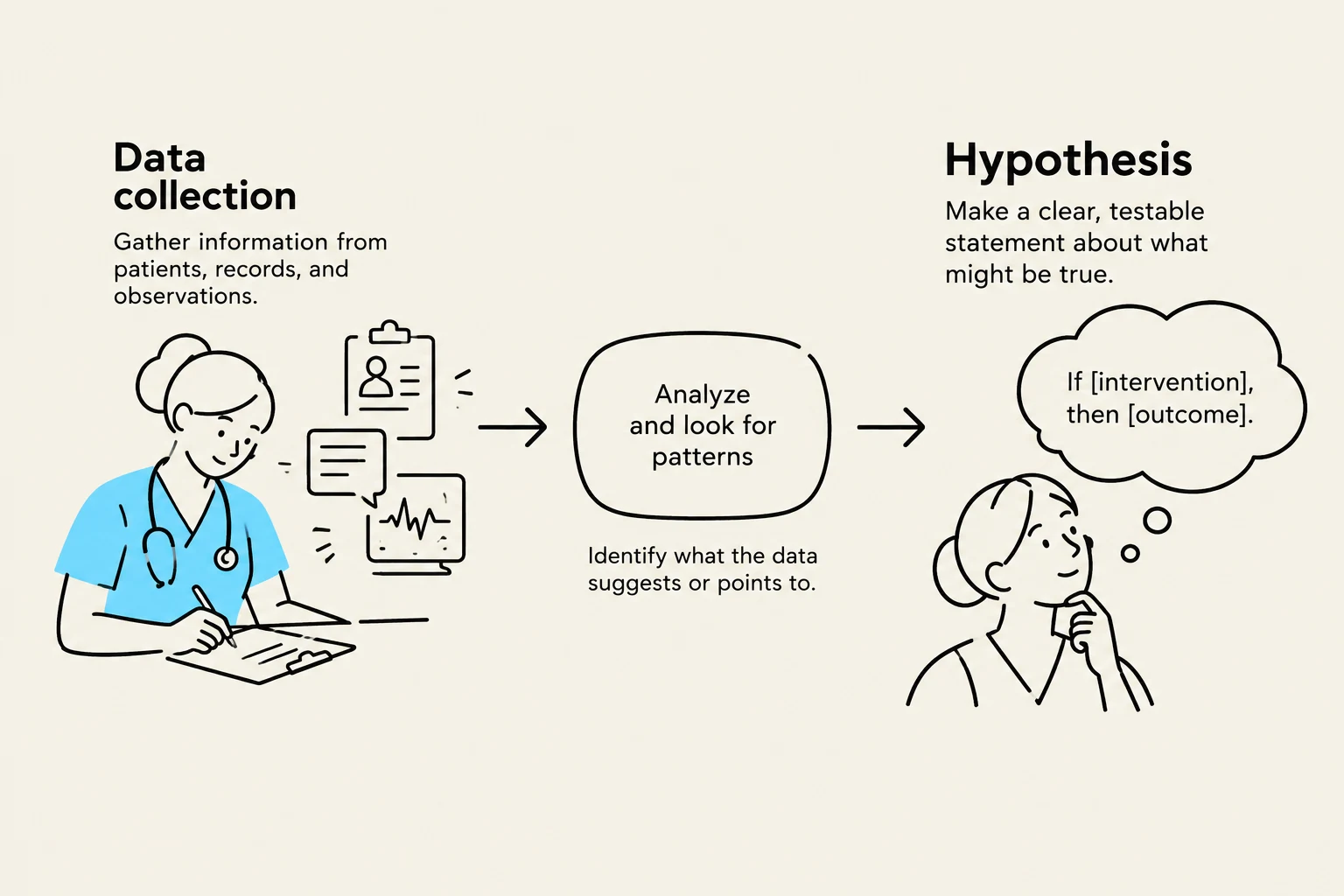
This diagram illustrates the initial steps of the scientific method, showing data collection, analysis, and hypothesis formation.
Exam Tip: Remember that a hypothesis is a proposed explanation, whereas data is the evidence used to support or refute it. Do not confuse the two during clinical assessments.
Moving to Action: Predict and Test
Once a hypothesis is formulated, the model shifts from the "thinking" phase to the "action" phase. This is where the "Deductive" part of the Hypothetico-Deductive model truly shines.
3. Predict
Deduction involves moving from the general (the hypothesis) to the specific (the expected outcome). If our hypothesis is true, what should happen in a specific scenario? For example, if we hypothesize that a patient has a bacterial infection, we must predict that a specific blood test will show an elevated white blood cell count.
4. Test
The testing phase is the implementation of the prediction. This involves performing the experiment, conducting the diagnostic test, or observing the specific phenomenon in question. The goal here is to gather new, targeted data that specifically addresses the prediction made in the previous step.
This diagram illustrates the process of deduction and empiricism, showing how a general hypothesis is used to make a specific prediction, which is then tested through observation and data collection to provide evidence.
The Critical Loop: Evaluate and Revise
The most important part of the H-D-P-T-E-R cycle is not the testing itself, but what happens after the results are in. This is the stage where scientific growth occurs.
5. Evaluate
In the evaluation stage, we compare the results of our test against our original prediction.
Did the data match the prediction?
Was the result statistically significant?
Did the test fail to support the hypothesis?
6. Revise
Science is self-correcting. If the evaluation shows that the prediction was incorrect, we do not simply give up; we Revise. This might mean refining the original hypothesis to be more specific, or discarding it entirely in favor of a new one based on the new data gathered. If the hypothesis was supported, we may still revise our understanding to account for any anomalies found during the test.
Worked Example: Clinical Application
To see how this works in practice, let's look at a hypothetical clinical scenario:
Data: A patient presents with extreme fatigue and increased thirst.
Hypothesis: The patient has Type 2 Diabetes.
Predict: If the patient has Type 2 Diabetes, then their blood glucose levels will be significantly higher than the normal range (>126 mg/dL after fasting).
Test: Perform a Fasting Plasma Glucose (FPG) test.
Evaluate: The test result comes back at 180 mg/dL. The prediction is supported.
Revise: Since the hypothesis was supported, the clinician moves to the next stage of care (treatment planning) or refines the hypothesis to include potential comorbidities.
If the test had come back at 80 mg/dL, the clinician would move to the Revise stage, perhaps hypothesizing an endocrine issue like adrenal insufficiency instead.
Summary Table of the H-D-P-T-E-R Cycle
Stage
Action
Purpose
Hypothesis
Propose an explanation
To provide a starting point for investigation
Data
Collect observations
To inform the hypothesis
Predict
Deduce specific outcomes
To establish what "success" looks like
Test
Execute the experiment
To gather empirical evidence
Evaluate
Analyze results
To determine if the prediction held true
Revise
Adjust the theory
To correct errors and refine understanding
By mastering this cycle, you move beyond rote memorization and begin to think like a scientist, capable of navigating complex, uncertain environments through logical rigor and continuous improvement.
Keep reading for free.
Create an account to finish this reading and make it part of your study routine.