Mastering Stoichiometric Calculations in Chemistry
This guide explains the fundamental principles of stoichiometry, including balanced chemical equations, molar ratios, limiting reactants, theoretical yield, and percent yield. It provides a step-by-step approach to solving mass-to-mass calculations and understanding the quantitative relationships in chemical reactions.
Chemistry is often described as a quantitative science, and nowhere is this more evident than in stoichiometry. At its core, stoichiometry is the study of the relationships between the amounts of reactants used and products formed in a chemical reaction. By understanding the mathematical proportions defined by chemical equations, scientists can predict exactly how much of a substance is needed to start a reaction or how much product can be expected from a given amount of starting material.
The Foundation: Balanced Chemical Equations
Before any calculations can begin, you must have a balanced chemical equation. A balanced equation ensures that the Law of Conservation of Mass is satisfied: matter is neither created nor destroyed during a chemical reaction.
In a balanced equation, the coefficients (the numbers in front of the chemical formulas) represent the molar ratio. This ratio tells us the relative number of moles of each substance involved in the reaction.
For example, consider the synthesis of water:
2H2+O2→2H2O
From this equation, we can see that 2 moles of hydrogen gas react with 1 mole of oxygen gas to produce 2 moles of water. This $2:1:2$ ratio is the "recipe" used for all subsequent stoichiometric steps.
Exam Tip: Always double-check your balance before starting a calculation. If your equation is unbalanced, every subsequent step—including molar mass conversions and yield calculations—will be incorrect.
The Stoichiometric Roadmap
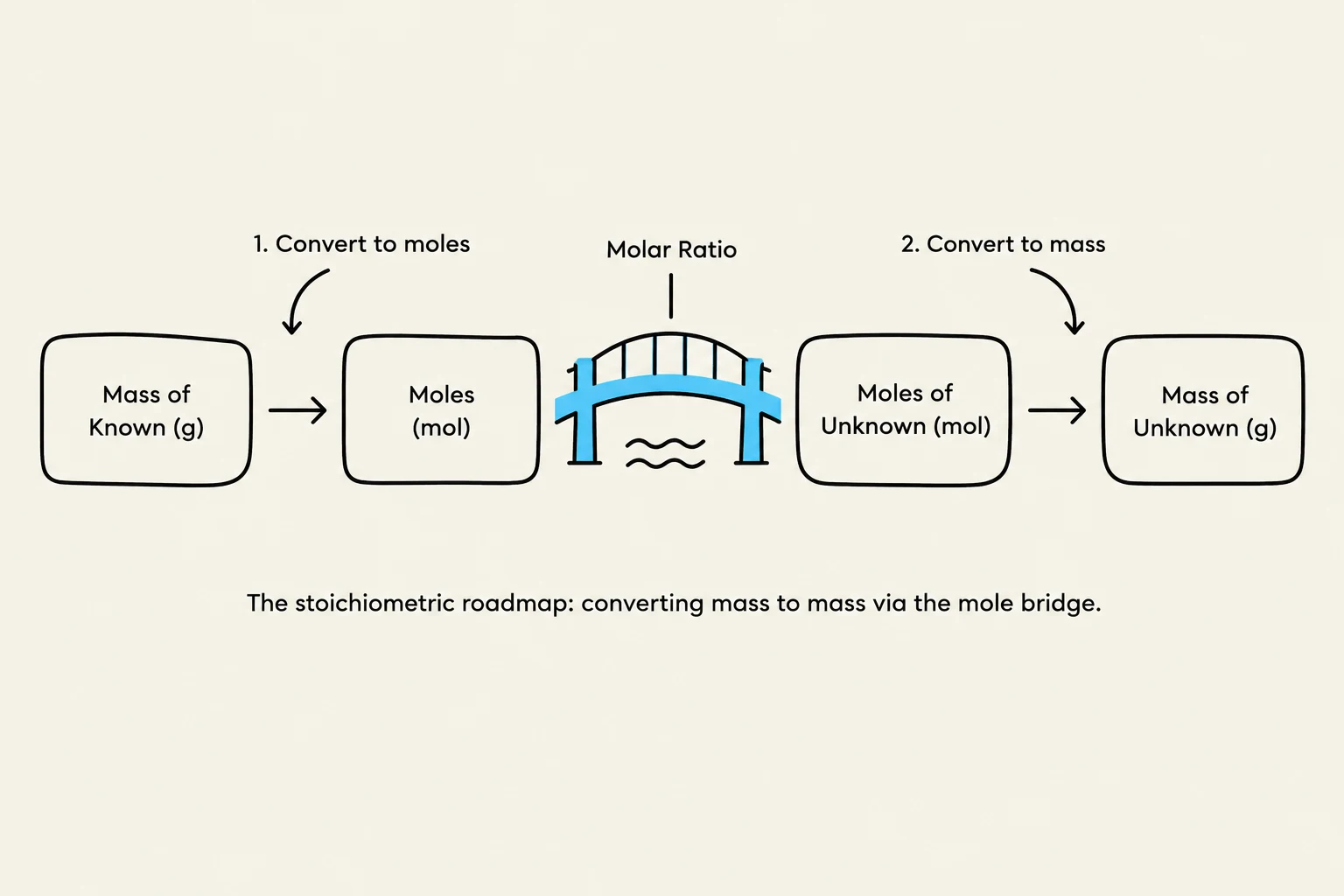
The stoichiometric roadmap illustrates the conversion of mass to mass using the mole bridge, involving steps to convert to moles and then back to mass.
To convert from the mass of one substance to the mass of another, you cannot simply jump from grams to grams. You must use the "Mole Bridge." The standard workflow follows these three essential steps:
Convert Mass to Moles: Use the molar mass of the substance (from the periodic table) to find how many moles you have.
Use the Molar Ratio: Use the coefficients from the balanced equation to convert from the moles of your "known" substance to the moles of your "unknown" substance.
Convert Moles back to Mass: Use the molar mass of the target substance to find the final mass in grams.
Worked Example: Mass-to-Mass Calculation
Question: How many grams of H2O are produced if 10.0 g of H2 reacts completely with excess O2?
Step 1: Convert grams of H2 to moles.
The molar mass of H2 is approximately 2.016 g/mol.
moles of H2=2.016 g/mol10.0 g≈4.96 mol
Step 2: Use the molar ratio.
From our balanced equation (2H2+O2→2H2O), the ratio of H2 to H2O is $2:2$, which simplifies to $1:1$.
moles of H2O=4.96 mol H2⋅(2 mol H22 mol H2O)=4.96 mol H2O
Step 3: Convert moles of H2O to grams.
The molar mass of H2O is approximately 18.02 g/mol.
mass of H2O=4.96 mol⋅18.02 g/mol≈89.4 g
Limiting Reactants and Excess Reactants
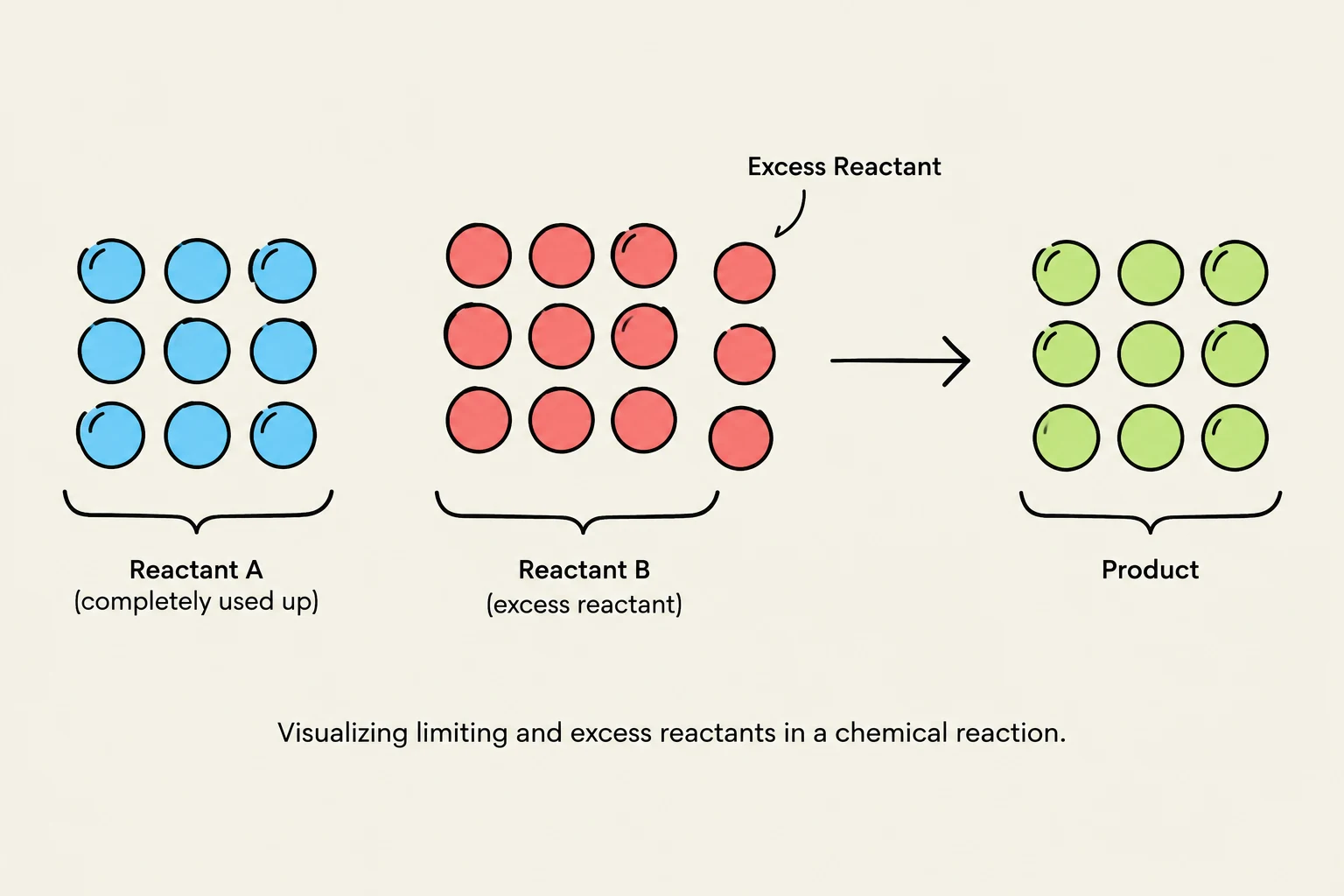
Visualizing limiting and excess reactants in a chemical reaction.
In real-world laboratory settings, reactants are rarely present in the exact stoichiometric proportions required by the equation. One reactant will typically run out first, stopping the reaction.
Limiting Reactant: The substance that is completely consumed first. It dictates the maximum amount of product that can be formed.
Excess Reactant: The substance that remains after the limiting reactant is exhausted.
To identify the limiting reactant, calculate the amount of product that each reactant could produce individually. The reactant that produces the smallest amount of product is your limiting reactant.
Theoretical vs. Percent Yield
This bar graph compares the theoretical yield of a product (the calculated maximum) to the actual yield measured in a laboratory setting, illustrating the concept of percent yield.
Even when we know the math perfectly, we rarely get 100% of the product in a lab. Factors such as side reactions, incomplete reactions, or loss of material during filtration can reduce the amount of product collected.
Theoretical Yield
The theoretical yield is the maximum amount of product that can be produced, calculated based on the limiting reactant using stoichiometry.
Actual Yield
The actual yield is the amount of product actually obtained from the experiment in a laboratory setting.
Percent Yield Calculation
To compare how efficient a reaction was, we calculate the percent yield using the following formula:
Note: A percent yield over 100% usually indicates an error, such as the product being wet (containing solvent) or containing impurities.
Summary Table for Stoichiometry
Term
Definition
Role in Calculation
Molar Ratio
Ratio of coefficients from a balanced equation
The "bridge" between different substances
Limiting Reactant
Reactant that runs out first
Determines the theoretical yield
Theoretical Yield
Calculated maximum product possible
The denominator in percent yield
Actual Yield
The real-world amount produced
The numerator in percent yield
By mastering these connections—from the balanced equation to the final percent yield—you can navigate almost any quantitative problem in chemical kinetics and thermodynamics.
Keep reading for free.
Create an account to finish this reading and make it part of your study routine.