Mastering Python: List Manipulation, Loops, and Functions
Explore fundamental Python programming concepts including list manipulation, iteration with for loops, and the use of functions with default parameters. This guide provides practical exercises to enhance problem-solving skills.
Python programming is a cornerstone of modern software development, prized for its readability and the powerful tools it provides to handle data structures efficiently. To move from a beginner to an intermediate level, a programmer must master the interplay between data containers (lists), control flow (loops), and reusable logic (functions). This article explores these core concepts through practical exercises designed to sharpen your problem-solving skills.
List Manipulation and Iteration
Lists are one of the most versatile data types in Python. They allow you to store collections of items and perform various operations to modify them. Mastering list manipulation involves understanding how to add, remove, and access elements based on their position or their value.
Managing Collections
A common task in programming is managing a list of items—such as a list of famous people—and performing specific removals. To truly understand lists, you should practice the following operations:
Extracting items: Removing the last item or extracting any item except the last one.
Targeted removal: Removing an item by knowing its specific index (location) or by knowing its actual content.
State checking: Writing logic to detect when a list has become empty and notifying the user.
Using For Loops for Data Processing
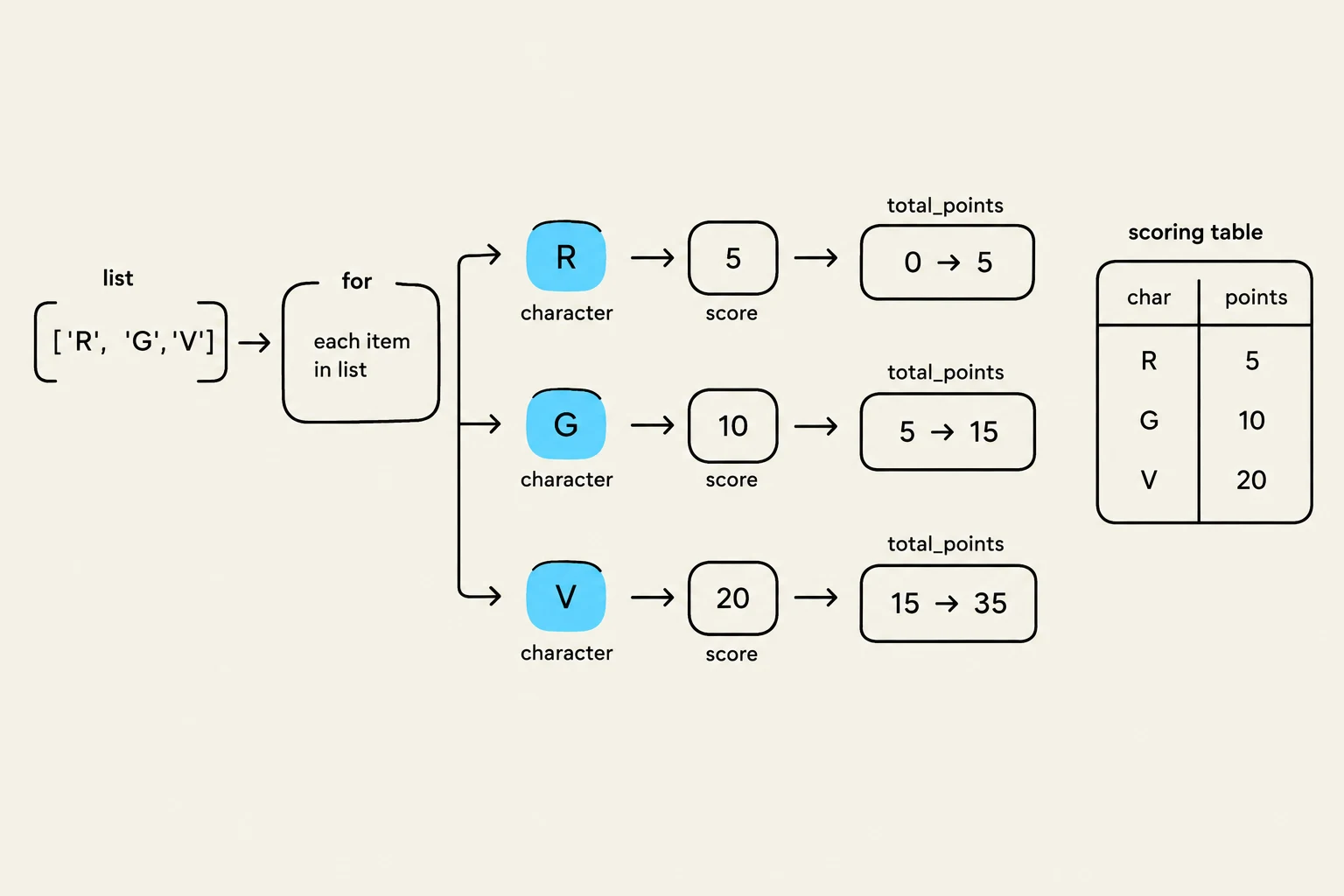
This diagram illustrates a scoring system where characters 'R', 'G', and 'V' are assigned scores of 5, 10, and 20 respectively. The diagram shows how these scores contribute to a total points range, with 'R' contributing 0-5, 'G' contributing 5-15, and 'V' contributing 15-35. A scoring table summarizes these assignments.
When you need to process every item in a collection, the for loop is your primary tool. A classic example is a scoring system. Imagine a game where you encounter different "aliens" identified by characters: 'R' (Red), 'G' (Green), or 'V' (Yellow).
By iterating through a list of these characters, you can assign points to each:
Red (R): 5 points
Green (G): 10 points
Yellow (V): 20 points
Using a for loop, you can traverse the list and maintain a running total of the points earned, demonstrating how loops turn raw data into meaningful information.
Exam Tip: When using loops to calculate totals, always initialize your accumulator variable (e.g., total_points = 0) outside the loop to avoid errors or incorrect resets during iteration.
Advanced List Techniques: Comprehension
Python offers a unique and concise way to create lists known as List Comprehension. This syntax allows you to generate a new list by applying an expression to each item in an existing iterable in a single line of code.
From Loops to Comprehension
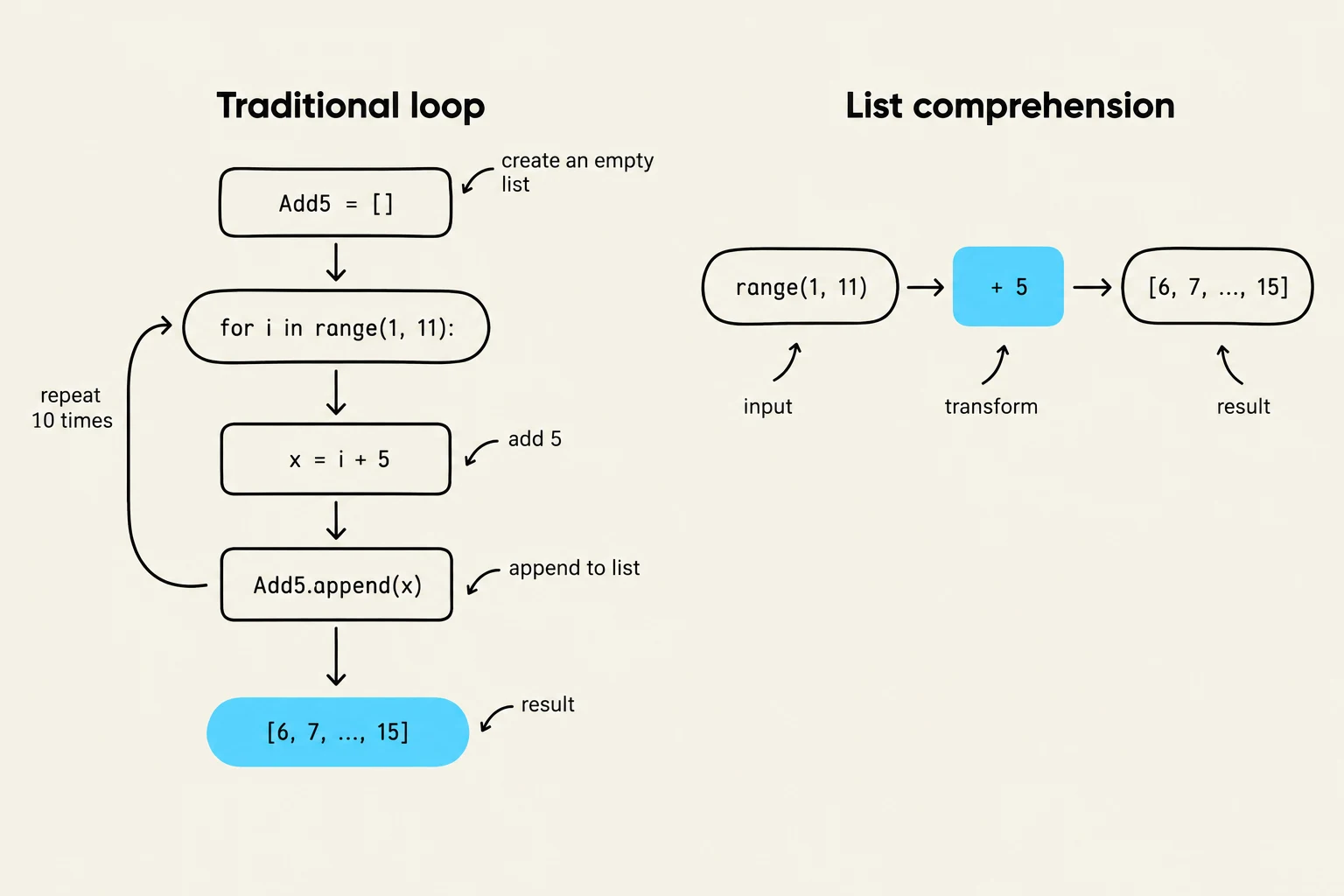
This diagram illustrates the difference between a traditional loop and a list comprehension in programming, showing how both achieve the same result of creating a list by adding 5 to each number in a range.
Consider the task of creating a list where every number from 1 to 10 has 5 added to it. A traditional approach would use a standard loop:
# Traditional way
Add5 = []
for num in range(1, 11):
    Add5.append(num + 5)
Using list comprehension, this becomes much more elegant:
# List comprehension way
Add5 = [num + 5 for num in range(1, 11)]
List comprehension is not just about math; it is excellent for string manipulation. For instance, if you have a list of five names, you can instantly create a second list that appends a compliment to each name, such as "she's a great person!", using a single line of code.
Functions and Default Parameters
Functions are blocks of reusable code that perform specific tasks. They help prevent repetition and make your programs modular.
The Power of Default Parameters
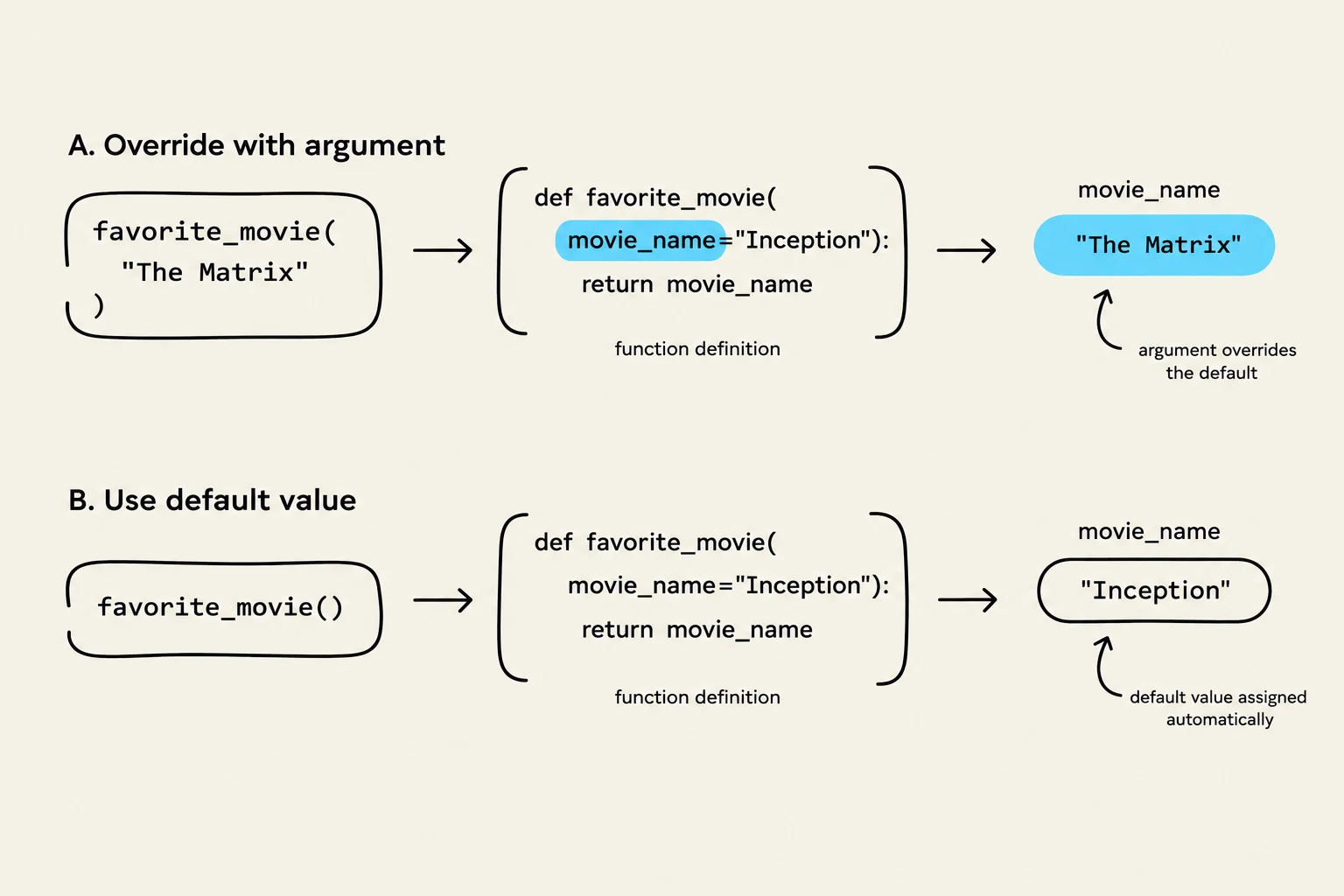
This diagram illustrates how default arguments work in programming. In section A, providing an argument overrides the default value. In section B, calling the function without an argument uses the default value.
One of the most useful features of Python functions is the ability to define default parameters. This allows a function to be called with or without certain arguments, providing a fallback value if the user doesn't specify one.
For example, if you write a function to announce a favorite movie, you can set a default movie title:
def favorite_movie(movie_name="Inception"):
    print(f"My favorite movie is {movie_name}.")

# Calling with an argument
favorite_movie("The Matrix")

# Calling without an argument (uses the default)
favorite_movie()
By providing a default value, your function becomes more flexible and robust, as it can handle different levels of input from the user.
Putting it All Together: A Logic Challenge
To bridge the gap between simple syntax and logical thinking, consider a geometry problem. You might be asked to write a program that takes three sides of a triangle ($A, B, C$) from a user and determines if it is a right-angled triangle.
If the sides satisfy the Pythagorean theorem:
A2+B2=C2
(assuming C is the longest side), the program should calculate the area. If it is not a right-angled triangle, the program should instead calculate the perimeter. This exercise requires combining user input, conditional logic (if/else), and mathematical formulas, providing a comprehensive test of your Python proficiency.
Keep reading for free.
Create an account to finish this reading and make it part of your study routine.