


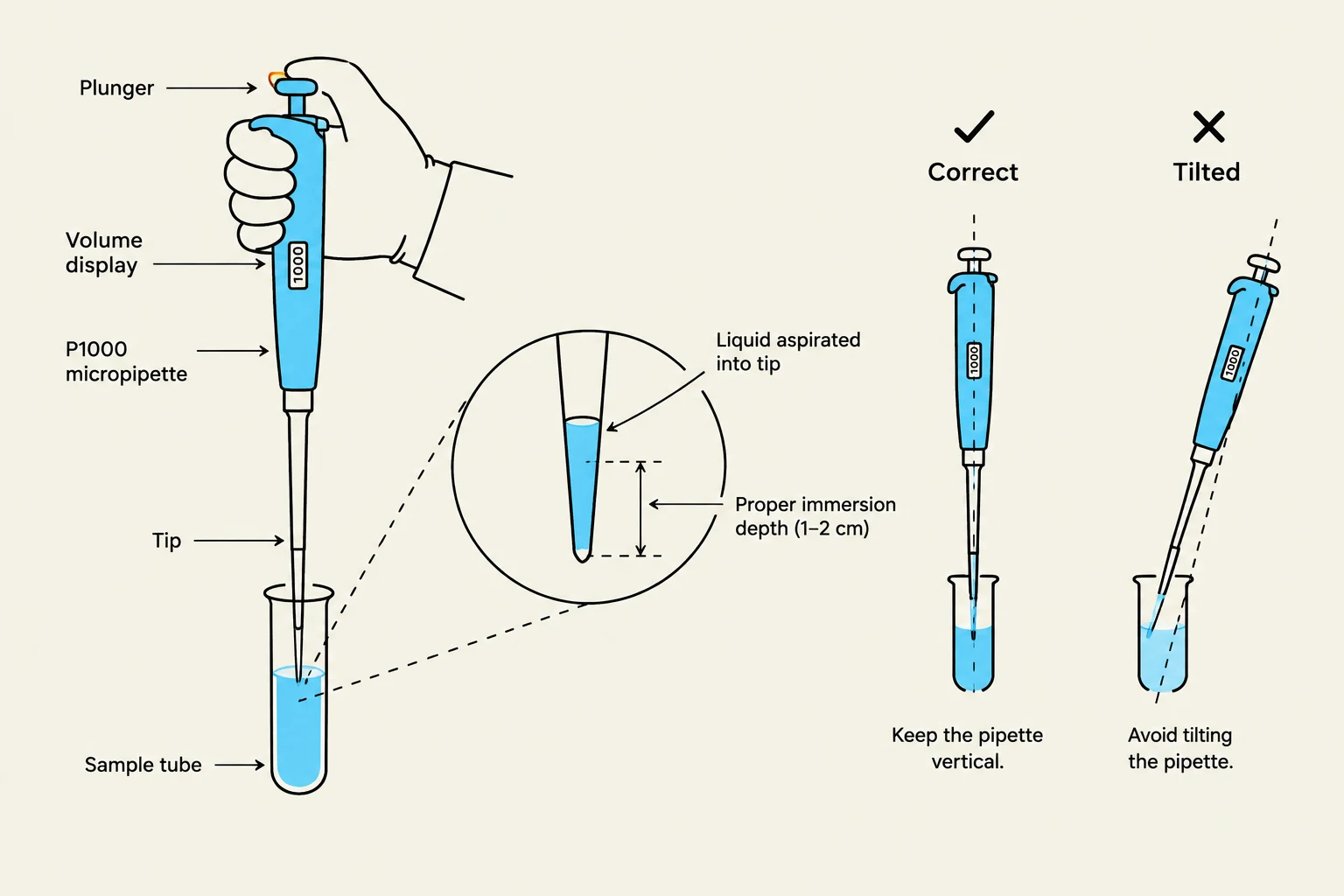
In the field of molecular biology, precision is the foundation of reproducible science. Whether you are preparing a restriction digest, performing a ligation, or conducting a transformation, your success depends heavily on your ability to transfer exact volumes of liquid. Pipetting is not merely a mechanical task; it is a technical skill that requires mastery of different instruments, an understanding of fluid dynamics, and a disciplined approach to error calculation. This article explores the two primary methods of liquid handling—serological pipetting and micropipetting—and provides the mathematical framework necessary to verify your accuracy.
Serological Pipetting and Accuracy Verification
Serological pipettes are typically used for larger volumes of liquid, such as when preparing buffers or handling media. While they are efficient, they are prone to human error, making it essential to periodically verify your technique using mass-based calibration.
To verify the accuracy of a serological pipette, you can use the known density of water. At room temperature, the density of water is approximately . By weighing the water you have dispensed, you can compare the "measured weight" against the "calculated weight" that should theoretically exist based on the volume and density.
Calculating Percent Error
To quantify your precision, you must calculate the percent error (% error). This value tells you how much your manual technique deviates from the theoretical ideal. Use the following formula:
Pro-Tip: In a standard laboratory setting, an error margin of is considered acceptable. However, if your calculated error exceeds $5%$, it is a clear signal that you must stop and review your pipetting technique to avoid compromising your experiments.

Keep reading for free.
Create an account to finish this reading and make it part of your study routine.
Continue reading freeAlready have an account? Log in
Updated