Mastering Biomedical Informatics: A Comprehensive Study Guide
This guide provides a structured review of the core domains in Biomedical Informatics (BMI), covering clinical informatics, imaging informatics, public health informatics, health information systems, policy, standards, terminologies, privacy, ethics, patient safety, and clinical methodology.
Biomedical Informatics (BMI) is a multidisciplinary field situated at the intersection of information science, computer science, and healthcare. While often confused with bioinformatics—which focuses primarily on biological data like DNA sequences—BMI has a much broader scope, applying computational methods to human health, clinical practice, and public health. This guide serves as a structured review of the core domains required for mastering the subject, from technical standards to clinical methodologies.
The Domains of Informatics
Informatics is not a monolith; it is divided into specialized sub-disciplines that address different aspects of the healthcare ecosystem.
Clinical Informatics: This domain focuses on the "point of care," aiming to improve clinical workflows and decision-making through tools like Clinical Decision Support (CDS).
Imaging Informatics: This field manages and analyzes medical imagery, ensuring that complex visual data is accessible and useful for diagnosis.
Public Health and Consumer Informatics: These areas shift the focus from the individual to the population, looking at how data can improve community health outcomes and how patients can interact with their own health data.
This diagram illustrates the intersection of Clinical Informatics, Imaging Informatics, and Public Health Informatics, with Biomedical Informatics at the center.
Exam Tip: If a question asks for the difference between Bioinformatics and Biomedical Informatics, remember that BMI is broader and specifically emphasizes human health applications.
Health Information Systems and Policy
The modern healthcare landscape has transitioned from paper records to Electronic Health Records (EHR), a shift catalyzed by significant legislative frameworks.
Legislation and Meaningful Use
The HITECH Act and the Affordable Care Act provided the momentum for widespread EHR adoption. A critical concept here is Meaningful Use, which dictates that simply having an EHR is insufficient; providers must use the technology in ways that demonstrably improve patient outcomes.
Data Exchange and Interoperability
For healthcare to function effectively, data must move between different organizations. This is known as Health Information Exchange (HIE). To ensure this happens without friction, the Trusted Exchange Framework and Common Agreement (TEFCA) was established to create a unified network. A major hurdle in this process is information blocking, where providers or vendors intentionally interfere with the exchange of health information, a practice discouraged by the 21st Century Cures Act.
Standards, Terminologies, and Interoperability
Interoperability is the ability of different systems to exchange and, more importantly, use the information effectively. This requires two distinct layers of standardization: structural standards and terminology standards.
Structural and Messaging Standards
These standards define the "envelope" or the format in which data is sent.
HL7 (Health Level Seven): A foundational set of standards for exchanging clinical data.
CDA (Clinical Document Architecture): A standard for structured clinical documents.
FHIR (Fast Healthcare Interoperability Resources): The modern standard that utilizes RESTful APIs to allow web-based, granular data exchange.
Health Data Terminologies
Even if two systems can "talk" (structural interoperability), they must speak the same language (semantic interoperability). Without standardized codes, a "heart attack" in one system might be recorded as "myocardial infarction" in another, causing confusion.
Terminology Type
Standard
Purpose
Clinical Terms
SNOMED CT
Comprehensive clinical vocabulary
Laboratory
LOINC
Identification of laboratory observations
Medications
RxNorm
Standardized names for clinical drugs
Diagnoses
ICD-10-CM
International classification of diseases
Procedures
CPT
Current Procedural Terminology
To integrate these various "languages," informatics uses Ontologies and tools like the UMLS (Unified Medical Language System), which provides a bridge between different terminologies.
Privacy, Ethics, and Patient Safety
As healthcare becomes more data-driven, protecting Protected Health Information (PHI) becomes paramount. In the United States, HIPAA provides the legal framework for safeguarding this data.
Privacy Concepts
Contextual Integrity: The idea that data privacy is not just about secrecy, but about ensuring information flows in ways that are appropriate to the context (e.g., a doctor seeing your records is appropriate; a marketer seeing them is not).
The Transparency Paradox: The tension between needing to be transparent about data usage and the overwhelming complexity of privacy notices that patients often cannot fully grasp.
Enhancing Patient Safety
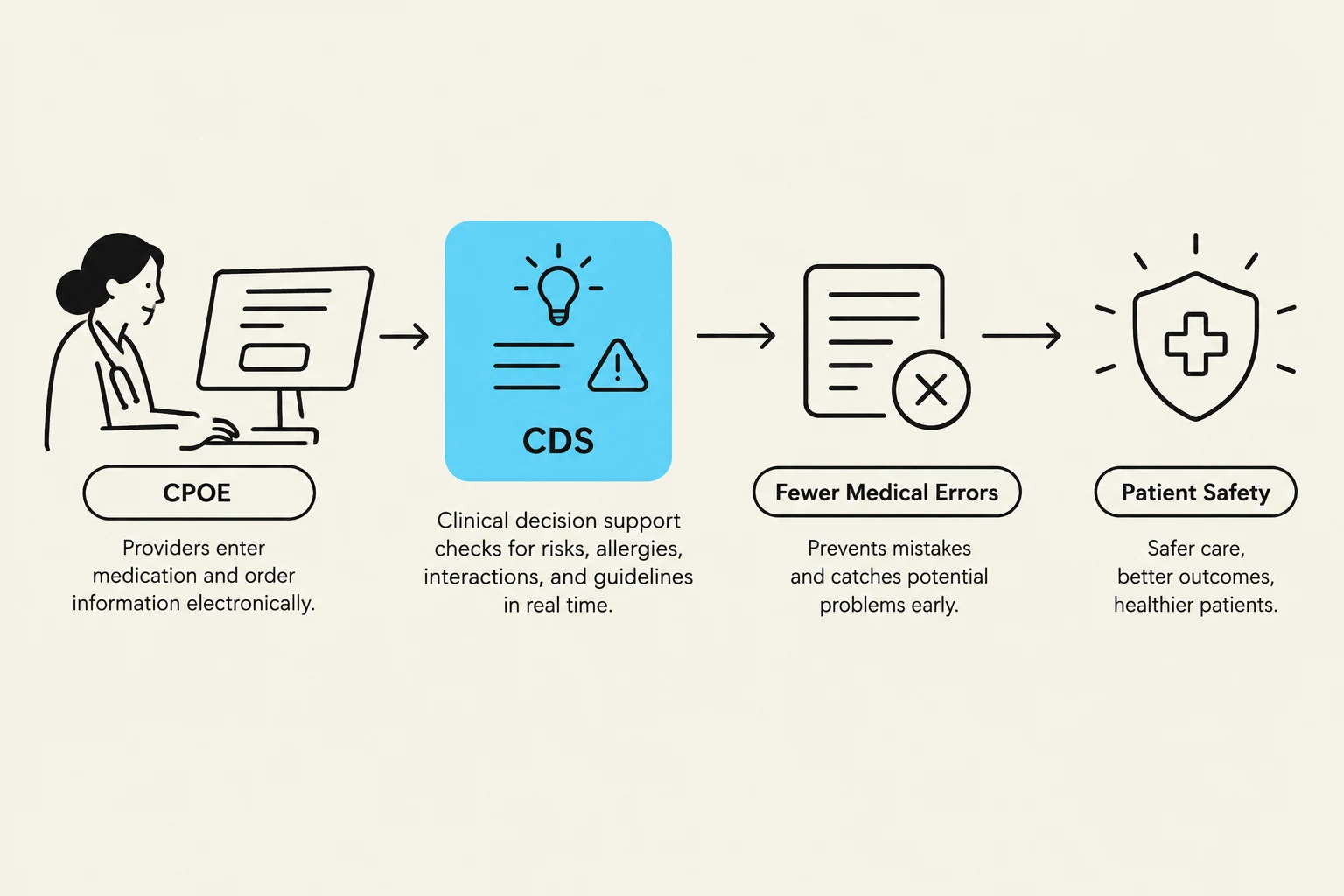
Informatics is a powerful tool for reducing medical errors. Clinical Decision Support (CDS) provides real-time alerts to clinicians, while Computerized Provider Order Entry (CPOE) reduces errors associated with handwriting and manual entry. However, designers must account for human factors and EHR usability; if a system is difficult to use, it can actually create new safety risks.
This diagram illustrates the process of Computerized Provider Order Entry (CPOE) and Clinical Decision Support (CDS) leading to fewer medical errors and improved patient safety.
Clinical Methodology and Personalized Medicine
Finally, informatics supports the highest levels of clinical decision-making through Evidence-Based Medicine (EBM). EBM relies on a hierarchy of evidence, distinguishing between different study designs, such as prospective cohorts (following a group forward in time) and retrospective cohorts (looking back at existing data).
The future of the field lies in Personalized (or Precision) Medicine, where clinical decisions are tailored to an individual's unique makeup. A key component of this is Pharmacogenomics (PGx), the study of how a person's genes affect their response to drugs. By integrating genetic data into the EHR, clinicians can move from a "one size fits all" approach to highly targeted, effective therapies.
Summary Checklist for Students:
Can you distinguish between SNOMED CT and LOINC?
Do you understand the role of the HITECH Act in EHR adoption?
Can you explain the difference between usability and usefulness?
Do you know the difference between a prospective and retrospective study?
Keep reading for free.
Create an account to finish this reading and make it part of your study routine.