Mastering Audience Awareness in Professional Communication
Learn to tailor your messages for maximum impact by understanding intended and unintended audiences, analyzing audience knowledge, relationship, and size, and selecting the right communication channels.
In professional communication, success is not measured by how much you say, but by how well your message is received. Effective communication is "audience-centered," meaning the primary goal is to ensure the audience receives the message exactly as the sender intended. To achieve this, a communicator must move beyond simply writing words; they must engage in a deliberate process of analyzing who is reading, how they will interpret the message, and who else might see it.
Understanding Intended and Unintended Audiences
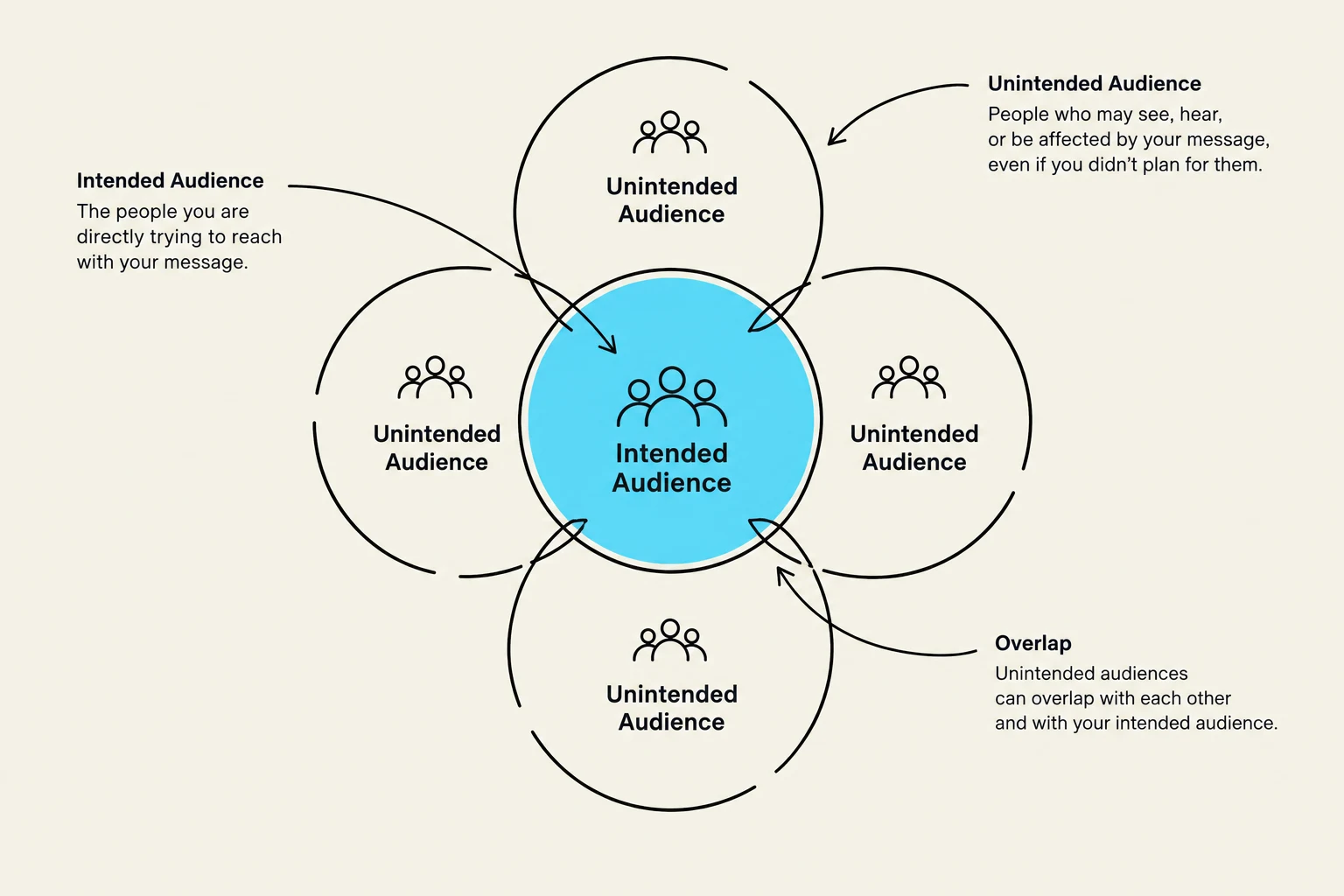
Every piece of professional communication has a target. This is known as the intended audience: the specific group or individual the message is aimed at. Whether you are a professor emailing a class about an assignment extension or a company posting a job opening on LinkedIn, your tone, detail, and word choice should be tailored to this group.
However, professional messages rarely exist in a vacuum. You must also account for the unintended audience—groups that might receive, see, or be affected by the message even though it was not meant for them.
Critical Awareness: You have no control over what happens to an email once it is sent. Messages can be forwarded, screenshotted, or shared. Furthermore, in a workplace setting, employers often have the right to access email logs, meaning company communications can be stored and retrieved later.
When drafting any message, always ask yourself: "Who could realistically see this?".
This diagram illustrates the concepts of intended and unintended audiences in communication, showing how unintended audiences can overlap with the intended audience and with each other.
The Process of Audience Analysis
To craft efficient messages, you must prioritize the "Preparing" stage of the writing process. This involves a deep dive into audience analysis, which looks at several key dimensions:
1. Audience Size and Scope
Writing to a single individual is relatively straightforward. However, as the audience size increases, your language must become more general, familiar, unbiased, and accessible. When addressing large, diverse groups, it is vital to use inclusive language, such as gender-neutral plural pronouns (they, them, their), and to avoid idioms or clichés that might not be understood by everyone.
2. Level of Knowledge
One of the most common communication failures is a mismatch in the audience's knowledge level.
Too much detail: You risk wasting the reader's time.
Too little detail/Too much jargon: You risk causing confusion, miscommunication, or even insulting the reader.
To improve readability, use plain, accessible language instead of industry jargon. You can also design documents for easier scanning by using brief, bolded headings, subheadings, lists, and diagrams.
3. Relationship and Demographics
Your professional or personal relationship with the audience dictates the level of formality required. Additionally, understanding demographics—such as age, ethnicity, ability, and orientation—helps you avoid bias and ensure your message is respectful and non-judgmental.
This diagram illustrates key factors to consider when delivering a message, including audience knowledge, audience size, relationship with the audience, and the potential for an unintended audience.
Soft Skills: Tact and Emotional Intelligence
Beyond the technical aspects of writing, successful communicators rely on "soft skills" to navigate complex social dynamics.
Tact: The ability to deliver information in a way that is sensitive and avoids giving offense.
Emotional Intelligence (EQ): The capacity to be aware of your own emotions and those of others to manage interactions successfully.
Nonverbal Cues: In face-to-face or virtual settings, the ability to read body language and "read between the lines" is essential for understanding the true sentiment behind a message.
Selecting the Right Channel
The "channel" is the medium you use to send your message. Choosing the wrong channel can lead to misinterpretation or a lack of necessary documentation.
Channel
Best Used For
Strengths
Limitations
Email
Professional, detailed, documented communication
Record-keeping, asynchronous
Can be misinterpreted; slower
Text Message
Quick updates, urgent reminders
Fast, high open rate
Not for formal/detailed messages; can be intrusive
In-Person
Sensitive subjects, relationship building
Personal connection, immediate feedback
No automatic record; time/location constraints
Virtual Meetings
Remote collaboration, presentations
Visual cues, connects dispersed teams
Technical issues, "Zoom fatigue"
Pro-Tip: When dealing with sensitive or highly emotional subjects, always opt for in-person communication to leverage body language and immediate feedback.
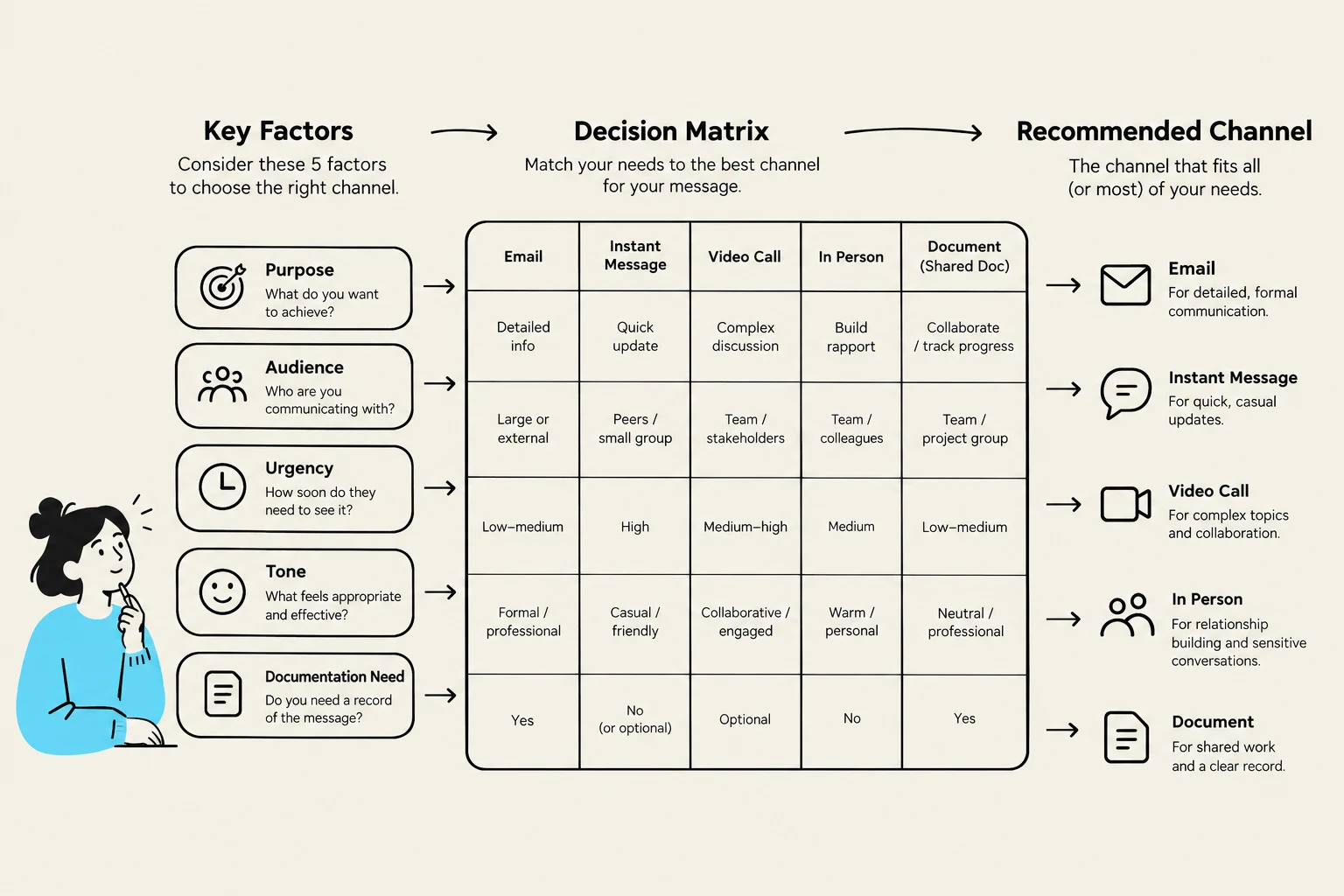
This diagram illustrates a decision matrix for selecting the appropriate communication channel based on key factors such as purpose, audience, urgency, tone, and documentation needs.
Summary Checklist for Communicators
Before you click "send" or walk into a meeting, run through this final analysis to ensure your communication is effective:
Knowledge: How much background explanation does my audience need?
Relationship: How formal or informal should my tone be?
Size: Does my language need to be more general and inclusive?
Needs: What specific information matters most to this reader?
Unintended Audience: Would I be comfortable if this message were forwarded or shared with others?
By considering these factors, you transform from a mere sender of information into a professional communicator capable of driving meaningful results.
Keep reading for free.
Create an account to finish this reading and make it part of your study routine.