In the world of business, your strategy is not determined in a vacuum. Whether you are setting prices, deciding how much to produce, or planning for future growth, your decisions are heavily influenced by the competitive environment surrounding you. This environment is known as the market structure. Understanding your market structure is the first step in determining your market power—the extent to which you can raise prices without losing a significant number of customers to competitors.
The Spectrum of Market Power
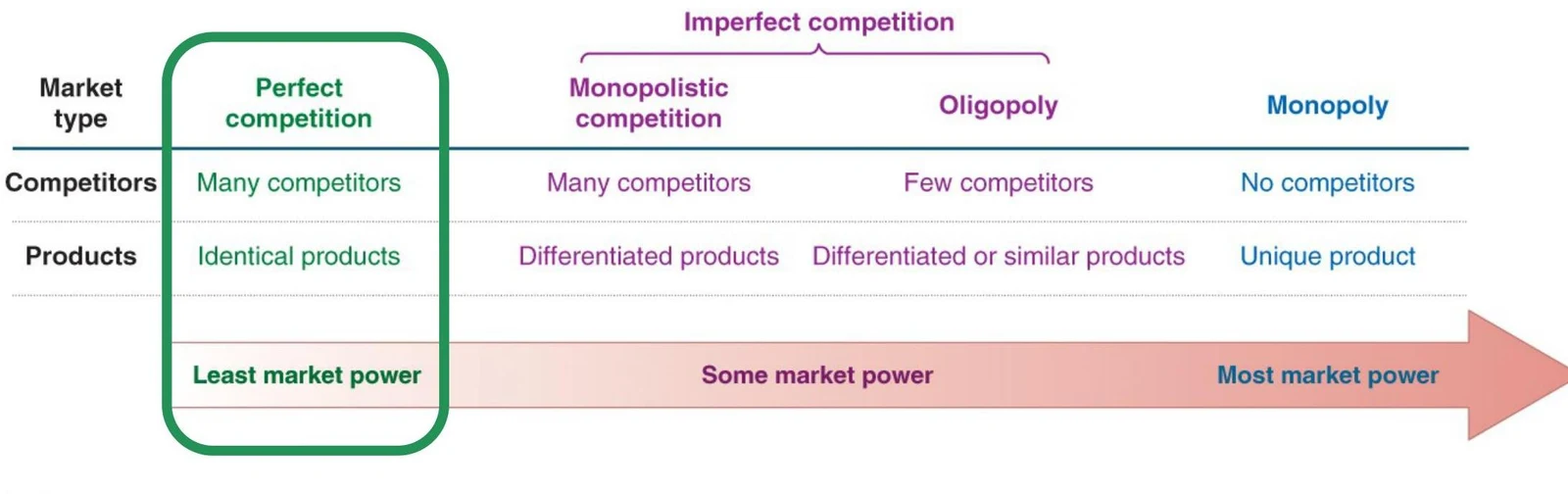
Market structures are not isolated categories; rather, they exist on a spectrum ranging from zero market power to absolute market power. This spectrum is defined by two primary factors: the number of competitors in the market and the degree of product differentiation.
1. Perfect Competition (Least Market Power)
In a perfectly competitive market, there are many buyers and many sellers, and all businesses sell identical goods. Because the products are indistinguishable (such as corn in agricultural markets or shares of a specific stock), no single seller has the power to influence the price.
In this scenario, you are a price-taker. You must accept the prevailing market price; if you raise your price even slightly, customers will immediately switch to a competitor.
2. Monopolistic Competition (Some Market Power)
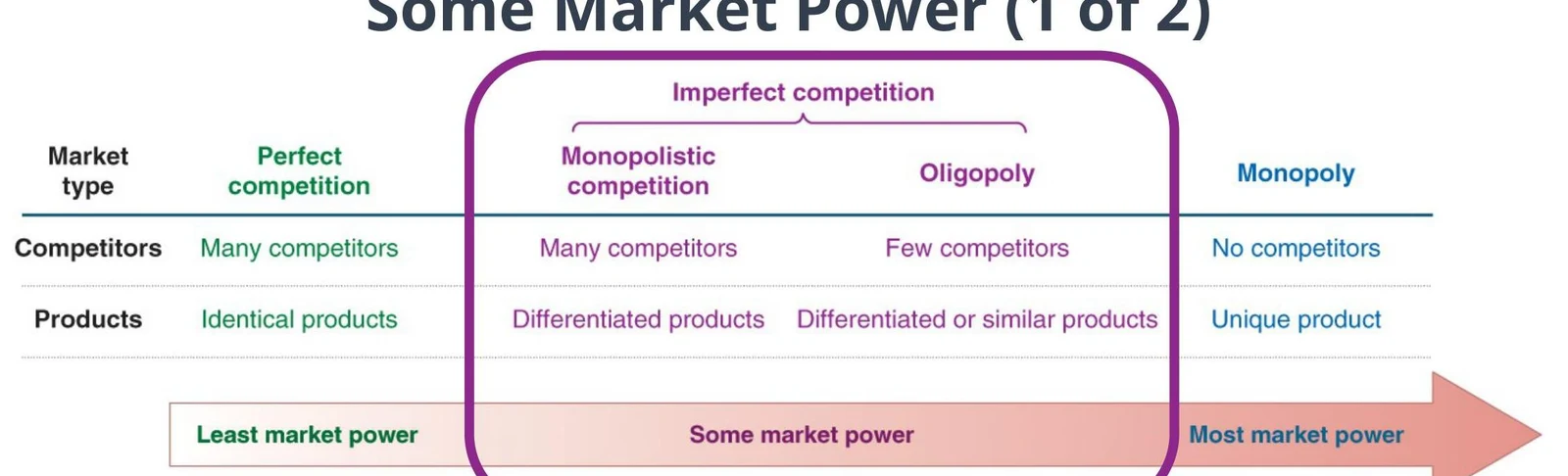
This structure involves many small businesses competing against one another, but they do not sell identical products. Instead, they engage in product differentiation—the process of making their products stand out through brand image, quality, service, or unique features.
For example, while many companies sell jeans, a consumer might choose Levi's over a generic brand due to specific cuts or quality. This differentiation grants the seller "some" market power, meaning they can raise prices slightly without losing all their customers.
3. Oligopoly (Some Market Power)
An oligopoly is a market dominated by a handful of large sellers. Because there are so few players, businesses must engage in strategic interaction. This means that when you make a pricing or output decision, you must carefully consider how your rivals will respond. A classic example is the cellular service market, dominated by a few major players like AT&T and Verizon.
4. Monopoly (Most Market Power)
A monopoly exists when there is only one seller in the market. In this case, the firm has significant market power and is not a price-taker. While a monopolist can raise prices without losing customers to direct competitors, they must still be mindful of the law of demand—customers may eventually switch to alternative products (substitutes) if the price becomes too high.
This chart illustrates different market types, categorizing them by competition, product characteristics, and market power. It distinguishes between perfect competition, monopolistic competition, oligopoly, and monopoly.This table illustrates different market types, including perfect competition, monopolistic competition, oligopoly, and monopoly, based on the number of competitors and product differentiation, and their corresponding market power.
Setting Prices with Market Power
When you possess market power, you are no longer a price-taker; you are a price-setter. However, setting the right price requires balancing two opposing forces: the desire for high margins and the reality of consumer demand.
The Firm's Demand Curve
To set prices, you must understand your firm demand curve, which illustrates how much quantity buyers will demand from your specific business at various price points.
Low Market Power: Your demand curve is relatively flat (highly elastic). A small price increase leads to a sharp drop in sales.
High Market Power: Your demand curve is steeper (inelastic). Customers are less responsive to price changes.
Monopoly: Your firm's demand curve is essentially the same as the entire market's demand curve.
Marginal Revenue and the Rational Rule
To maximize profit, you must use the marginal principle to decide how many units to sell. You should continue selling as long as the marginal revenue (the addition to total revenue from selling one more unit) is greater than or equal to the marginal cost.
Calculating marginal revenue involves understanding two effects:
The Output Effect: The revenue gained from selling an additional unit (equal to the price of that unit).
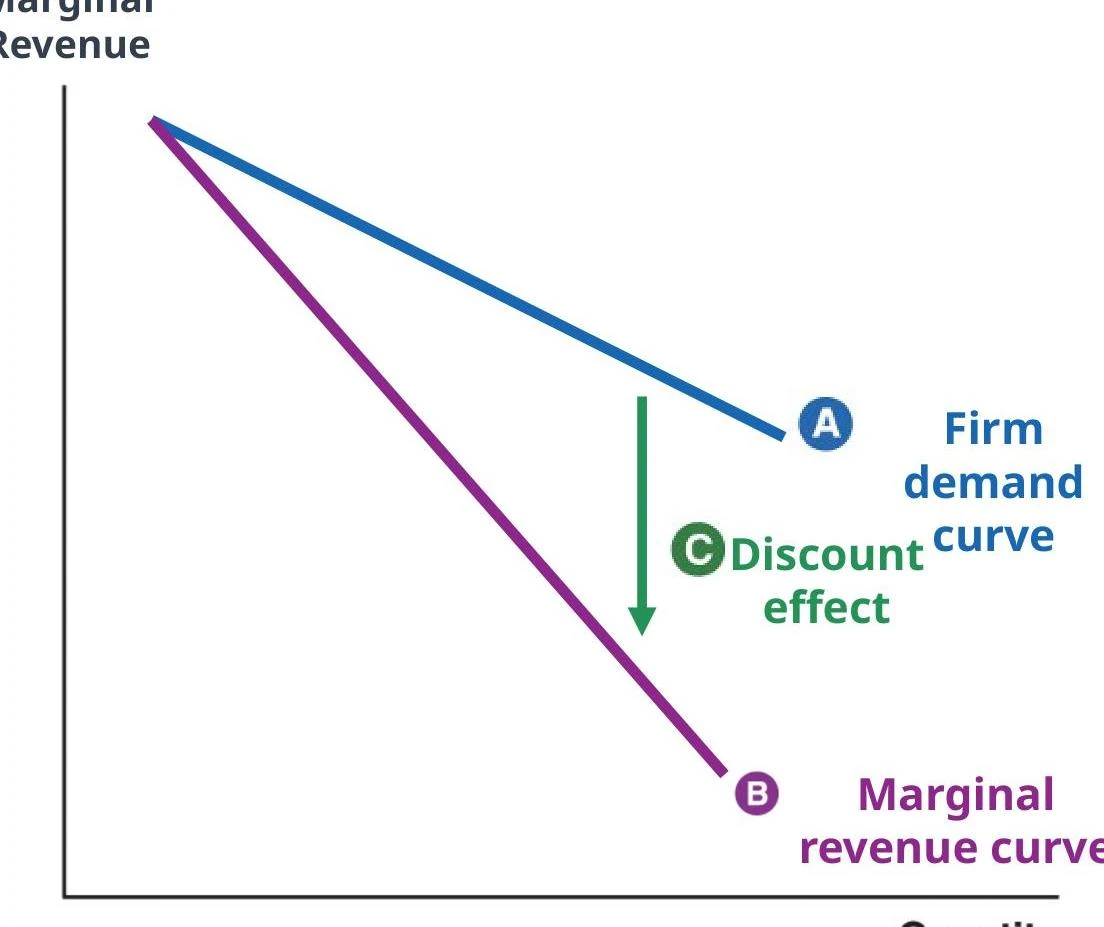
The Discount Effect: The revenue lost because you had to lower the price on all previous units to sell that extra unit.
Marginal Revenue=Output Effect−Discount Effect
The Rational Rule for Sellers:
Find the quantity where Marginal Revenue = Marginal Cost.
Look at your Demand Curve to find the highest price customers are willing to pay for that specific quantity.
This graph illustrates the relationship between marginal revenue and quantity, showing a firm demand curve and a marginal revenue curve, with an indicated discount effect.
The Problem with Market Power
While market power increases profits for businesses, it often leads to "worse outcomes" for society as a whole. Compared to a perfectly competitive market, a market with high market power typically results in:
Higher prices for consumers.
Inefficiently smaller quantities produced (underproduction).
Larger economic profits for the firm.
Inefficiently high costs, as firms with market power feel less pressure to cut costs.
A historical example is the pricing of early AIDS medications. Due to patent protections that granted monopoly status, drugs that cost less than $1 to produce were sold for $$10,000$ per year, making them unaffordable for millions.
Public Policy and Regulation
Because market power can distort market forces, governments use various policies to balance the tension between business profitability and societal welfare.
Ensuring Competition (Antitrust Policy)
Governments implement competition policy (or antitrust policy) to ensure markets remain competitive. This includes:
Anti-collusion laws: Preventing businesses from agreeing to limit competition (collusion).
Merger laws: Blocking mergers that would substantially lessen competition.
Preventing Monopolization: Making it illegal to use "exclusionary practices" or "predatory pricing" to drive rivals out of business.
Encouraging International Trade: Making it harder for domestic firms to build up excessive market power.
Minimizing Harm
In cases where competition is not feasible, such as natural monopolies (e.g., water or electric companies where it is most efficient for one firm to serve the whole market), governments may intervene directly. They might use price ceilings to prevent monopolies from charging excessive prices or implement direct regulations on how these essential services are managed.
Keep reading for free.
Create an account to finish this reading and make it part of your study routine.