This content explains how firms use demand curves and marginal revenue to set prices and determine optimal quantities based on market power. It covers different market structures, the tools for setting prices, and the economic impact of market power.
In the world of business, your pricing strategy is not a decision made in a vacuum. It is heavily dictated by the environment in which you operate, known as your market structure. Whether you are a small farmer selling corn or a massive pharmaceutical company with a patented life-saving drug, the level of competition you face determines how much control you have over your own prices. This degree of control is what economists call market power.
Understanding Market Power and Market Structure
Market power is defined as the extent to which a seller can charge a higher price without losing many sales to competing businesses. If you have high market power, you are a "price-setter"; if you have no market power, you are a "price-taker".
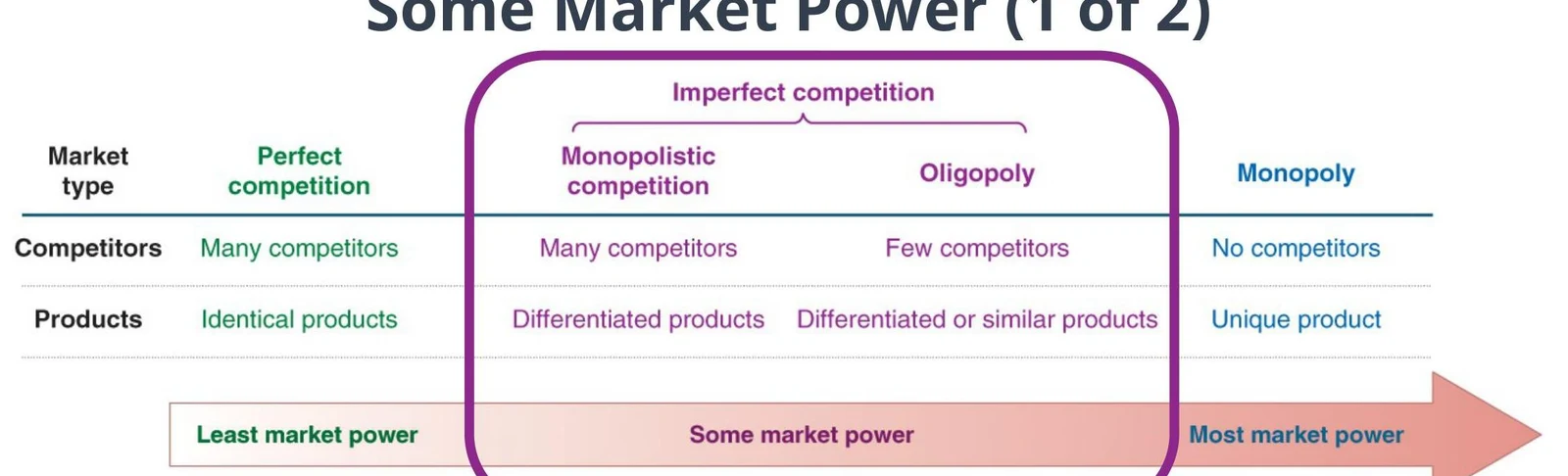
Market structures exist on a spectrum, ranging from no market power to total market power:
Perfect Competition: This is a market with many buyers and many sellers offering identical goods (such as agricultural commodities or gold). In this structure, businesses have no market power. If you raise your price even slightly, customers will immediately buy from someone else.
Monopolistic Competition: Here, many small businesses compete, but they sell differentiated products. Differentiation can be based on brand, quality, or service (like different types of jeans or apples). Because your product is slightly unique, you have some market power.
Oligopoly: This market is dominated by a handful of large sellers. Because there are so few players (like the cellular service industry), you have substantial market power and must engage in strategic interaction, meaning your pricing decisions depend on how your rivals respond.
Monopoly: This occurs when there is only one seller in the market. A monopolist has the most market power and can set prices significantly above marginal costs.
This table illustrates different market types, including perfect competition, monopolistic competition, oligopoly, and monopoly, based on the number of competitors and product differentiation, and their corresponding market power.
Tools for Setting Prices: Demand and Revenue
When you possess market power, you face a critical trade-off: if you set the price too low, your profit margins disappear; if you set it too high, you won't sell enough units. To navigate this, firms use two primary analytic tools: the firm demand curve and the marginal revenue curve.
The Firm Demand Curve and Elasticity
The firm demand curve illustrates how the quantity demanded from your specific business changes as you change your price. It is important to distinguish this from the market demand curve, which represents the total demand across all firms in an industry.
The shape of your demand curve is determined by the price elasticity of demand—how sensitive your customers are to price changes:
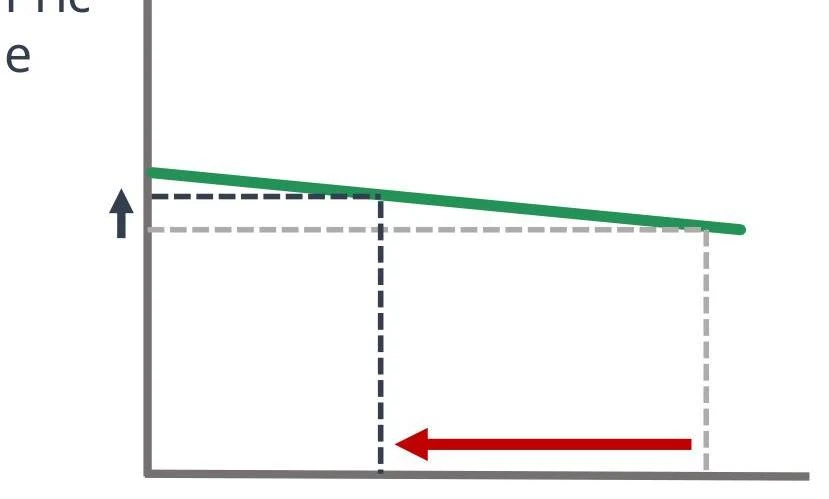
Low Market Power: Your demand curve is relatively flat (highly elastic). A small price increase causes a sharp drop in quantity sold.
High Market Power: Your demand curve is relatively steep (inelastic). Customers are less responsive to price hikes, meaning you lose fewer sales when you raise prices.
A graph illustrating a downward sloping curve with an upward arrow indicating an increase on the y-axis and a red arrow indicating a decrease on the x-axis.
The Marginal Revenue Curve
To decide how many units to sell, firms apply the marginal principle and the cost-benefit principle. Specifically, you must calculate marginal revenue (MR): the additional revenue gained from selling one more unit.
Calculating MR involves understanding two opposing forces that occur when you lower your price to sell more units:
The Output Effect: You gain revenue from the new units sold. This effect is equal to the price of the extra item.
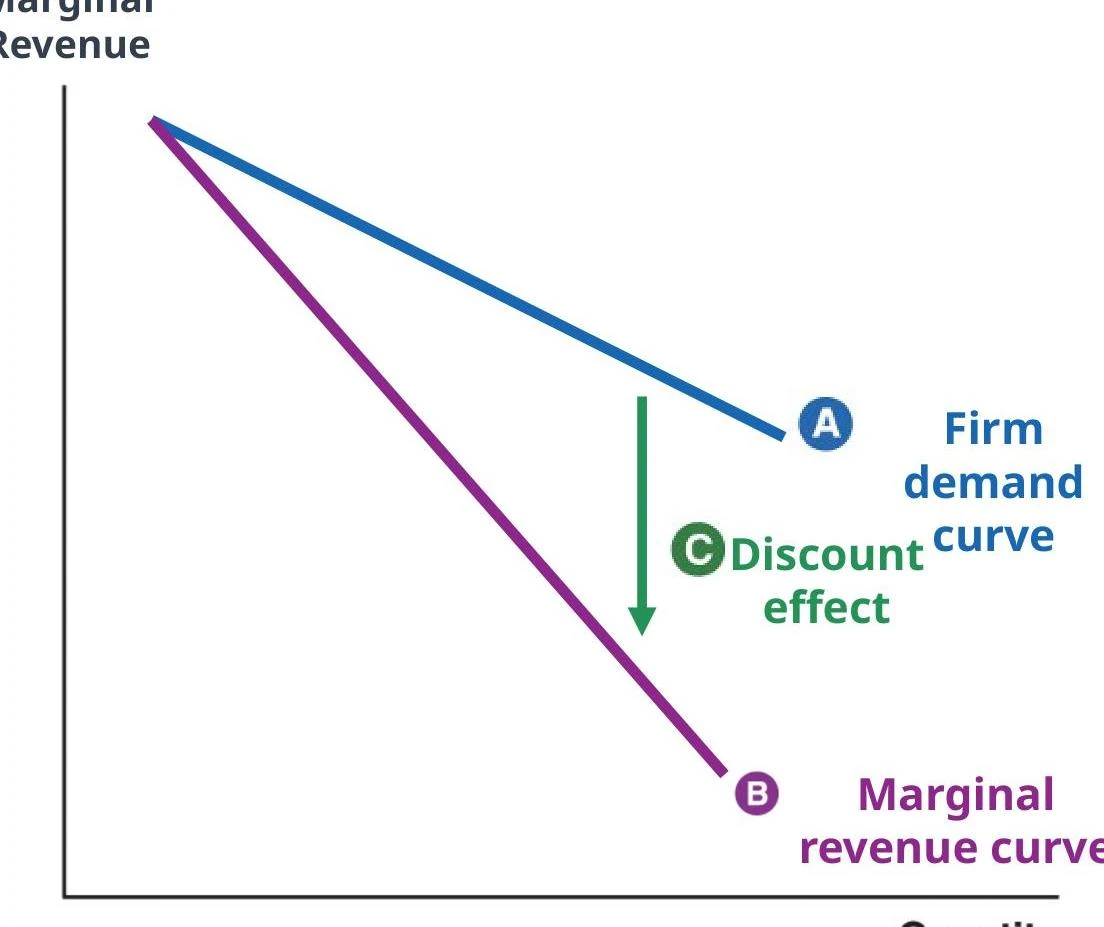
The Discount Effect: To sell that extra unit, you must lower the price on all previous units you were selling. This results in a loss of revenue.
Therefore, the relationship is:
Marginal Revenue=Output Effect−Discount Effect
Because of the discount effect, the marginal revenue curve always lies below the firm's demand curve and declines more sharply.
This graph illustrates the relationship between marginal revenue and quantity, showing a firm demand curve and a marginal revenue curve, with an indicated discount effect.
The Rational Rule for Sellers
To maximize profit, sellers follow a specific two-step process:
Step 1: Determine Quantity
Apply the rational rule for sellers: Keep producing more units as long as the marginal revenue is greater than or equal to the marginal cost (MR≥MC). The optimal quantity is found exactly where $MR = MC$.
Step 2: Determine Price
Once you have determined the optimal quantity, do not look at the marginal revenue curve to set your price. Instead, look at the demand curve to see the highest price customers are willing to pay for that specific quantity.
Exam Tip: When graphing the solution, always find the intersection of MR and MC to find the quantity ($Q^$), but then move vertically up to the demand curve to find the profit-maximizing price ($P^$).
The Economic Impact of Market Power
While market power is beneficial for firms, it often leads to "worse outcomes" for society. Compared to a perfectly competitive market, a market with significant market power results in:
Higher prices for consumers.
Inefficiently smaller quantities produced (underproduction).
Larger economic profits for the firm.
Inefficiently high costs, as firms have less pressure to innovate or cut costs when they face no competition.
To combat these issues, governments use competition policy (or antitrust policy) to ensure markets remain competitive. This includes anti-collusion laws to prevent businesses from acting like a single monopoly, merger laws to prevent excessive consolidation, and regulations to manage natural monopolies (like utility companies where it is most efficient for only one firm to exist).
Keep reading for free.
Create an account to finish this reading and make it part of your study routine.