Examines how government interventions like price ceilings, price floors, and quotas affect market efficiency, leading to unintended consequences such as shortages, surpluses, and deadweight loss.
In an ideal market, prices act as a sophisticated communication system. They signal to producers what to make and to consumers what to buy, guiding resources toward their most efficient uses. However, governments often intervene in these markets to achieve social or political goals. While these interventions—known as price and quantity controls—are often well-intentioned, they frequently lead to unintended consequences, including shortages, surpluses, and significant economic waste.
Price Controls: Ceilings and Floors
Price controls are legal restrictions on how high or low a market price may go. There are two primary forms of intervention: price ceilings and price floors.
Price Ceilings
A price ceiling is a maximum price that sellers are allowed to charge for a good or service. To have any effect on the market, a price ceiling must be "binding," meaning it is set below the natural market equilibrium price. If a ceiling is set above the equilibrium, it is "nonbinding" and the market will continue to operate at its natural price.
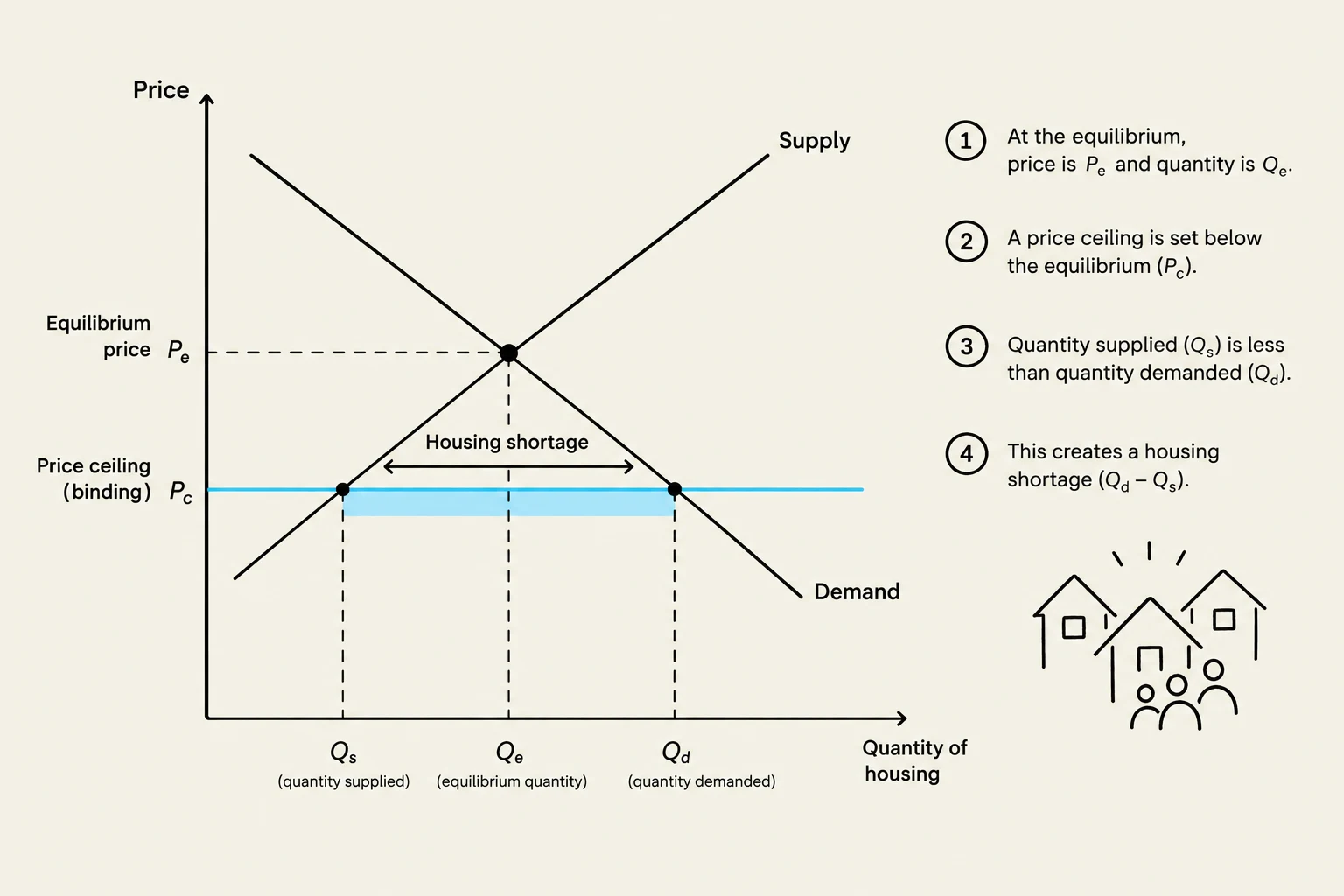
When a binding price ceiling is imposed, it creates a shortage because the quantity demanded by consumers exceeds the quantity supplied by producers at that lower price.
This graph illustrates the economic concept of a housing shortage caused by a binding price ceiling. The price ceiling (Pc) is set below the equilibrium price (Pe), leading to a quantity supplied (Qs) that is less than the quantity demanded (Qd), resulting in a shortage.
Common examples include rent control in cities or attempts to freeze gas prices. While intended to help consumers, these controls often lead to:
Inefficiently low quantity: Fewer goods are produced or provided.
Inefficient allocation: Goods do not necessarily go to those who value them most.
Wasted resources: Consumers may spend hours in lines or use bribes to secure goods.
Inefficiently low quality: Since sellers cannot raise prices to increase profit, they may reduce the quality of their service or product.
Black markets: Illegal markets emerge where goods are traded at prices higher than the legal limit.
Price Floors
Conversely, a price floor is a minimum price that buyers are required to pay. For a price floor to be binding, it must be set above the equilibrium price. If it is set below equilibrium, it has no effect.
A binding price floor creates a surplus, as the quantity supplied by producers at the higher price exceeds the quantity demanded by consumers. Examples include minimum wage laws or agricultural price supports.
Exam Tip: To determine if a control is "binding," always compare it to the equilibrium price. A ceiling must be below equilibrium to matter; a floor must be above equilibrium to matter.
Quantity Controls: Quotas
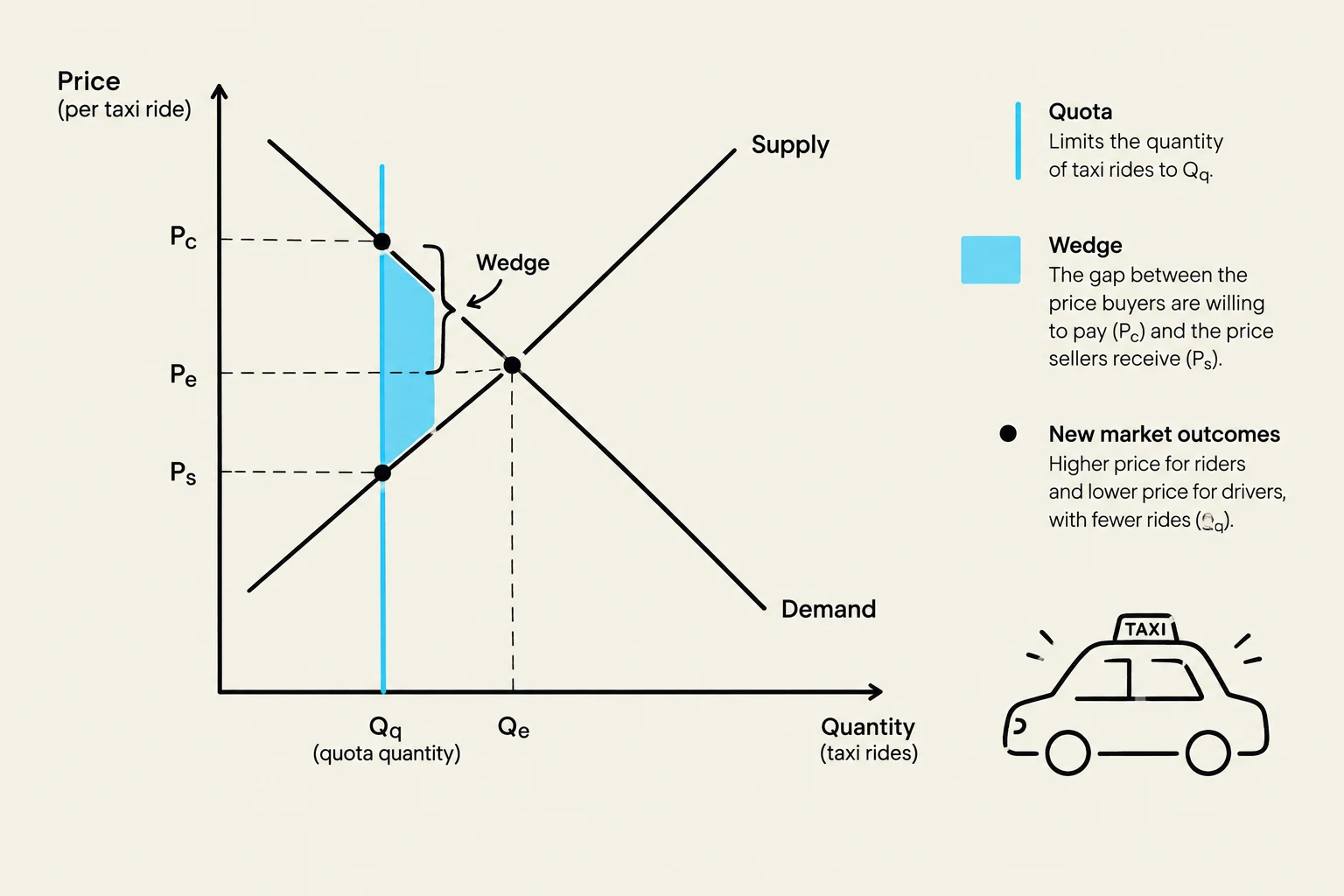
Sometimes, governments limit the amount of a good that can be traded rather than its price. This is known as a quota or quantity control. A quota sets an upper limit on the quantity of a good that can be legally transacted. To manage these, governments often issue licenses, which grant the legal right to supply a specific amount of a good.
This graph illustrates the economic impact of a quota on taxi rides. A quota limits the quantity of rides to Qq, creating a wedge between the price buyers pay (Pc) and the price sellers receive (Ps). This results in higher prices for riders, lower prices for drivers, and fewer rides overall compared to the equilibrium quantity Qe.
Quotas create a "wedge" between the price consumers are willing to pay (the demand price) and the price producers are willing to accept (the supply price). The difference between these two prices at the quota limit is called quota rent. Like price controls, quotas can lead to illegal activities, such as the operation of unlicensed, dangerous services.
The Economic Cost: Inefficiency and Deadweight Loss
The most significant economic criticism of both price and quantity controls is that they create market inefficiency. In a free market, equilibrium maximizes the total surplus (the sum of consumer and producer surplus). When the government interferes, it prevents mutually beneficial transactions from occurring.
This loss of total surplus is known as deadweight loss.
Distorted Price Signals and Resource Misallocation
Prices are not just numbers; they are signals.
Distorted Price Signals: When a price is controlled, it no longer reflects the true scarcity of a resource.
Resource Misallocation: Because the signals are wrong, resources are directed to the wrong places.
For example, a price floor might allow high-cost, inefficient firms to stay in business while preventing low-cost, efficient firms from entering the market. Similarly, a price ceiling might result in a situation where a person who values a product very highly cannot obtain it, while someone with a lower valuation receives it simply because they were first in line.
This graph illustrates deadweight loss in economics, which is the loss of potential trades and total welfare that do not occur due to a price ceiling.
In summary, while interventions like price ceilings, price floors, and quotas are often used to protect specific groups, they all share a common outcome: they decrease the total amount of goods traded and create deadweight loss for society.
Keep reading for free.
Create an account to finish this reading and make it part of your study routine.