Explores the fundamental relationship between consumer decisions, market prices, and resource allocation in a market economy, highlighting the role of contracts and information asymmetry.
At its core, an economy is a massive, decentralized system of decision-making. Every time you purchase a cup of coffee, subscribe to a streaming service, or sign a lease for an apartment, you are participating in a complex mechanism that determines how the world's limited resources are distributed. This process is driven by consumer demand and facilitated by the legal mechanism of the contract. Understanding this relationship requires us to look at how individual choices aggregate into market signals and how the law provides the framework that makes these exchanges possible.
The Engine of Allocation: Consumer Choice and Demand
In a market economy, resources—such as labor, raw materials, and capital—are not distributed by a central authority. Instead, they are allocated through the "invisible hand" of market prices, which are themselves a reflection of consumer preferences. When consumers express a preference for a specific good or service, they signal to producers that resources should be shifted toward the production of that good.
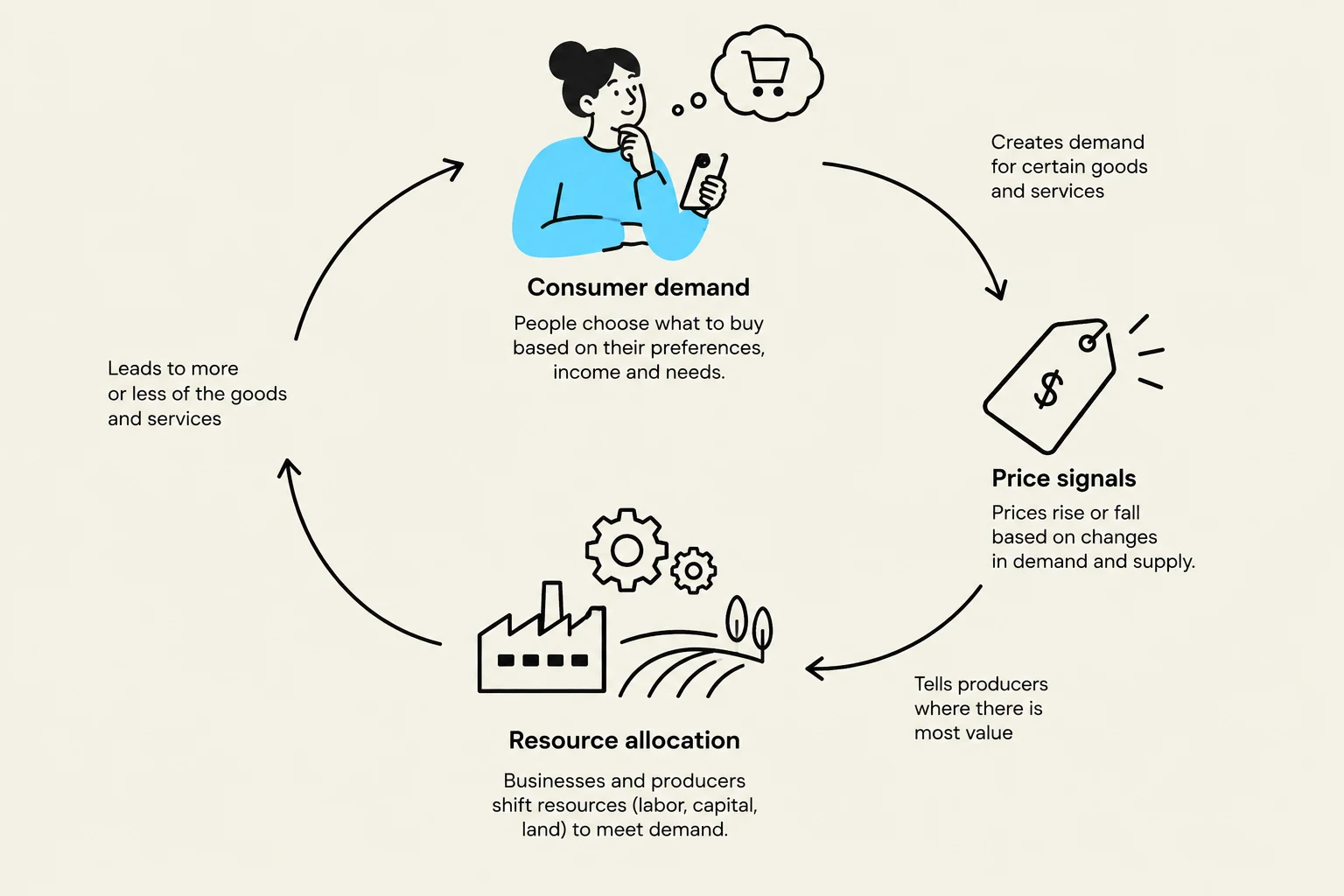
This process can be viewed as a feedback loop. Consumer choice dictates demand, demand influences price, and price serves as a signal for resource allocation. If the demand for electric vehicles increases, the price typically rises, signaling to mining companies to extract more lithium and to engineers to design more efficient batteries.
Key Concept: The Signaling Function of Price
Prices are more than just costs; they are information carriers. High prices signal scarcity or high demand, encouraging more supply, while low prices signal abundance or low demand, encouraging conservation or alternative uses.
This diagram illustrates the economic cycle of consumer demand, price signals, and resource allocation. Consumer demand influences price signals, which in turn guide resource allocation by businesses and producers to meet that demand. This process leads to fluctuations in the availability of goods and services.
The Medium of Exchange: The Role of Contract
If consumer choice provides the direction for the economy, the contract provides the infrastructure. A market exchange is rarely just an informal handshake; in modern complex economies, it is a legally binding agreement. The contract is the medium through which two parties commit to an exchange of value.
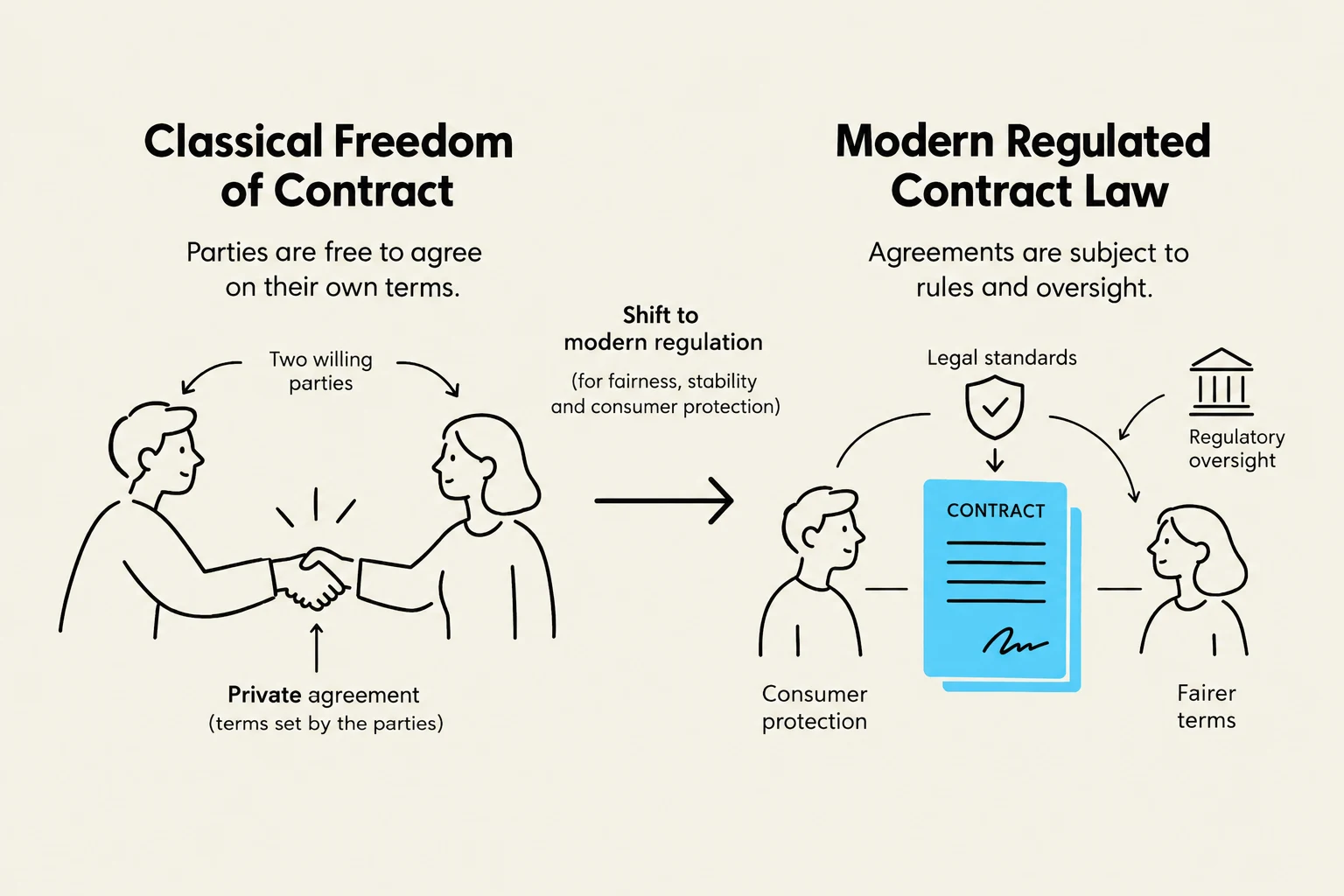
The evolution of how we view these contracts is central to understanding modern markets. Historically, the "Classical Theory" of contract law was dominated by the principle of "Freedom of Contract." This theory posited that as long as two parties entered an agreement voluntarily, the state had no business interfering in the terms of that agreement. Under this view, the market was seen as a perfectly level playing field where individuals were assumed to have equal bargaining power and perfect information.
However, as markets became more complex and asymmetrical, the legal landscape shifted. The decline of absolute freedom of contract reflects a realization that not all exchanges are equal. When one party has significantly more power or information than the other, the "choice" made by the consumer may not be truly free, but rather a result of coercion or deception.
This illustration contrasts classical freedom of contract, where parties agree on their own terms, with modern regulated contract law, where agreements are subject to legal standards and regulatory oversight for fairness and consumer protection.
Information Asymmetry and Market Efficiency
For market exchange to function efficiently, consumers need accurate information to make choices that reflect their true preferences. When information is distributed unevenly between the buyer and the seller, we encounter "Information Asymmetry."
Consider a used car sale. The seller knows exactly when the engine last failed, but the buyer does not. If the buyer cannot distinguish between a high-quality car and a "lemon," they may offer a lower average price for all cars. This can lead to a market collapse where sellers of high-quality cars exit the market because they cannot get a fair price, leaving only low-quality goods behind.
To prevent this, modern contract law and consumer protection regulations intervene to "level the playing field." These interventions include:
Mandatory Disclosures: Requiring sellers to reveal certain facts (e.g., nutritional labels or interest rates).
Implied Warranties: Legal assumptions that a product will work as intended, even if not explicitly stated in a contract.
Unconscionability Doctrines: Allowing courts to strike down contract terms that are shockingly unfair to one party.
Mathematical Representation of Utility and Choice
To model how consumers make these choices, economists often use the concept of Utility, which represents the satisfaction or value a consumer derives from a good. A consumer's goal is to maximize their total utility subject to a budget constraint.
If we let U represent utility, x represent the quantity of good A, and y represent the quantity of good B, a simple utility function might look like this:
U(x,y)=xα⋅yβ
Where α and β represent the relative importance or "weight" the consumer places on each good. The consumer's decision is constrained by their budget B, where Px is the price of x and Py is the price of y:
Px⋅x+Py⋅y≤B
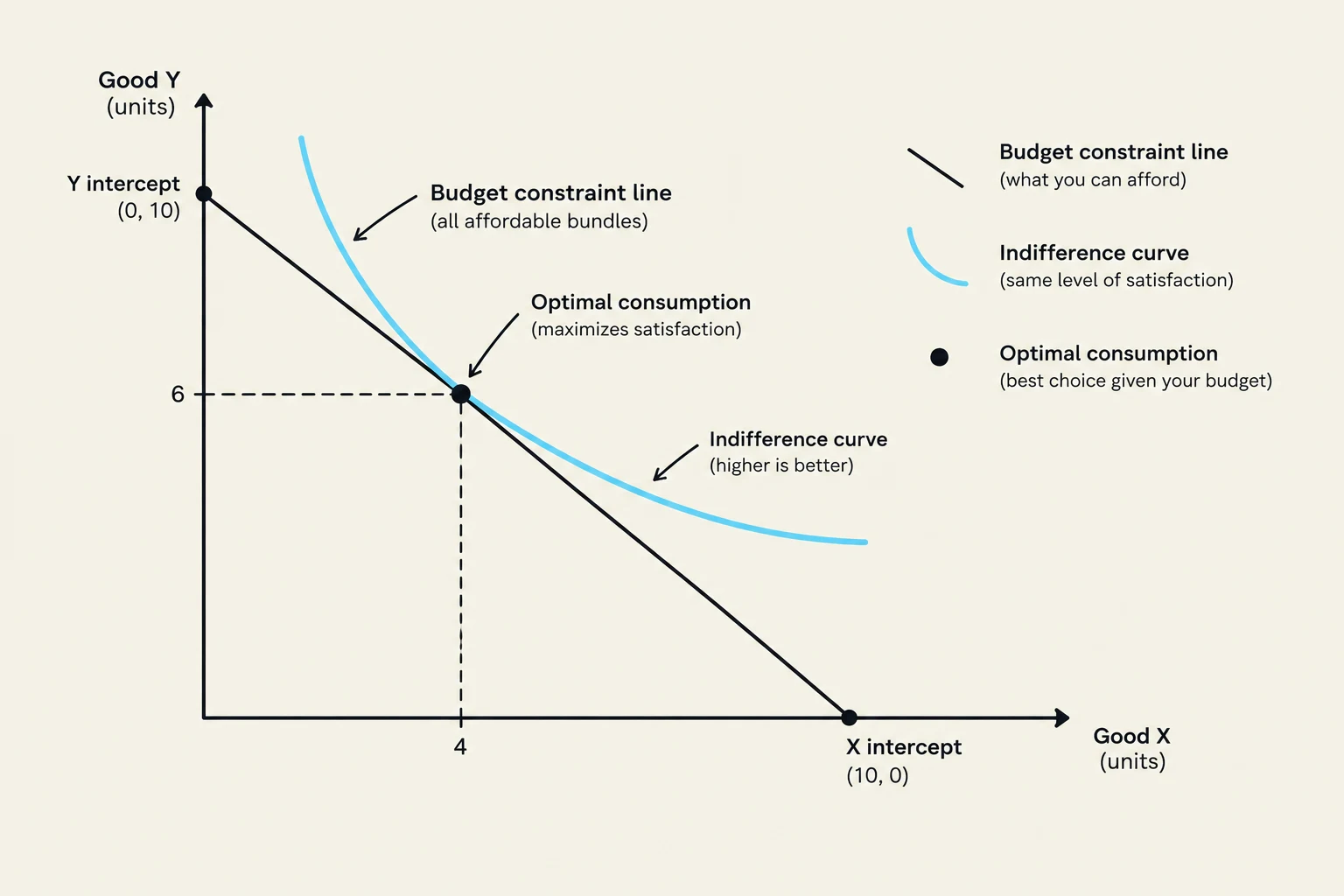
The "optimal" choice occurs where the marginal utility per dollar spent is equal across all goods. This mathematical equilibrium is what drives the market signals mentioned earlier. When the price Px changes, the consumer must re-calculate their optimal x and y, thereby shifting demand and signaling the market to reallocate resources.
This graph illustrates the concept of optimal consumption in economics, showing the intersection of a budget constraint line and an indifference curve.
Summary: The Interconnected System
The relationship between market exchange and consumer choice is a cycle of signals and commitments.
Consumer Choice creates demand based on individual utility.
Market Prices translate that demand into signals for producers.
Contracts provide the legal certainty required for parties to act on those signals.
Regulation ensures that the contracts and information flows remain fair enough to prevent market failure.
Without the ability to make choices, there is no direction for the economy. Without the ability to form contracts, there is no way to execute those choices reliably. Together, they form the backbone of modern economic life.
Exam Tip: Connecting Law and Economics
When asked about the efficiency of markets, don't just talk about supply and demand. Remember that markets require low transaction costs. Contracts and contract law are tools used to reduce these costs by providing predictability and enforcement.
Keep reading for free.
Create an account to finish this reading and make it part of your study routine.