Market Efficiency, Equity, and Signals in Economics
Explore the concepts of consumer and producer surplus, market equilibrium, and the role of property rights and economic signals in allocating resources. Understand the tension between market efficiency and equity, and the concept of market failures.
In a healthy economy, markets serve as powerful engines for organizing human activity. By coordinating the desires of millions of individual buyers and sellers, competitive markets aim to allocate resources in a way that maximizes the benefits to society. However, the pursuit of "efficiency"—the most productive use of resources—does not always align with "equity," or the fairness of how those resources are distributed. Understanding how these forces interact requires a look at the mechanics of surplus, the importance of signals, and the role of property rights.
Measuring Benefit: Consumer and Producer Surplus
To understand if a market is working well, economists measure the "gains from trade" through two primary concepts: consumer surplus and producer surplus.
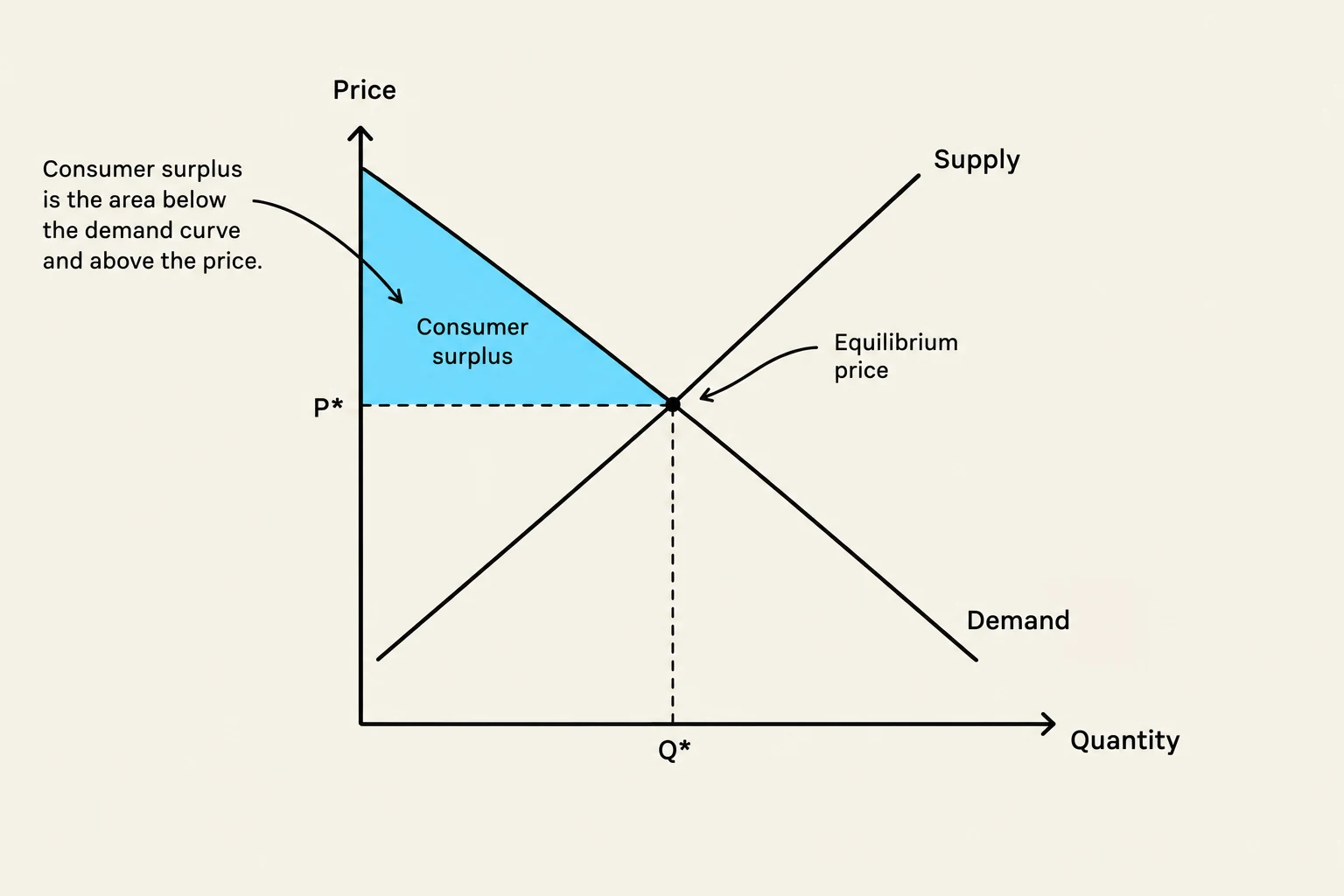
Consumer surplus is the difference between the market price and the maximum price a consumer would be willing to pay for a good. For example, if you are willing to pay $59 for a textbook but the market price is only $30, you have gained a consumer surplus of $29. Graphically, consumer surplus is represented by the area beneath the demand curve and above the market price.
Producer surplus is the difference between the market price and the minimum price at which a firm is willing to supply a product. This minimum price is essentially the seller's opportunity cost. If a seller is willing to provide a service for $6 but receives $10 from the market, their producer surplus is $4. On a graph, this is the area above the supply curve and below the market price.
A graph illustrating consumer surplus in economics, showing the area below the demand curve and above the equilibrium price.
When we add these two together, we get total surplus. Total surplus is the sum of consumer and producer surpluses, and it serves as a metric for the overall benefit a market provides to society.
Market Equilibrium and Efficiency
A market reaches equilibrium when the quantity demanded by consumers equals the quantity supplied by producers. At this equilibrium price, total surplus is maximized.
Competitive markets are considered efficient because they achieve three specific goals:
They allocate consumption to the potential buyers who value the good most.
They allocate sales to the potential sellers who have the lowest costs (and thus most value the right to sell).
They ensure that every transaction is mutually beneficial, meaning every buyer values the good more than the price they pay, and every seller receives more than their cost of production.
A graph illustrating the economic principles of supply and demand, showing how equilibrium price and quantity are determined at the intersection of the supply and demand curves.
Exam Tip: If a question asks you to calculate total surplus, remember the formula for the area of a triangle:
Area=21⋅(base⋅height)
Use this to find the area of the triangles formed by the demand and supply curves relative to the equilibrium price.
The Role of Property Rights and Economic Signals
Why do markets function so smoothly most of the time? Two pillars support this functionality: property rights and economic signals.
Property rights are essential because they create and protect the incentives necessary to trade and innovate. Without clearly defined ownership, there is little motivation for individuals to invest in resources or engage in the exchange of goods.
Economic signals are provided by prices. Equilibrium prices act as a communication tool, signaling to resources exactly where they are most valued. Prices translate complex information into simple instructions:
When consumer demand rises, profits in that industry increase, signaling firms to produce more.
When demand falls, profits decline, signaling firms to shift resources elsewhere.
For instance, during a natural disaster, a high price for a necessity like ice signals to firms that there is a massive need, making it profitable to transport and provide that resource to the affected area.
Efficiency vs. Equity
While efficiency focuses on maximizing the "size of the pie" (total surplus), equity focuses on how that pie is sliced among members of society.
A market might be perfectly efficient—meaning it maximizes total surplus—but still result in an outcome that society deems unfair. Because of this, governments often intervene in markets to increase equity. However, there is a fundamental tension here: interventions designed to redistribute wealth (like taxes or price controls) can sometimes reduce the overall efficiency of the market.
Market Failures
It is important to note that markets are not perfect. While they are usually efficient, they can sometimes fail. A market failure occurs when the market is inefficient, meaning opportunities are missed and it is possible to make some people better off without making others worse off. While the specific causes of market failures (such as externalities or monopolies) are complex, they represent the instances where the "invisible hand" of the market fails to reach its optimal potential.
Keep reading for free.
Create an account to finish this reading and make it part of your study routine.