Explains the fundamental economic concepts of market demand, supply, and equilibrium, detailing how consumer benefits and producer costs interact to determine prices and quantities. Covers shifts in curves, surpluses, and shortages.
At its core, a market is a mechanism where buyers and sellers interact to exchange goods and services. To understand how prices are set and how much of a product is produced, we must look at the underlying motivations of these two groups. By analyzing individual decisions—specifically how much benefit a consumer gains and how much cost a producer incurs—we can construct the curves that define the entire market.
Market Demand: The Consumer Perspective
Market demand is not just a single person's preference; it is the horizontal summation of the quantities demanded by every individual consumer in the market at every possible price. When we "sum" demand, we keep the prices fixed and add up the quantities that each person is willing to buy.
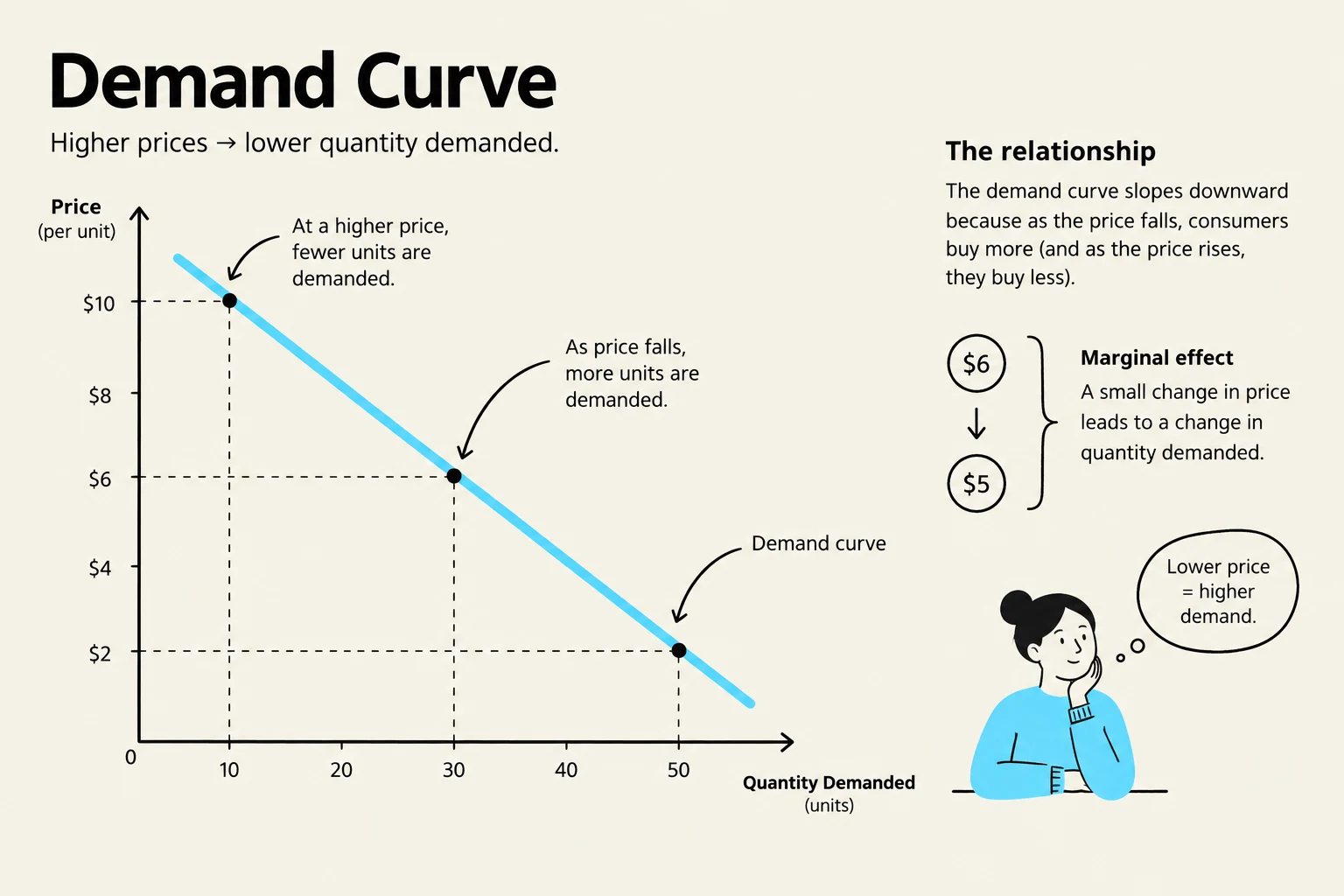
The resulting demand curve is typically downward-sloping. This reflects a fundamental relationship: as the price of a product decreases, the quantity demanded increases. This behavior is driven by the concept of marginal benefit (MB)—the additional satisfaction or utility a consumer receives from consuming one more unit of a good.
A rational consumer follows a simple rule: they will continue to purchase a product as long as their marginal benefit is greater than or equal to the market price:
MB≥P
When a consumer purchases a good, they often receive more benefit than the price they paid. This difference is known as economic surplus. For example, if your marginal benefit for a cup of coffee is $9 but the price is only $6, your economic surplus for that cup is $3.
A demand curve illustrates the inverse relationship between the price of a good and the quantity demanded, showing that as price decreases, quantity demanded increases, and vice versa.
Movement vs. Shifts in Demand
It is vital to distinguish between a change in "quantity demanded" and a change in "demand" itself. This is a common area of confusion in economic analysis.
Movement along the curve: This occurs only when the price of the product itself changes. If the price goes up, we move up the curve to a lower quantity demanded; if the price goes down, we move down the curve to a higher quantity demanded.
Shift in the curve: This occurs when external factors change, causing consumers to want more or less of the product at every price point.
Key factors that cause shifts include:
Income: The direction of the shift depends on the type of good.
Normal Goods: Demand increases (shifts right) as income rises.
Inferior Goods: Demand decreases (shifts left) as income rises.
Substitute Products: If the price of a substitute (a different good that satisfies a similar need) falls, the demand for your product will shift to the left because the substitute has become more attractive.
Market Supply: The Producer Perspective
While demand represents the consumer's benefit, supply represents the producer's cost. The market supply curve is the horizontal summation of the quantities that all individual suppliers are willing to provide at various prices.
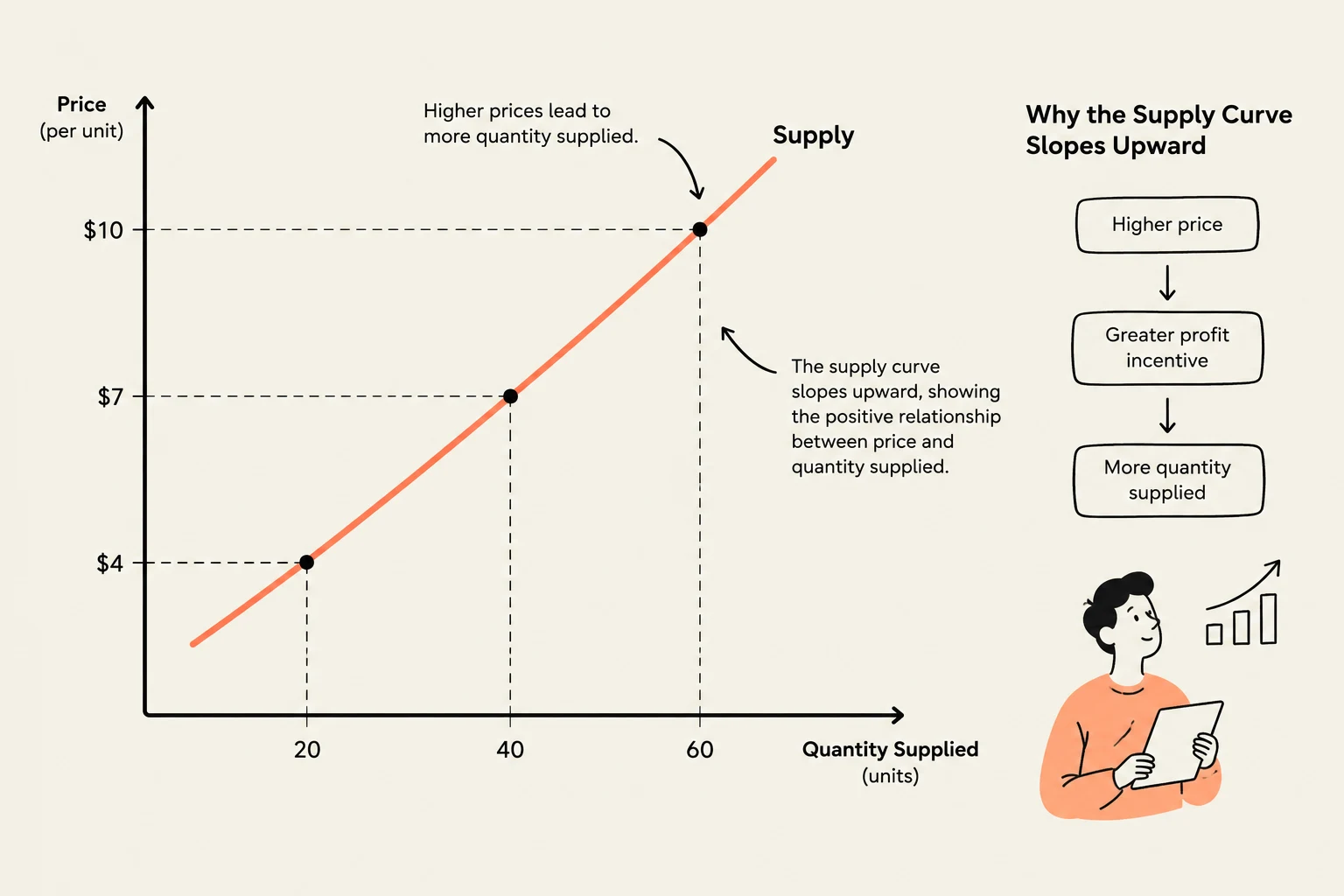
The supply curve is upward-sloping for two primary reasons. First, higher prices provide a greater incentive for firms to produce more. Second, the curve reflects the marginal cost (MC) of production—the cost of producing one additional unit. In most industries, marginal costs increase as production expands (due to factors like resource scarcity or diminishing returns), which creates the upward slope.
This graph illustrates the law of supply, showing that as the price of a good increases, the quantity supplied also increases, assuming all other factors remain constant. This positive relationship is driven by the greater profit incentive for producers at higher prices.
Movement vs. Shifts in Supply
Similar to demand, we must distinguish between movements and shifts in supply:
Movement along the curve: Occurs when the product's own price changes, altering the quantity supplied.
Shift in the curve: Occurs when factors affecting production costs change.
Technological Improvements: These decrease marginal costs, shifting the supply curve to the right (downward).
Increased Input Costs: If it becomes more expensive to produce a good (e.g., due to a hurricane destroying facilities), the supply curve shifts to the left.
Market Equilibrium
Equilibrium is the state where the market "clears," meaning there is no inherent pressure for the price to change. Formally, equilibrium occurs at the intersection of the demand and supply curves, where:
Quantity Demanded (Qd)=Quantity Supplied (Qs)
At this intersection, we find the equilibrium quantity ($Q^$) and the equilibrium price ($P^$).
Reaching Equilibrium: Surpluses and Shortages
Markets are not always in equilibrium. If the price is not at P\*, the market will naturally adjust through the following processes:
Surplus: If the price is set above the equilibrium, the quantity supplied (Qs) will exceed the quantity demanded (Qd). Sellers find themselves with excess inventory and will lower their prices to attract buyers. As the price falls, quantity demanded rises and quantity supplied falls until they meet at equilibrium.
Shortage: If the price is set below the equilibrium, the quantity demanded (Qd) will exceed the quantity supplied (Qs). Consumers will compete for the limited goods, allowing suppliers to raise prices. As the price rises, quantity demanded falls and quantity supplied rises until equilibrium is restored.
Exam Tip: Analyzing Simultaneous Shifts
When two changes happen at once (e.g., technology improves and a substitute's price falls), determine the effect of each change on price and quantity separately.
An increase in supply (tech improvement) pushes price down and quantity up.
A decrease in demand (substitute price fall) pushes price down and quantity down.
Combined Result: The price will definitely fall, but the effect on quantity is ambiguous because the two shifts pull it in opposite directions.
Keep reading for free.
Create an account to finish this reading and make it part of your study routine.