In physics, understanding how objects move and interact requires more than just knowing "how much" or "how fast." We must also know the direction in which these quantities act. This is where vectors become essential. To master physics, you must become an expert in manipulating vectors in 2D so that the mathematical process becomes second nature, allowing you to focus on the underlying physical principles.
Understanding Vector Quantities and Notation
A vector quantity is a measurement that possesses both a magnitude (size) and a direction. Common examples you likely already encounter include displacement, velocity, acceleration, and force. This distinguishes them from scalar quantities, such as mass or temperature, which only have magnitude.
To distinguish a vector from a scalar in writing, we use specific notations:
Bold print: For example, A or v.
Arrows: An arrow placed on top of the letter, such as A or v.
The magnitude of a vector represents its length when drawn as an arrow. It is important to remember that magnitude is always a positive number, as a length cannot be negative.
Components and Vector Resolution
While a vector might point diagonally across a plane, it is often easier to describe it using its components—the parts of the vector that lie along the axes of a coordinate system. Depending on how the vector is oriented relative to your x and y axes, these components can be positive or negative.
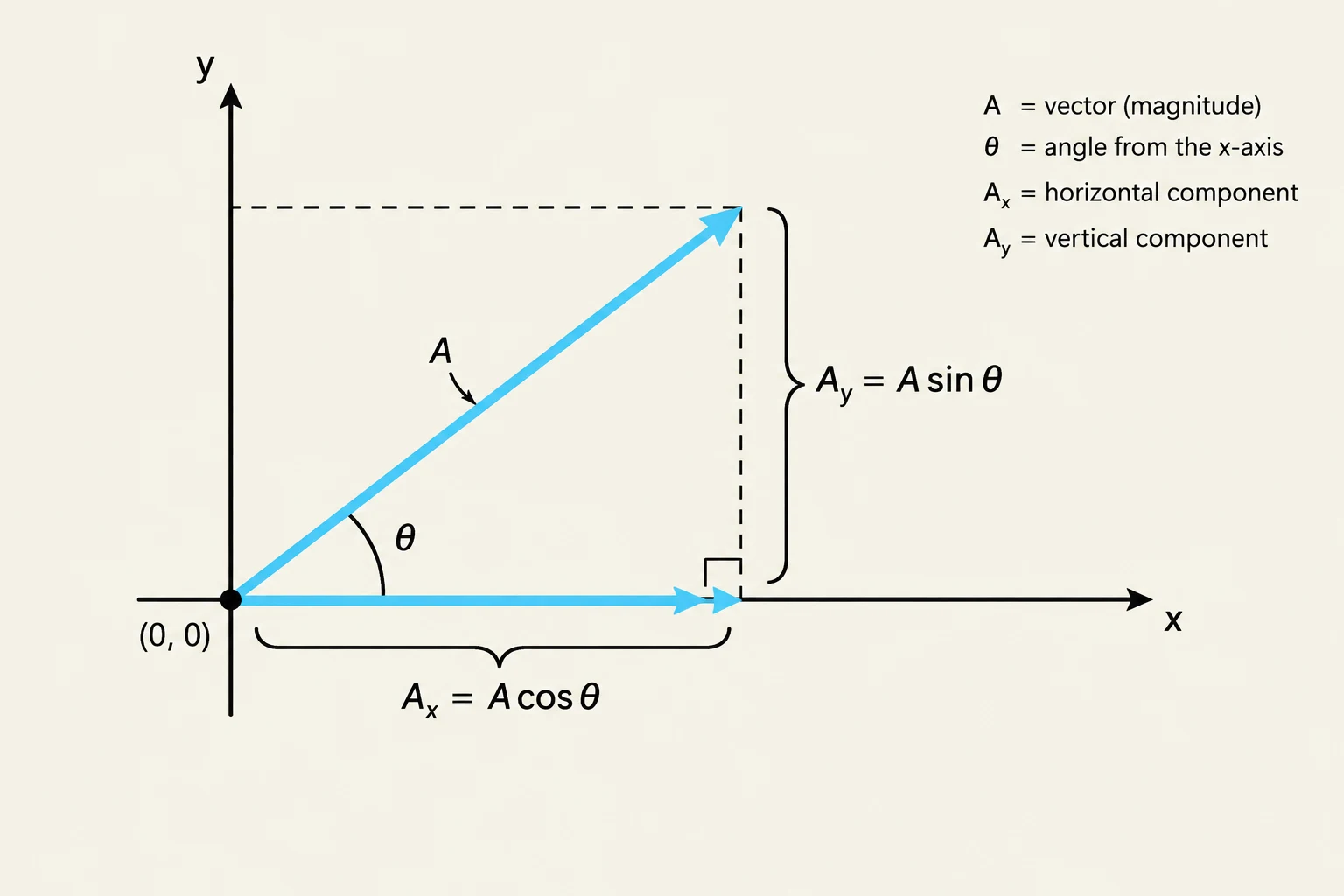
Resolving a vector is the process of breaking a single diagonal vector into these perpendicular components. If we have a vector A at an angle θ relative to the horizontal x-axis, we can find its horizontal component (Ax) and its vertical component (Ay) using trigonometry:
AxAy=Acosθ=Asinθ
A diagram illustrating the components of a vector in a 2D Cartesian coordinate system, showing its magnitude, angle, and horizontal and vertical components.
Exam Tip: Always double-check which axis your angle θ is measured from. The formulas Acosθ and Asinθ assume θ is the angle between the vector and the horizontal axis.
Vector Addition and Subtraction
When multiple vectors act on a single point, we are often interested in the resultant vector, which is the single vector that represents the sum of all the individual vectors. There are two primary ways to find this resultant: graphical and analytical methods.
Graphical Methods
Graphical methods involve drawing the vectors to scale. For addition, you can place the "tail" of the second vector at the "tip" of the first. The resultant vector is drawn from the starting tail of the first vector to the final tip of the last vector.
Analytical Methods
The analytical method is much more precise because it uses mathematics rather than drawing tools. This method relies on the Pythagorean theorem and trigonometric identities to find the exact magnitude and direction of the resultant.
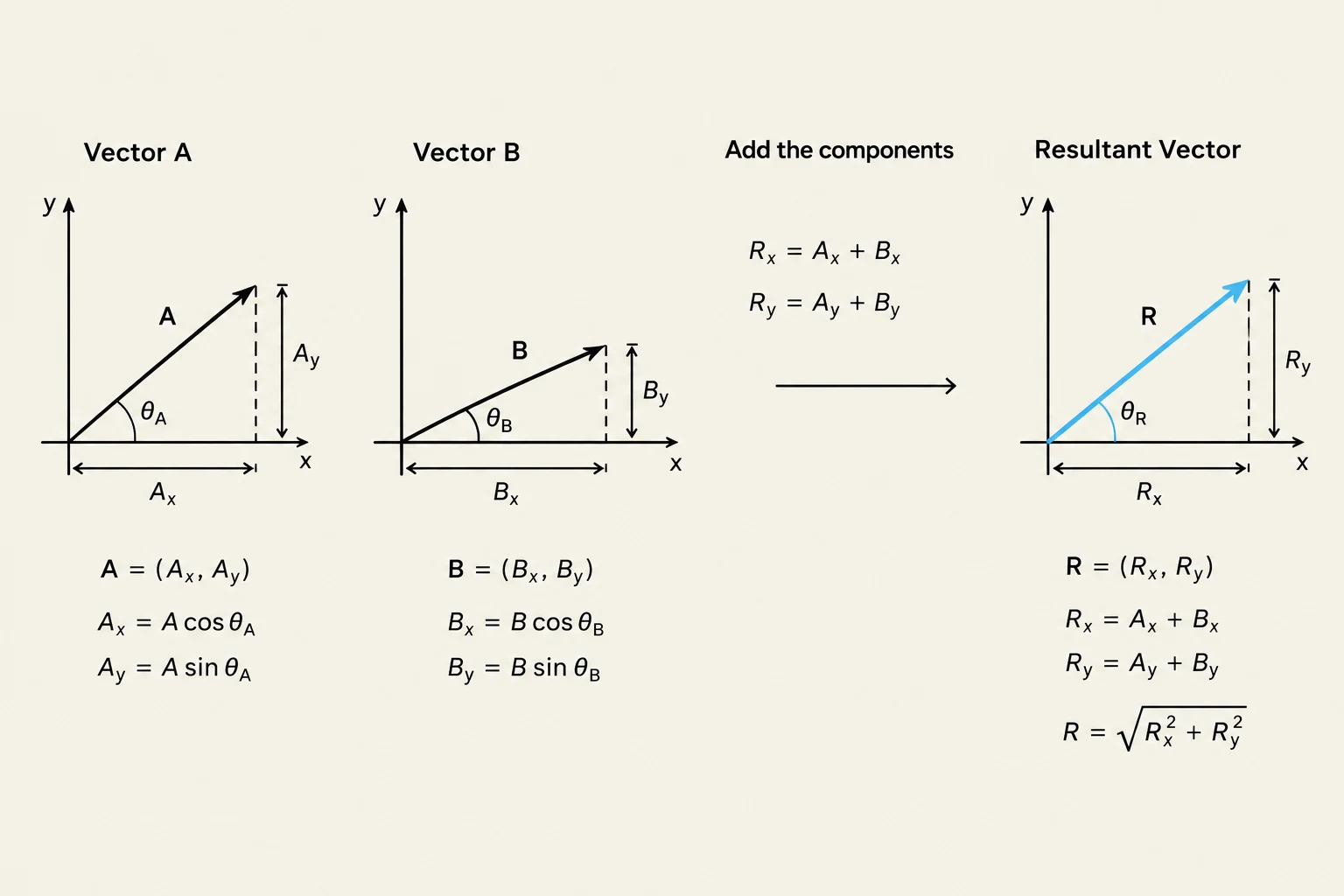
To add two vectors, A and B, follow these steps:
Resolve into components: Find the x and y components for every vector.
AxAyBxBy=AcosθA=AsinθA=BcosθB=BsinθB
Sum the components: Add all horizontal components together to get Rx, and all vertical components to get Ry.
RxRy=Ax+Bx=Ay+By
Calculate Resultant Magnitude: Use the Pythagorean theorem.
R=Rx2+Ry2
Calculate Resultant Direction: Use the inverse tangent function.
θ=tan−1(RxRy)
This diagram illustrates the process of adding two vectors, A and B, by resolving them into their x and y components, summing the corresponding components, and then constructing the resultant vector R.
Worked Example: The Pilot's Path
To see these steps in action, let's look at a practical problem:
Problem: A pilot flies 40.0 km at 60∘ north of east, and then flies 30.0 km at 19∘ north of east. Find her total distance R from the starting point and her final direction θ.