Management of Early Onset of Labor and Preterm Birth
This guide details the management of preterm labor, including risk factors, diagnostic testing, pharmacological interventions like tocolytics and betamethasone, and care for prelabor rupture of membranes (PROM).
Managing the early onset of labor requires rapid recognition and precise intervention to mitigate risks to both the pregnant client and the developing fetus. When labor occurs prematurely, the clinical focus shifts toward delaying delivery to allow for fetal maturation and preventing complications such as infection or respiratory distress. This article explores the nuances of preterm labor, the management of ruptured membranes, and the pharmacological interventions essential for stabilizing these high-risk pregnancies.
Understanding Preterm Labor
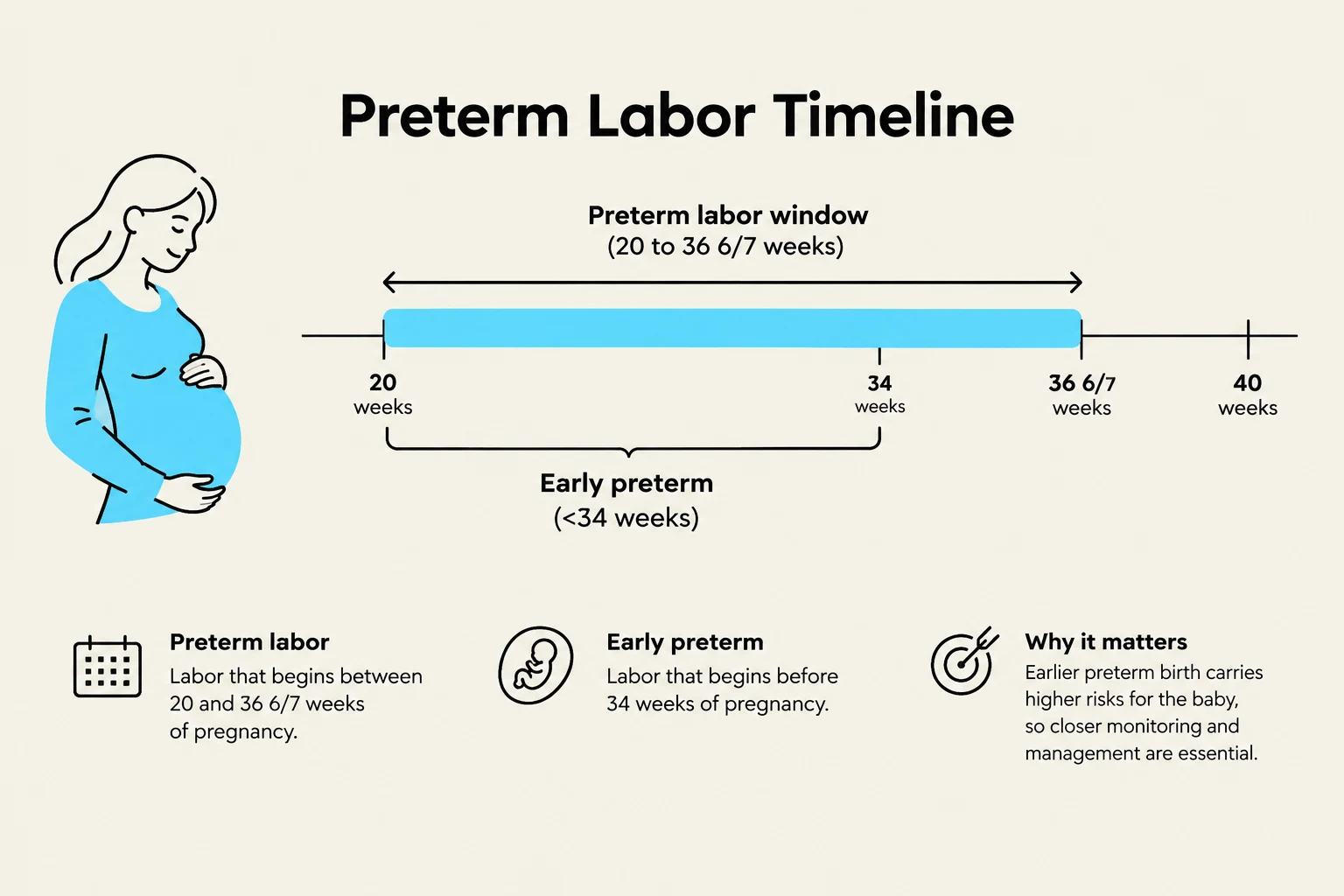
Preterm labor is defined as the presence of uterine contractions accompanied by cervical changes (such as dilation or shortening) occurring between 20 weeks and 36 weeks and 6 days of gestation. It is critical to distinguish true preterm labor from Braxton Hicks contractions; while Braxton Hicks are irregular and painless, preterm labor contractions are regular and do not subside with rest or position changes.
Clinicians categorize preterm births based on the timing of delivery:
Early preterm: Less than 34 weeks.
Late preterm: 34 weeks to 36 weeks and 6 days.
The risk to the newborn increases significantly the earlier the birth occurs.
Exam Tip: Preterm labor is not just "having contractions." To meet the clinical definition, there must be evidence of cervical change (dilation or shortening) within the 20 to 36 6/7 week window.
This timeline illustrates the definition and significance of preterm labor, which is labor that begins between 20 and 36 6/7 weeks of pregnancy. It also defines early preterm labor as labor beginning before 34 weeks and highlights the increased risks associated with earlier preterm birth, emphasizing the need for closer monitoring and management.
Risk Factors and Clinical Assessment
Identifying at-risk clients is the first step in prevention. The strongest single clinical clue for preterm labor is a history of a previous preterm birth. Other significant risk factors include:
Obstetric/Maternal: Multifetal pregnancy, uterine abnormalities, advanced maternal age, and comorbidities like gestational diabetes or hypertensive disorders.
Infection: Genitourinary infections are a major trigger.
Lifestyle/Social: Smoking, substance use, low prepregnancy weight, and exposure to violence.
Clients often report pelvic pressure, menstrual-like cramping, persistent low backache, or changes in vaginal discharge.
Diagnostic Testing
To confirm the risk of preterm labor, several diagnostic tools are utilized:
Fetal Fibronectin (fFN): A vaginal swab used to detect a protein that, if found between 22 and 34 6/7 weeks, signals an increased risk of preterm labor.
Cervical Length Ultrasound: A measurement of ≤25 mm is a strong predictor of preterm labor.
Laboratory Work: CBC and urinalysis are used to screen for infections (e.g., elevated WBC or UTI), which can trigger labor.
Pharmacological Interventions
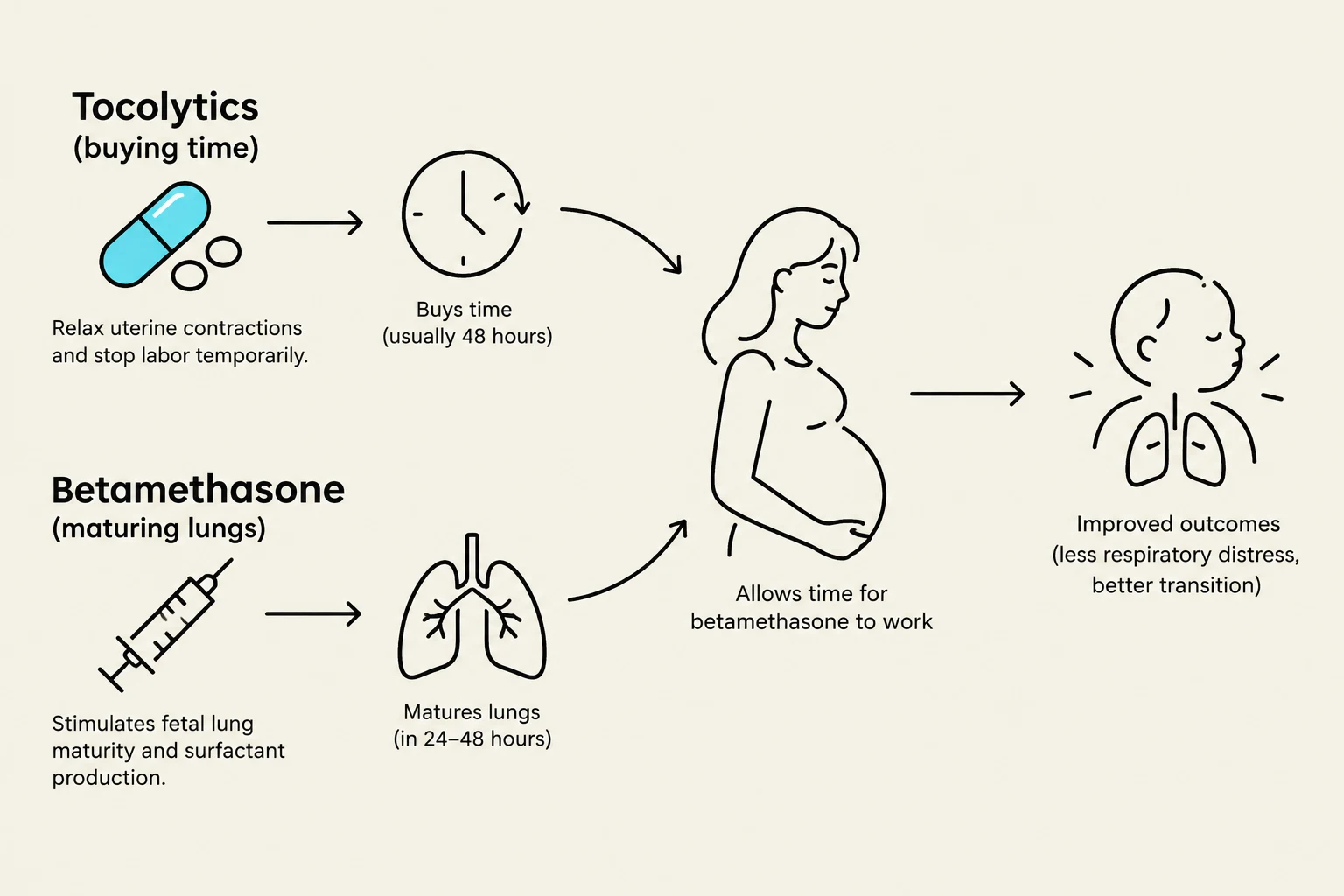
The primary goal of medication in preterm labor is to "buy time"—typically about 48 hours—to allow for steroid administration or safe transfer to a higher level of care.
Tocolytics (Contraction Suppressants)
Tocolytics are used to inhibit uterine activity. Common agents include:
Drug
Mechanism
Key Nursing Considerations
Nifedipine
Calcium channel blocker; blocks calcium entry into smooth muscle
Monitor for orthostatic hypotension (dizziness, flushing). Do not administer with magnesium sulfate.
Magnesium Sulfate
CNS depressant; relaxes smooth muscle
Used for neuroprotection if birth is expected <32 weeks. Monitor for toxicity.
Terbutaline
Beta-adrenergic agonist; relaxes smooth muscle
Monitor for tachycardia and chest discomfort. Use with caution in clients with cardiac disease or diabetes.
Critical Safety Alert: Magnesium Sulfate Toxicity
Before each assessment, use the R-U-R mnemonic:
Reflexes: Check for loss of deep tendon reflexes (the first sign of toxicity).
Urine Output: Monitor for output <30 mL/hr.
Respirations: Monitor for respirations <12/min.
Antidote: Calcium gluconate.
Fetal Lung Maturity
Betamethasone is a glucocorticoid used to boost fetal lung maturity and surfactant production in fetuses between 24 and 34 weeks. It is administered as 12 mg IM × 2 doses, 24 hours apart.
Nursing Note: Betamethasone is not a tocolytic. It does not stop contractions; it prepares the baby for the consequences of preterm birth. Nurses must monitor the mother for hyperglycemia and signs of pulmonary edema (shortness of breath, crackles).
This diagram illustrates the medical intervention of tocolytics and betamethasone for premature labor. Tocolytics are used to relax uterine contractions and temporarily stop labor, buying time. Betamethasone is administered to mature fetal lungs and stimulate surfactant production, which allows for better respiratory outcomes for the infant upon birth.
Prelabor Rupture of Membranes (PROM) and pPROM
When the amniotic membranes rupture before labor begins, it is termed PROM. If this occurs between 20 and 37 weeks of gestation, it is classified as Preterm PROM (pPROM).
Assessment and Verification
Clients typically report a sudden gush or a continuous leak of clear fluid. To distinguish amniotic fluid from urine, clinicians use:
Nitrazine Test: Amniotic fluid is more alkaline than vaginal fluid; a positive test turns the paper blue (pH 6.5–7.5).
Ferning Test: Dried fluid under a microscope will exhibit a characteristic palm-leaf (fern) pattern.
Emergency Complication: Umbilical Cord Prolapse
A rupture of membranes carries the immediate risk of umbilical cord prolapse. If a nurse observes abrupt fetal heart rate (FHR) decelerations or a visible cord at the introitus, this is a medical emergency.
Nursing Care for PROM/pPROM
The primary threat in pPROM is infection (sepsis) due to the loss of the protective amniotic barrier.
Infection Surveillance: Monitor vital signs frequently. A maternal temperature >38∘C (100.4∘F) or fetal tachycardia (FHR >160/min) may indicate intrauterine infection.
Infection Prevention: Limit vaginal exams to reduce the risk of introducing bacteria.
Medication: Administer antibiotics (e.g., Ampicillin) to prevent infection, but ensure vaginal, urine, and blood cultures are obtained before the first dose.
Client Education and Discharge Teaching
Education for clients with PROM or pPROM focuses on two pillars: preventing infection and early detection of complications.
To prevent infection, instruct the client to:
Abstain from sexual intercourse.
Avoid tub baths; use showers instead.
Do not insert anything into the vagina (no tampons).
Wipe from front to back after toileting.
To detect complications early, instruct the client to report:
Any foul-smelling vaginal discharge.
A temperature >38∘C (100.4∘F).
Changes in fetal movement (daily kick counts).
Increased uterine contractions.
Keep reading for free.
Create an account to finish this reading and make it part of your study routine.