Management and Internationalization of Multinational Corporations
Explores the complexities of managing multinational corporations (MNCs), including agency problems, organizational structures, internal and external challenges, classical theories of internationalization, and valuation implications.
In an increasingly interconnected world, the transition from a domestic firm to a Multinational Corporation (MNC) represents more than just a change in scale; it is a fundamental shift in complexity. An MNC is defined as an enterprise that engages in foreign direct investment (FDI) and controls income-generating assets, such as subsidiaries, in more than one country. While the pursuit of global markets offers unparalleled opportunities for growth and cost reduction, it also introduces a unique set of management dilemmas, agency conflicts, and environmental risks that domestic firms rarely encounter.
The Agency Problem and Management Structures
One of the most persistent challenges in managing an MNC is the agency problem. This occurs when a conflict of interest arises between the shareholders (the principals) who own the company and the managers (the agents) who run it. In a domestic setting, monitoring managers is relatively straightforward. However, in an MNC, agency costs are often significantly higher due to geographic dispersion, vast organizational size, and communication barriers. These costs typically manifest in three ways: monitoring expenditures to ensure managers act in the shareholders' interest, bonding expenditures to protect the firm, and residual losses resulting from decisions that favor managers over owners.
To mitigate these costs and ensure strategic alignment, MNCs typically adopt one of three organizational models:
Centralized Management: A small group of executives at the headquarters makes most strategic decisions. This promotes a unified global brand and consistent strategy but risks "information asymmetry," where headquarters lacks the local market knowledge necessary for optimal decision-making.
Decentralized (Regionalized) Management: Decision-making power is delegated to subsidiary or regional managers. This model allows for high responsiveness to local consumer preferences and cultural nuances but can lead to higher agency costs and a lack of cohesion with the parent company's global goals.
Balanced Model: A hybrid approach where subsidiaries are granted autonomy over day-to-day operations up to a specific financial threshold, while the parent company retains control over major capital expenditures and long-term strategic shifts.
This diagram illustrates three organizational structures: centralized, decentralized, and balanced, detailing their decision-making flows and subsidiary relationships.
Exam Tip: When analyzing a case study, look for "information asymmetry." If a manager in a foreign subsidiary makes a decision that hurts the parent company's global brand, it is likely a failure of the centralized model or an increase in agency costs.
Internal and External Challenges
MNCs do not operate in a vacuum; they are subject to a constant tug-of-war between internal pressures and external environmental shifts.
Internal Pressures
Modern MNCs face increasing shareholder activism, where sophisticated investors use their influence to push for changes in management, dividend policies, or strategic directions. Furthermore, the threat of a hostile takeover—where an outside entity attempts to acquire the firm against the wishes of current management—can force executives to prioritize short-term stock prices over long-term value to remain attractive or defensible. To align manager interests with shareholders, many firms utilize stock options, providing incentives that reward managers for long-term growth in share price.
External Pressures
Externally, MNCs must navigate a complex web of "external challenges":
Regulatory and Legal Landscapes: Firms must comply with both the laws of their home country (such as U.S. anti-corruption laws) and the host country's regulations regarding taxes, labor, and currency.
Cultural Distance: Differences in language, religion, and social values can create "liability of foreignness," increasing transaction costs and necessitating high levels of cross-cultural literacy among management.
Economic and Political Risk: Fluctuations in exchange rates, changes in foreign government policy, and even the threat of expropriation can drastically alter the projected cash flows of an international project.
Classical Theories of Internationalization
Why do firms bother with the complexity of going global? Historically, the rationale is rooted in classical economic theories that explain the benefits of trade and specialization.
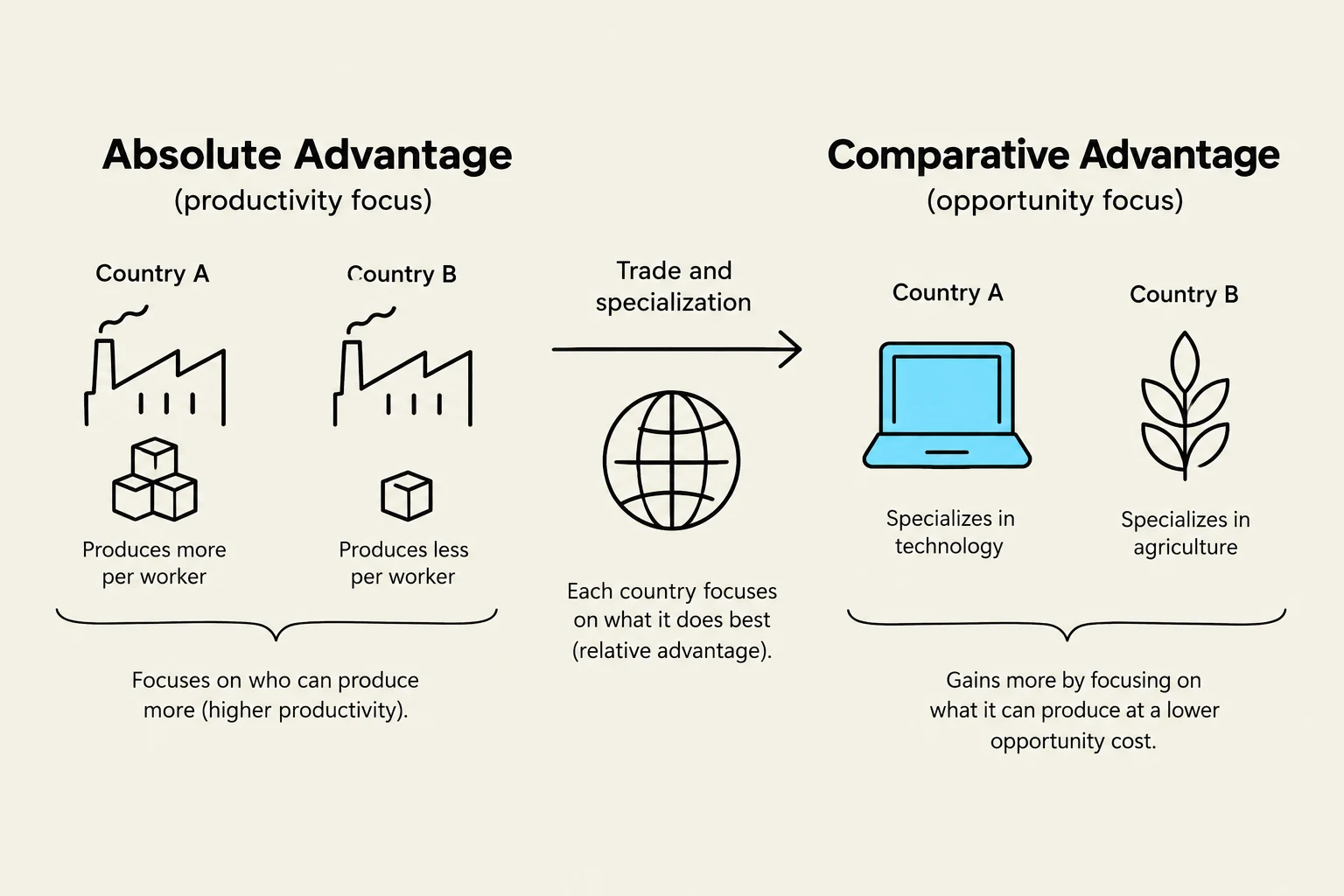
Absolute Advantage
Proposed by Adam Smith, the absolute advantage theory suggests that a nation should specialize in producing goods that it can produce more efficiently (with higher productivity) than any other nation. By exporting these goods and importing products that are less efficient to produce domestically, global efficiency is maximized.
Comparative Advantage
David Ricardo expanded on this with the comparative advantage theory. He argued that even if one country is more efficient at producing everything than another country, trade can still be mutually beneficial. The key is opportunity cost: a nation should specialize in the goods it can produce at a lower opportunity cost relative to other goods it could produce.
This diagram illustrates the concepts of absolute advantage and comparative advantage in economics, explaining how countries can benefit from trade and specialization based on productivity and opportunity cost.
While these theories explain why nations trade, modern MNCs often move beyond simple trade to address imperfect markets. In the real world, resources like capital and specialized labor are not perfectly mobile. Therefore, instead of just trading goods, firms engage in Foreign Direct Investment (FDI) to directly control the resources they need in foreign locations.
Valuation Implications
For a financial manager, internationalization changes the fundamental math of business valuation. When valuing a domestic firm, one primarily looks at domestic cash flows and domestic risk. For an MNC, the valuation must account for a much more volatile set of variables.
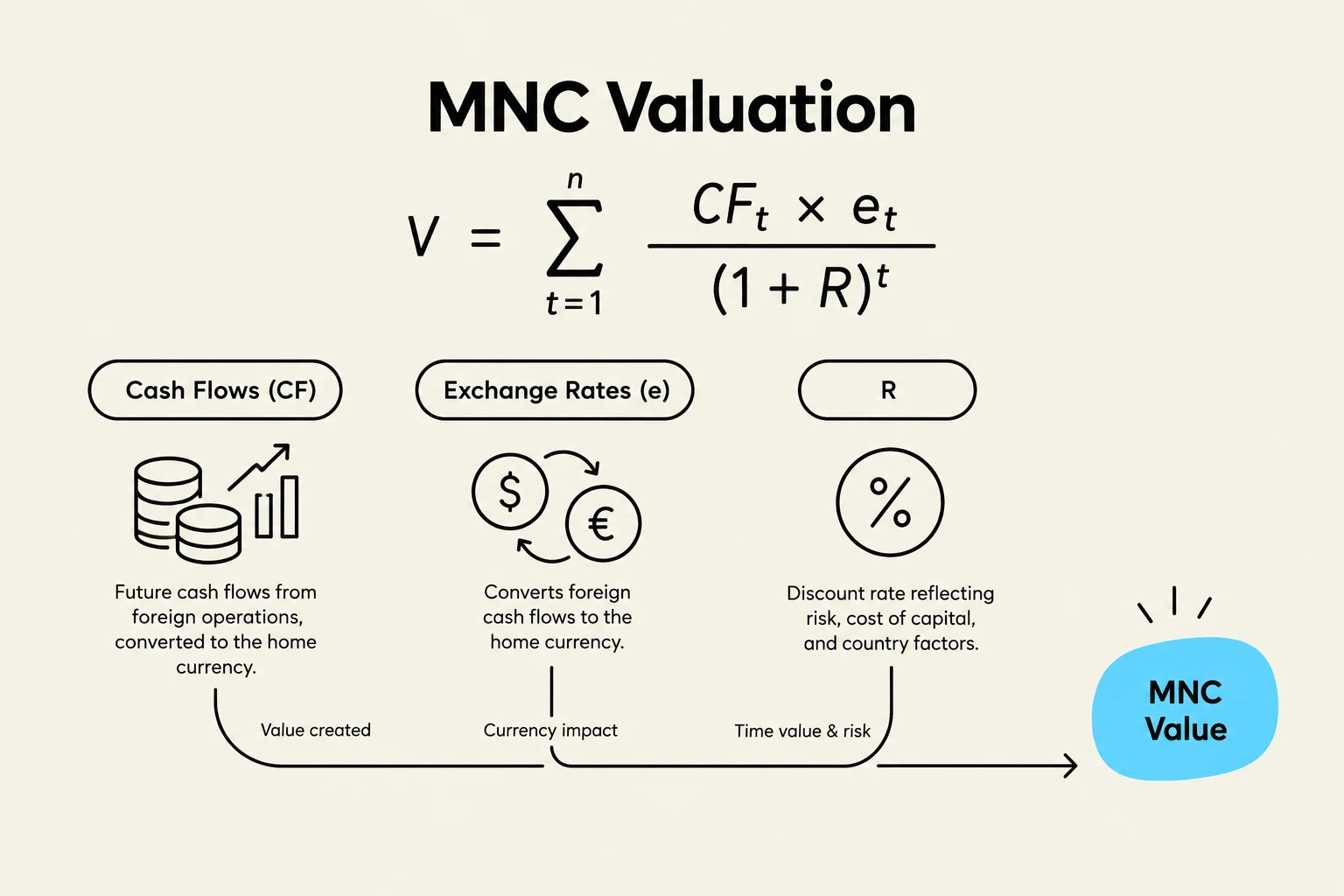
The value of an MNC is typically assessed using the Discounted Cash Flow (DCF) method, but the inputs are more complex:
Cash Flows: These must be forecasted in multiple currencies and adjusted for expected exchange rate movements.
Risk (The Discount Rate): The discount rate must reflect not just the business risk, but also the specific country risk and currency risk of every subsidiary.
A common approach to handle this is the "home currency approach," where exchange rate risk is incorporated into the expected cash flows, or the "foreign currency approach," where the NPV is calculated using the foreign country's cost of capital and then converted back to the home currency using the spot exchange rate.
This diagram illustrates the formula for Multinational Corporation (MNC) valuation, which considers cash flows, exchange rates, and a discount rate reflecting time value and risk.
Key Takeaway for Students:
To value an MNC, you cannot simply aggregate the profits of all subsidiaries. You must account for the fact that each subsidiary operates under different inflation rates, different tax regimes, and different political risks. An error in assessing a single country's risk can lead to a massive miscalculation of the entire corporation's value.
Keep reading for free.
Create an account to finish this reading and make it part of your study routine.