


The local anesthetic armamentarium is a specialized set of tools designed to deliver anesthetic solutions safely, precisely, and effectively. Successful administration depends not only on the clinician's technique but also on a deep understanding of the mechanical components of the syringe, the physical properties of the needle, and the chemical integrity of the anesthetic cartridge.
Syringe Components and Types
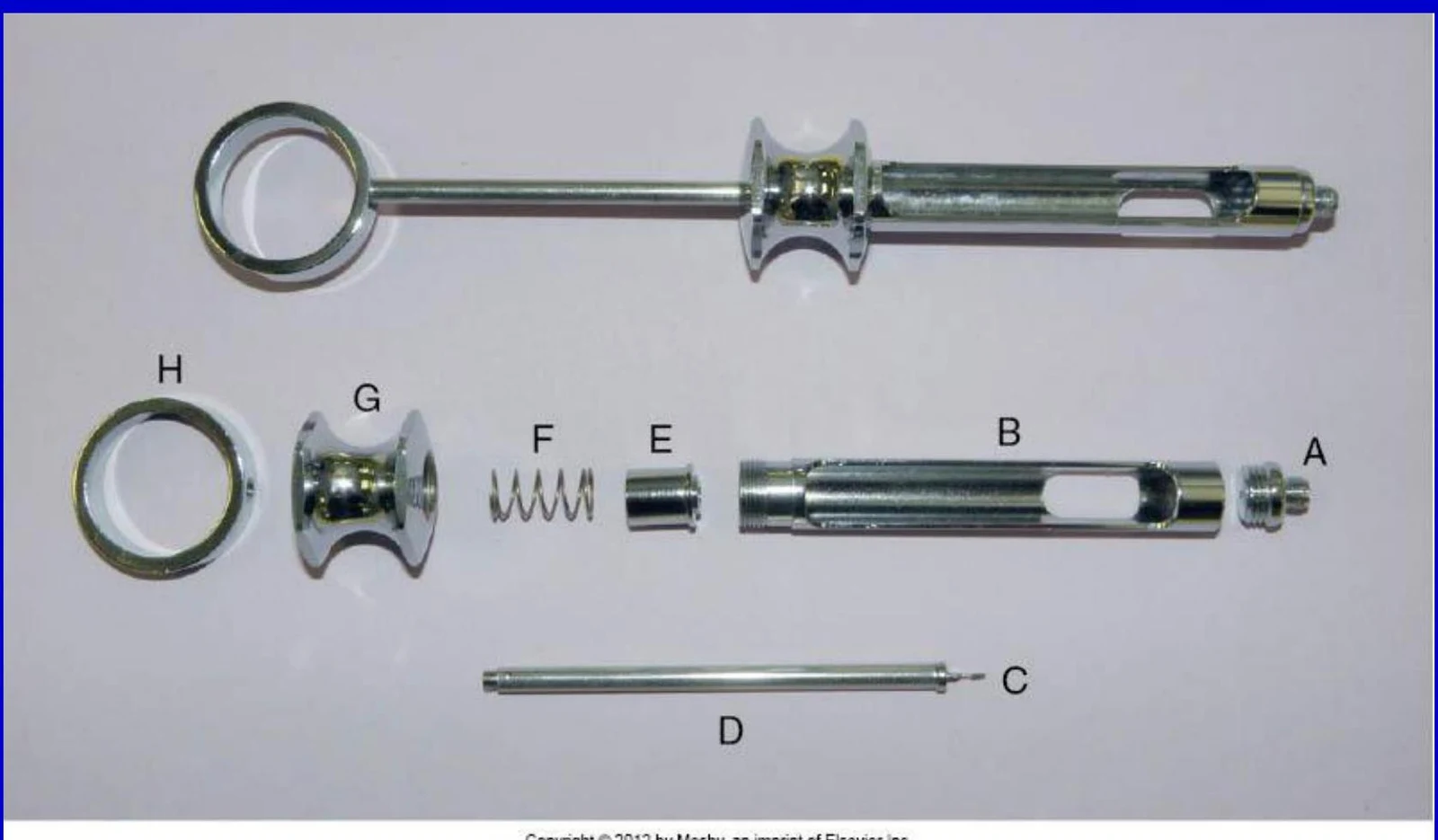
The standard delivery system is the breech-loading syringe. This device consists of several critical parts that work in unison to allow for both the injection of fluid and the vital safety step of aspiration.
Anatomy of a Standard Syringe
A standard syringe includes a barrel, which often features a large window to visualize the cartridge and a small window to monitor for blood during aspiration. The barrel is attached to a needle adapter (or hub) where the needle is secured. The piston contains a harpoon, a sharp protrusion that attaches to the cartridge's rubber stopper.
When the clinician pulls back on the thumb ring, the harpoon creates negative pressure within the cartridge. If the needle tip is located within a blood vessel, blood will be drawn into the cartridge; this is known as a positive aspiration.
Variations in Syringe Design
Clinicians may choose from several syringe types depending on the clinical scenario:
- Metallic Aspirating Syringes: Reusable, autoclavable, and rust-resistant. While they allow for easy one-handed aspiration, the harpoon may occasionally disengage from the stopper.
- Self-Aspirating Syringes: These utilize a metallic sleeve surrounding the needle to create negative pressure, eliminating the need for a harpoon. This prevents accidental disengagement but requires the clinician to move their thumb from the ring to a thumb disk.
- Plastic Aspirating Syringes: These are lighter and may appear less threatening to pediatric patients, though they can discolor over time due to repeated autoclaving.
- Pressure-Type Syringes: Specifically designed for periodontal ligament (PDL) injections, delivering a measured dose (typically 0.2 mL).
- Computer-Controlled Delivery Systems: These systems (such as the Wand) provide precise control over flow rate and pressure, offering automatic aspiration and reducing hand fatigue.
- Disposable Syringes: Prepackaged and intended for single use; the entire unit is discarded after one procedure.
Keep reading for free.
Create an account to finish this reading and make it part of your study routine.
Continue reading freeAlready have an account? Log in
Updated