Local Anesthesia and Pain Management in Endodontics
This guide explains the principles of local anesthesia, including its chemistry, mechanism of action, and clinical techniques for effective pain management in endodontic procedures. It also covers analgesia and antibiotic adjuncts.
Effective endodontic patient management relies on a triad of clinical precision: accurate triage, precise anesthesia, and appropriate analgesia. For many patients, the fear of dental pain is a significant barrier to care. In fact, patients often cite "a dentist who doesn't hurt" and "painless injections" as their top two criteria for choosing a provider. To achieve these goals, the clinician must understand the underlying chemistry of anesthetics, the physiological mechanisms of pain, and the clinical protocols required to ensure profound anesthesia.
Triage and Urgency
Before any treatment begins, the clinician must categorize the patient's condition to determine the appropriate level of care.
Dental Emergency: Potentially life-threatening conditions that require immediate intervention. Examples include uncontrolled bleeding, diffuse soft-tissue infections, or facial bone trauma that may compromise the airway.
Urgency: Pain that is spontaneous, disrupts daily activities, lasts less than two days, and is unrelieved by analgesics. This includes severe pulpal inflammation, abscesses, or dental trauma such as avulsion.
Routine Care: Non-urgent procedures that can be deferred, such as periodic exams, preventive cleanings, and asymptomatic extractions.
Clinical Note: If a patient is in pain and their case difficulty score (via the AAE EndoCase app) is high, they should be referred immediately. However, a patient in pain with a high score is an urgent referral, not a change in the difficulty level itself.
The Science of Pain and Anesthesia
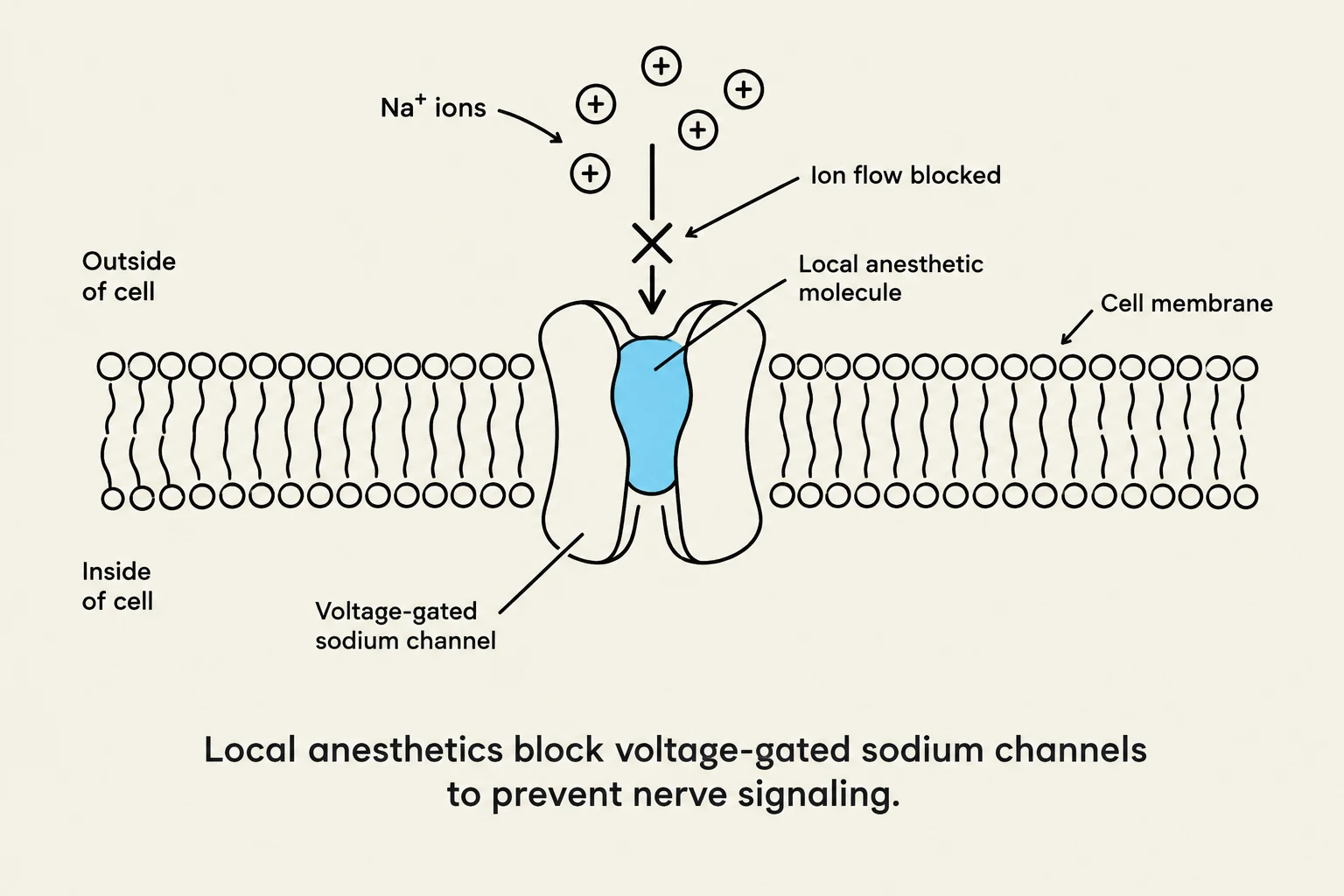
Local anesthetics block voltage-gated sodium channels to prevent nerve signaling.
To prevent pain, we must first understand nociception. A nociceptor is a specialized neuron that responds to potentially damaging stimuli by sending signals to the spinal cord and brain. Nociception is the process of these signals traveling; local anesthetics (LA) are unique because they are the only drugs that prevent these nociceptive impulses from reaching the brain.
Mechanism of Action
Local anesthetics elicit their numbing activity by blocking voltage-gated sodium channels. By blocking these channels, the neurons in the treated tissue become transiently incapable of signaling sensations to the brain.
Chemistry of Common Agents
The chemical structure of an anesthetic determines how it is metabolized:
Lidocaine: Contains an amide bond and is metabolized in the liver by the P450 3A4 isoenzyme.
Articaine: Contains an ester (and amide) bond and is metabolized in the serum by plasma cholinesterase.
Psychological Factors
Pain is psychophysiological. Emotional trauma or dental pain can be permanently stored in the amygdala, the brain's "dread center". This can lead to trypanophobia (fear of needles) and increased anxiety, which may make a patient harder to anesthetize.
Clinical Anesthesia Techniques
Successful anesthesia requires choosing the right technique and confirming its efficacy before beginning any invasive procedure.
Classification of Techniques
Techniques are categorized into two groups:
Primary: Infiltration and Intraosseous injections.
Secondary: Periodontal ligament (PDL), Intrapulpal, and Intraosseous injections.
Managing Irreversible Pulpitis
Cases of irreversible pulpitis are notoriously difficult to anesthetize because nociceptor excitability can be increased by existing inflammation. For these "hot tooth" scenarios, a specific sequence of injections is recommended:
Mandibular Molars: IAN Block → Long Buccal nerve block → Intraosseous or PDL → Intrapulpal.
The addition of vasoconstrictors (such as epinephrine) is common practice to increase the duration of anesthesia for both infiltration and nerve blocks. While 1.8 ml of LA with vasoconstrictor generally does not increase heart rate, larger volumes or intraosseous injections almost always will.
Exam Tip: Always confirm pulpal anesthesia using a cold sensitivity test or Electric Pulp Test (EPT) before beginning access. Lip numbness alone does not guarantee pulpal anesthesia.
Pain Management (Analgesia)
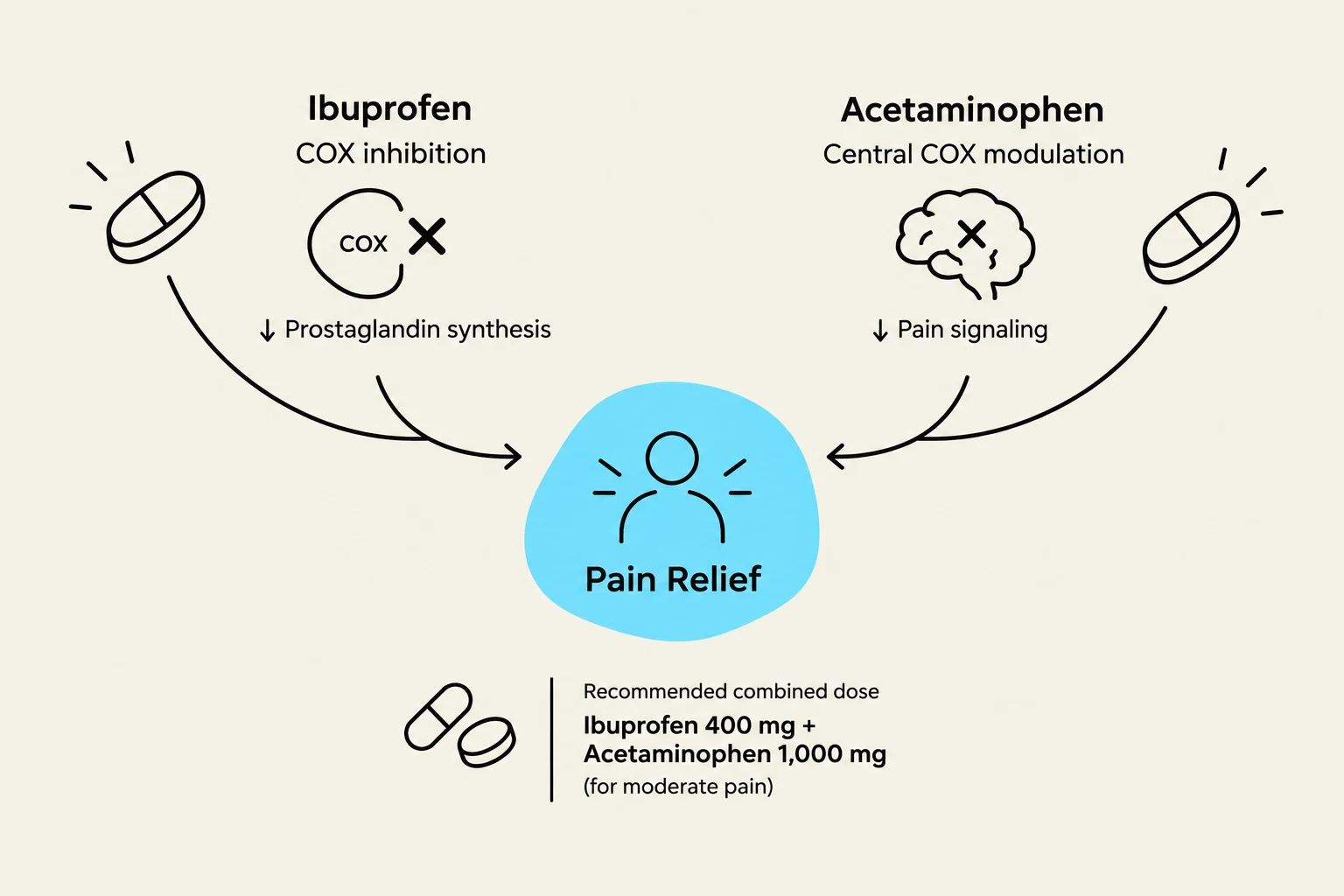
This diagram illustrates how Ibuprofen and Acetaminophen contribute to pain relief through different mechanisms. Ibuprofen inhibits COX, reducing prostaglandin synthesis, while Acetaminophen modulates central COX, affecting pain signaling. A recommended combined dose for moderate pain is also shown.
When local anesthesia is insufficient or for post-operative care, systemic analgesia is required. Always review the medical history before prescribing, particularly for patients with liver disease, as this alters the metabolism of drugs like acetaminophen.
Recommended Regimens
Pain Level
Regimen
Max Daily Dose Limits
Moderate
400–600 mg Ibuprofen + 1000 mg Acetaminophen
Ibuprofen: 3200 mg/day Acetaminophen: 3000 mg/day
Regular Post-op
Acetaminophen (500 mg) OR Ibuprofen (600 mg) every 6h for 3 days
See above
Severe Post-op
Acetaminophen (500 mg) PLUS Ibuprofen (600 mg) every 6h for 3 days
See above
Note: Avoid opioids due to side effects and addiction potential.
Antibiotics
Antibiotics are an adjunct to debridement and drainage, not a substitute. They should be used for patients with an acute apical abscess and systemic involvement. Standard regimens include Amoxicillin (500 mg TID).
Clinical Tips for Reducing Injection Pain
To improve patient comfort and reduce the risk of needle phobia, consider these chairside techniques:
Topical Anesthetics: Apply $20%$ benzocaine to the mucosa for at least one full minute before injection.
Temperature: Warm the anesthetic cartridge to body temperature to reduce stinging.
Rate of Injection: Inject slowly (approximately 1 ml per minute); most injection pain is caused by the rate of injection rather than the needle itself.
Buffering: Use buffered anesthetic solutions to shorten onset and reduce the burning sensation.
Communication: Use "counterstimulation" (hand vibration) or distraction, and always narrate the next steps to remove the element of surprise.
Worked Example: The "Hot Tooth"
A 48-year-old patient presents with spontaneous, throbbing night pain in tooth #19 (mandibular first molar). Cold testing shows a lingering response (40 seconds), and the tooth is tender to percussion.
Diagnosis: Symptomatic irreversible pulpitis and symptomatic apical periodontitis.
Difficulty: The EndoCase score is 24, indicating a high-difficulty case.
Action: Because the patient is in pain, the clinician must escalate to faculty/residents immediately. Treatment should involve an IAN block, potentially followed by PDL or intrapulpal injections to overcome the inflammatory environment.
Keep reading for free.
Create an account to finish this reading and make it part of your study routine.