LLM Architecture Basics: Understanding the Transformer
An explanation of the Transformer architecture, the foundational technology behind modern Large Language Models (LLMs), covering tokenization, embeddings, positional encoding, self-attention, multi-head attention, and feed-forward networks.
Large Language Models (LLMs) like GPT-4 or Claude have revolutionized how we interact with machines. While these models often feel like "magic," their capabilities are rooted in a specific mathematical framework known as the Transformer architecture. Unlike previous generations of AI that processed text word-by-word in a linear sequence, Transformers allow for massive parallelism and a sophisticated understanding of context.
In this article, we will break down the fundamental components that allow these models to "read," "understand," and "predict" the next token in a sequence.
From Sequences to Tokens: The Input Layer
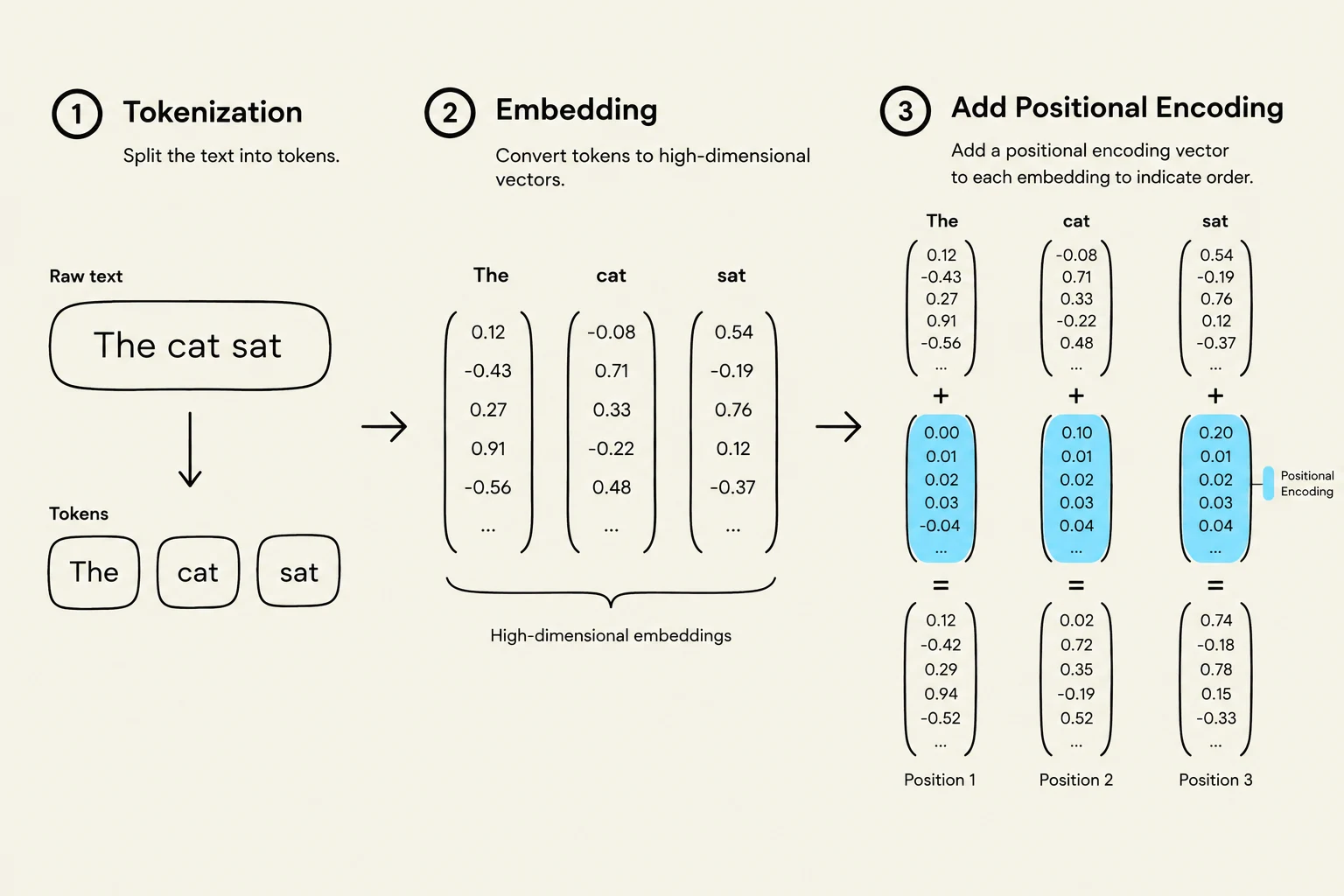
This diagram illustrates the process of tokenization, embedding, and positional encoding in natural language processing. Raw text is first split into tokens, then converted into high-dimensional vectors, and finally, positional encoding is added to these vectors to retain word order information.
Before a model can perform complex math, it must convert human language into a format a computer can process. Computers do not understand words; they understand numbers. This process happens in two primary stages: Tokenization and Embedding.
Tokenization
Tokenization is the process of breaking a string of text into smaller units called "tokens." A token can be a whole word, a part of a word (sub-word), or even a single character. For example, the word "unhappiness" might be broken into ["un", "happi", "ness"]. This allows the model to handle rare words by looking at their constituent parts.
Embeddings and Positional Encoding
Once we have tokens, we convert them into Embeddings. An embedding is a high-dimensional vector (a long list of numbers) that represents the semantic meaning of a token. In this vector space, words with similar meanings (like "king" and "queen") are mathematically positioned closer to one another.
However, there is a problem: the standard Transformer architecture processes all tokens in a sequence simultaneously to save time. This means it naturally loses the sense of order. To fix this, we use Positional Encoding. We add a specific mathematical signal to each embedding that tells the model where that token sits in the sentence.
Exam Tip: If a question asks why Transformers are faster than older RNN (Recurrent Neural Network) models, the answer is parallelization. Because Transformers use positional encodings instead of sequential processing, they can look at an entire sentence at once.
The Engine of Intelligence: Self-Attention
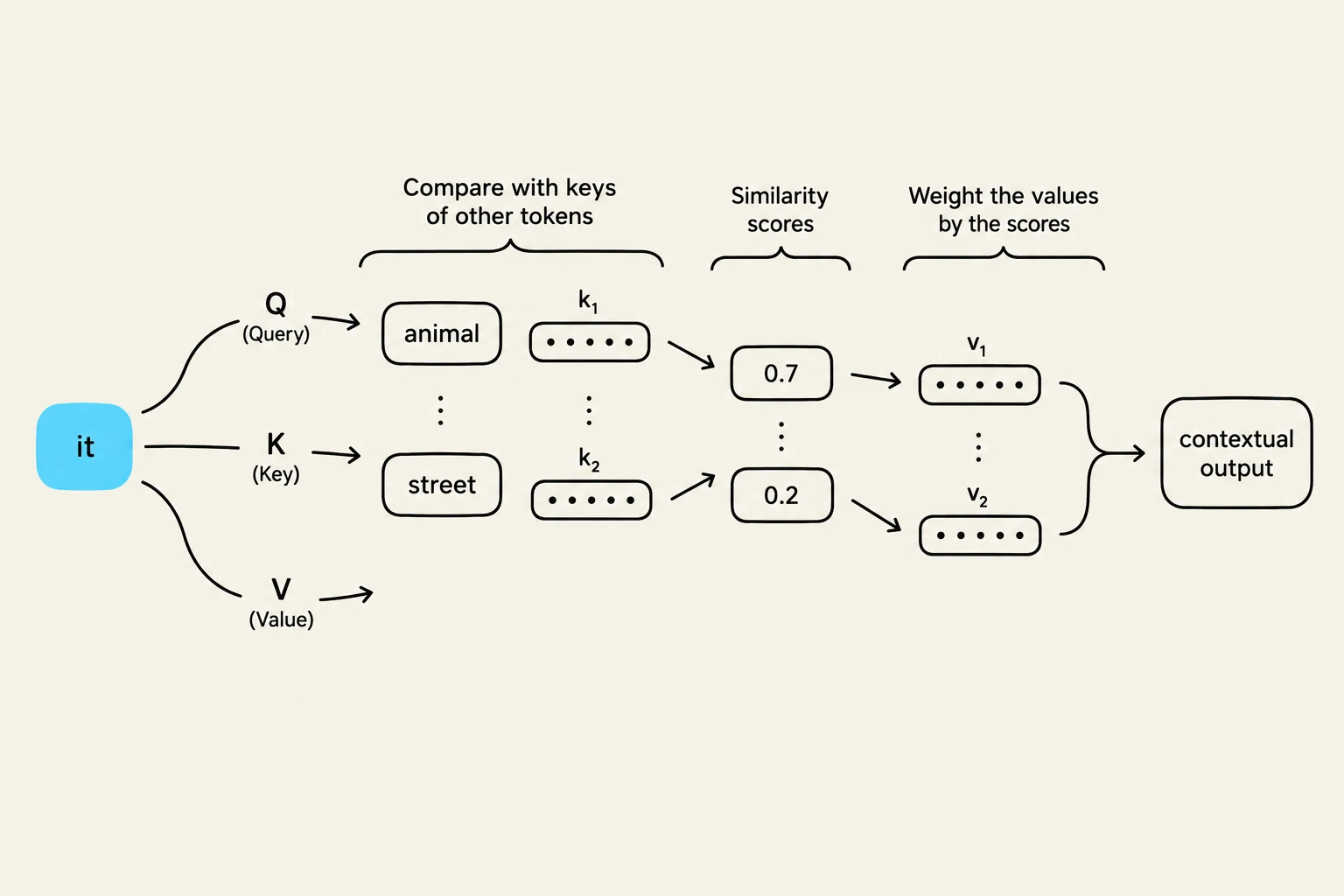
This diagram illustrates the process of calculating contextual output using query, key, and value vectors. It shows how a query is compared with keys to generate similarity scores, which are then used to weight the values, ultimately producing a contextual output.
The most critical innovation in the Transformer architecture is the Self-Attention mechanism. This is what allows a model to understand context. Consider the sentence: "The animal didn't cross the street because it was too tired."
When a model processes the word "it," how does it know if "it" refers to the animal or the street? Self-attention allows the model to "attend" to different parts of the sentence to resolve this ambiguity.
The Query, Key, and Value Mechanism
To achieve this, the model creates three different vectors for every single token:
Query (Q): What am I looking for?
Key (K): What information do I contain?
Value (V): If I am relevant, what information should I provide?
The relationship between tokens is calculated using the Scaled Dot-Product Attention formula:
Attention(Q,K,V)=softmax(dkQKT)V
In this equation:
$QK^T$ calculates the similarity (dot product) between the Query of one token and the Keys of all other tokens.
dk is a scaling factor (where dk is the dimension of the keys) used to prevent the values from getting too large, which would make the gradients vanish during training.
The softmax function turns these similarity scores into probabilities that sum to 1.
Finally, we multiply these probabilities by the Value vectors to get a weighted representation of the context.
Multi-Head Attention and Feed-Forward Networks
A single attention mechanism might only focus on one type of relationship (e.g., grammatical structure). To capture a richer understanding, Transformers use Multi-Head Attention.
Instead of performing attention once, the model performs it multiple times in parallel (each "head" is a separate attention mechanism). One head might focus on the relationship between verbs and nouns, while another might focus on pronouns and their antecedents. These different perspectives are then concatenated and transformed back into the original dimension.
After the attention layer, the data passes through a Feed-Forward Neural Network (FFN). While attention helps tokens "talk" to each other, the FFN allows the model to process the information gathered by the attention heads and refine the representation of each token individually.
The Architecture Stack: Layers and Residuals
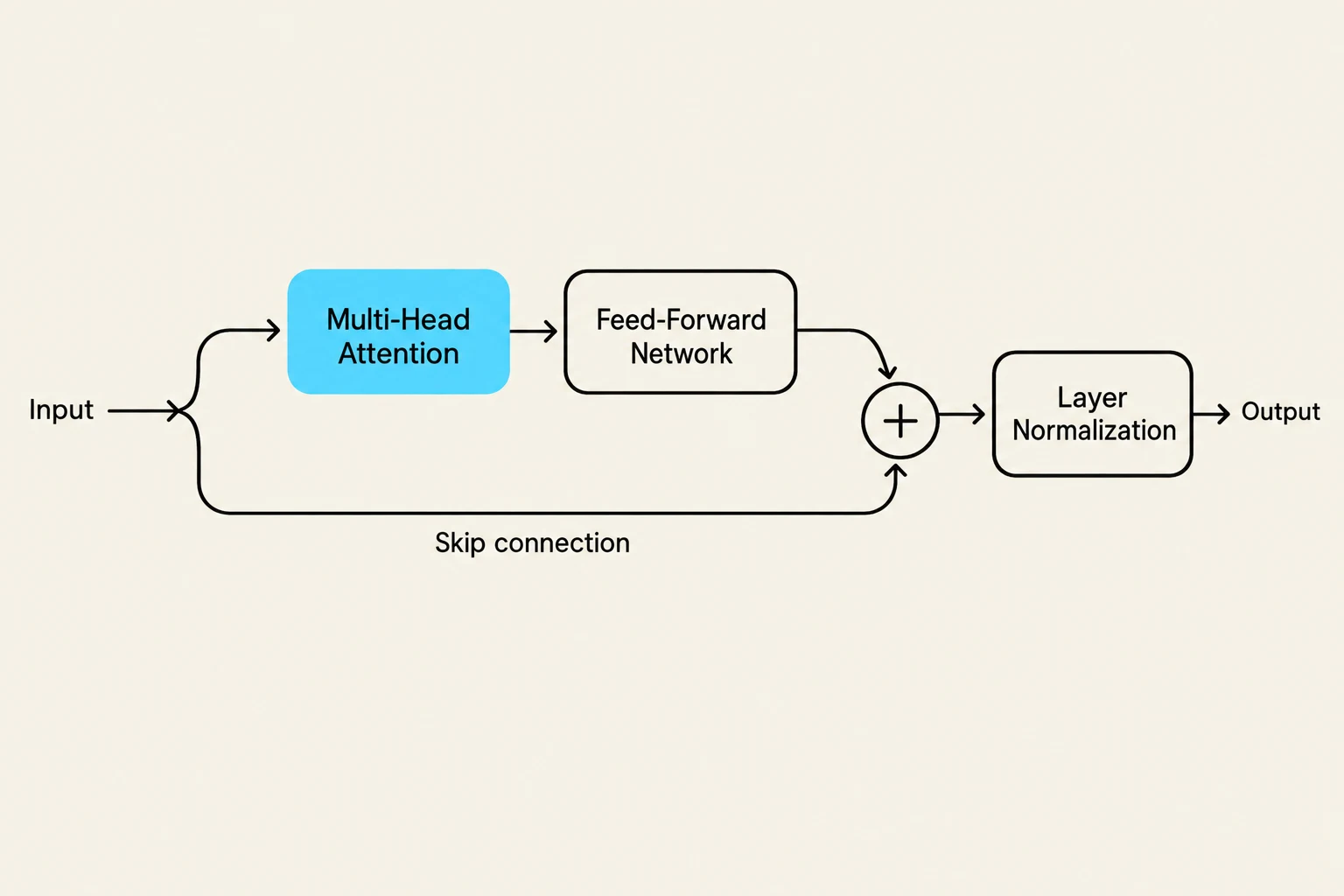
A diagram illustrating a Transformer block, showing the flow of input through Multi-Head Attention, a Feed-Forward Network, and Layer Normalization, with a skip connection.
A modern LLM is not just one attention layer and one FFN; it is a massive stack of these components repeated dozens or even hundreds of times.
Residual Connections and Layer Normalization
As information travels through these many layers, there is a risk that the signal will degrade or the gradients will become unstable during training. To prevent this, Transformers use two key techniques:
Residual Connections (Skip Connections): The original input to a layer is added back to the output of that layer. This allows the gradient to flow more easily through the network.
Layer Normalization: This stabilizes the mathematical values within the network, ensuring that no single neuron's output becomes so large that it overwhelms the others.
Summary Table: The Transformer Workflow
Stage
Component
Purpose
Input
Tokenization
Converts text to discrete IDs.
Input
Embedding + Positional Encoding
Converts IDs to vectors and adds order information.
Processing
Multi-Head Attention
Allows tokens to relate to each other contextually.
Processing
Feed-Forward Network
Processes the contextual information for each token.
Output
Linear & Softmax Layer
Predicts the probability of the next token in the sequence.
By combining these elements, the Transformer architecture creates a system capable of capturing the vast complexities of human language, enabling the generative capabilities we see in modern AI.
Keep reading for free.
Create an account to finish this reading and make it part of your study routine.