


Lipids are essential molecules for life, serving as structural components of cell membranes and precursors to hormones. However, a fundamental physiological challenge exists: lipids are insoluble in water. Because the bloodstream is an aqueous environment, lipids cannot travel freely without a specialized transport system. To overcome this, the body utilizes lipoproteins—complex particles composed of both lipids and proteins that ferry these insoluble molecules to their necessary destinations. Understanding how these particles move and how their dysregulation leads to cardiovascular disease (CVD) is central to modern medicine.
The Architecture of Lipoproteins
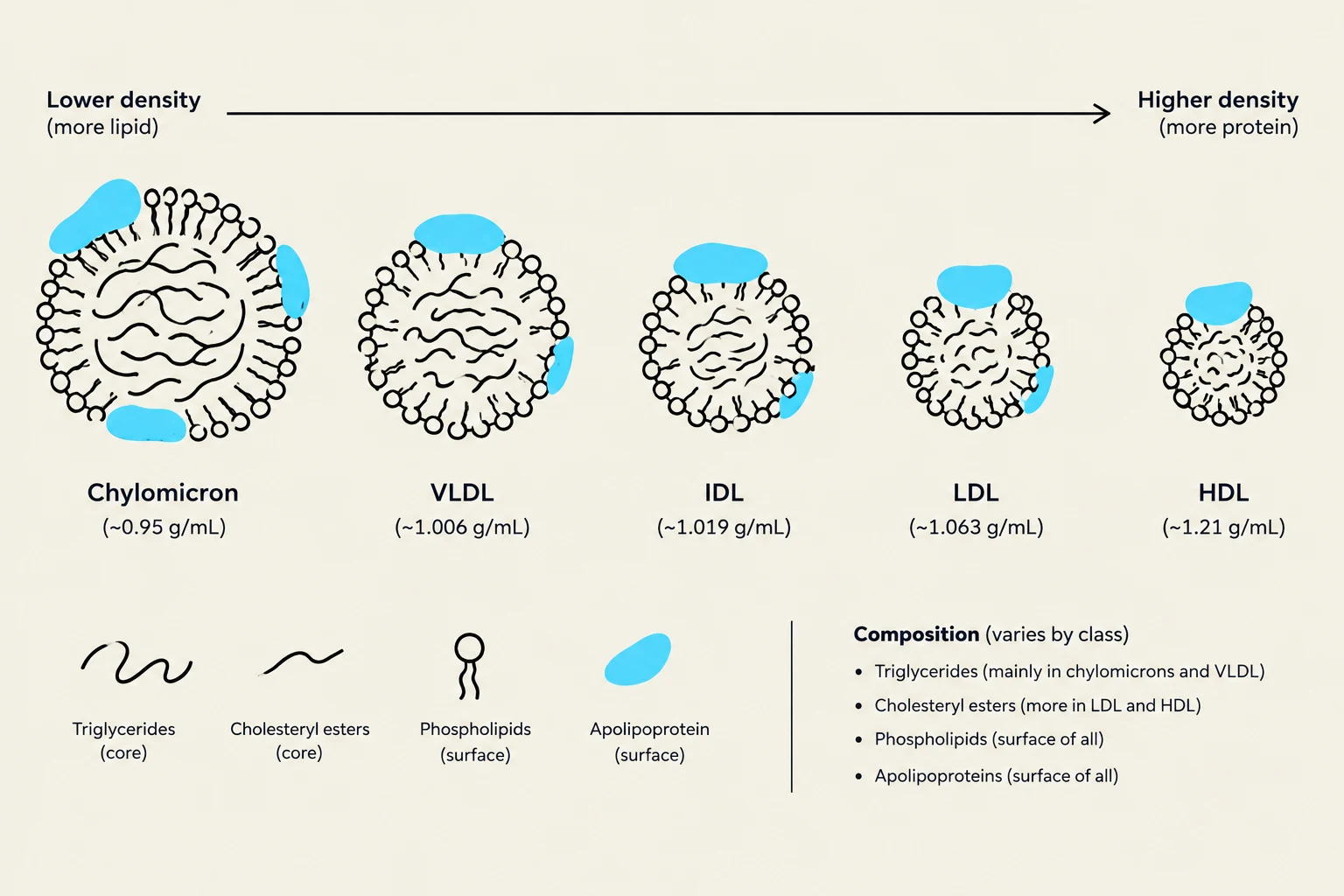
A lipoprotein is not a single molecule but a complex assembly. It consists of a hydrophobic core containing triglycerides (TG) and cholesterol esters (CE), surrounded by a hydrophilic shell of phospholipids (PL) and proteins.
The proteins embedded in these particles are known as apolipoproteins. These are not merely structural; they act as "molecular addresses" or ligands. They serve as cell surface receptors that direct lipoproteins to specific tissues and act as cofactors to mediate enzymatic reactions, such as the activation of lipases.
Exam Tip: When analyzing lipoprotein function, always look for the specific apolipoprotein mentioned. For example, if a question mentions Apo B-100, think of VLDL or LDL; if it mentions Apo AI, think of HDL.
The Five Major Classes of Lipoproteins
Lipoproteins are classified primarily by their density, which is determined by the ratio of protein to lipid. As the lipid content decreases and the protein content increases, the density of the particle rises.
- Chylomicrons (CM): These are the largest and least dense particles. They are responsible for transporting dietary triglycerides from the intestines to the rest of the body using Apo B-48.
- Very Low-Density Lipoprotein (VLDL): Produced by the liver, VLDL transports endogenously synthesized triglycerides and cholesterol to peripheral tissues using Apo B-100, E, and C.
- Intermediate-Density Lipoprotein (IDL): Formed during the partial hydrolysis of VLDL, these particles contain Apo B-100 and E.
- Low-Density Lipoprotein (LDL): Often termed "bad cholesterol," LDL is derived from the further hydrolysis of IDL. Its primary role is to deliver cholesterol to peripheral tissues via Apo B-100. A specific, highly atherogenic variant is Lipoprotein (a), which is essentially an LDL particle with an additional protein attached.
- High-Density Lipoprotein (HDL): Known as "good cholesterol," HDL is the densest class because it is composed mostly of protein. It utilizes Apo AI and AII to facilitate the removal of excess cholesterol from tissues.


Keep reading for free.
Create an account to finish this reading and make it part of your study routine.
Continue reading freeAlready have an account? Log in
Updated